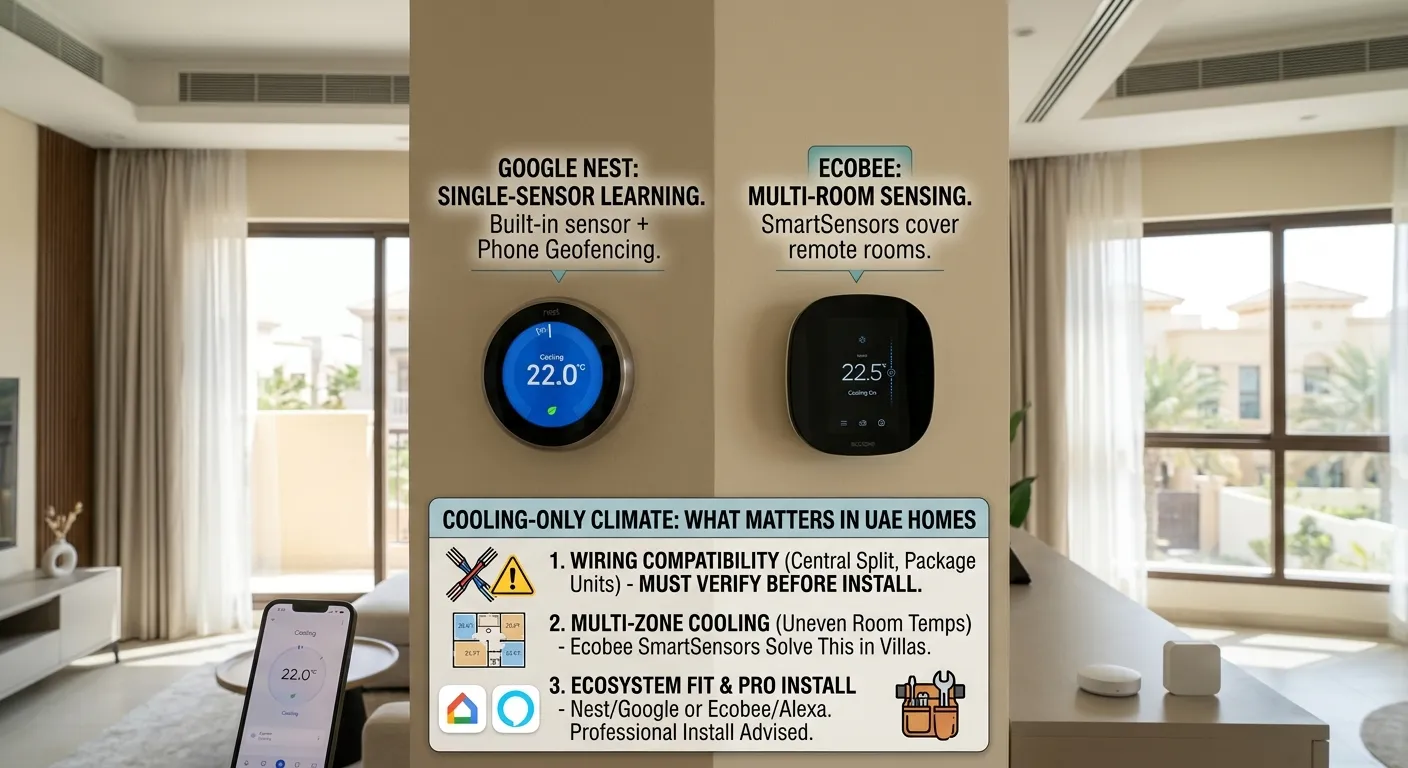

Most smart thermostat comparisons are written with a heating-and-cooling climate in mind, which makes a lot of them fairly useless if you live somewhere like Dubai. There's no furnace, no heat pump, no winter mode. It's cooling, essentially year-round, and that single fact changes what actually matters when choosing between Nest and Ecobee.
How They Learn Your Schedule
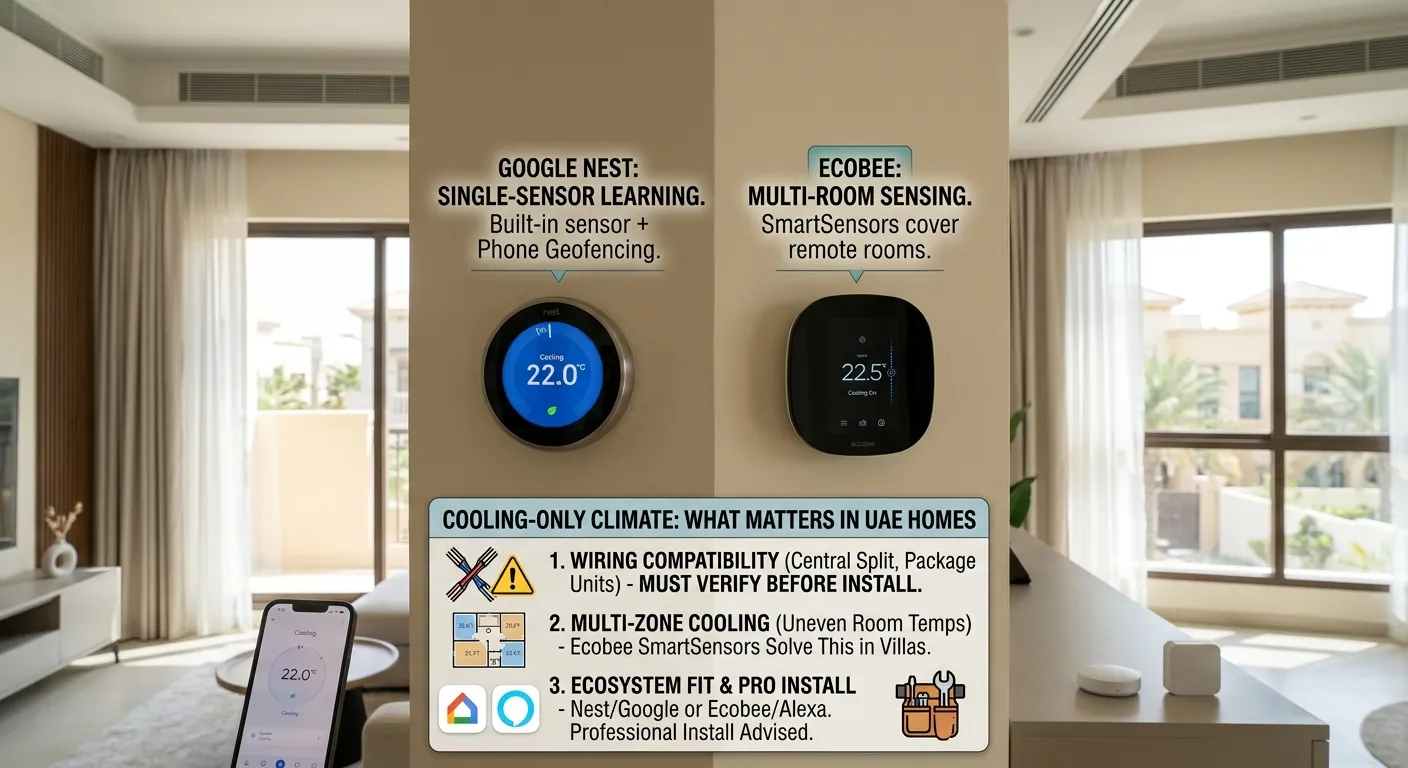
Both brands build a schedule around your habits, but differently. Nest relies on a single built-in occupancy sensor plus your phone's location to detect when the house is empty. Ecobee uses SmartSensors placed in other rooms to catch occupancy and temperature beyond wherever the thermostat itself is mounted, which solves a real problem in larger homes where one room stays cold while a bedroom further from the vent runs warm. In a small apartment with even airflow, that gap barely matters. In a villa with rooms spread out, it often does.
The Compatibility Question Most People Skip
This is where a lot of buyers run into trouble after the fact. UAE homes run on central split systems, package units, or VRF setups depending on the building, and the wiring behind the wall doesn't always match the standard terminal layout these thermostats expect out of the box. Getting this wrong isn't just a thermostat that won't turn on, it can trip the AC compressor's protection circuit, turning a simple install into a repair call. Checking compatibility before buying, not after, is the single most useful thing you can do here.
Do the Energy Savings Actually Hold Up?
Both brands advertise savings in the 10 to 23% range, and that's generally supported by real data. The catch is how much of that depends on your prior habits. If you were already adjusting the thermostat manually before leaving or sleeping, there's less inefficiency left to remove. If your AC has been running at a fixed setpoint around the clock regardless of occupancy, the savings tend to be far more noticeable.
Ecosystem Fit
Nest integrates naturally with Google Home and Assistant, and pairs well with other Nest hardware like cameras and doorbells. Ecobee leans toward Alexa, with a few models including a built-in speaker. Neither wins outright here, it comes down to which platform you're already using or planning to build around.
Why Professional Installation Matters More Here Than Elsewhere
Both are marketed as DIY-friendly, and for a simple single-zone setup, that's often fair. But villas here frequently run multi-zone cooling, and older buildings can have wiring that doesn't map cleanly onto what these thermostats are designed for. As the UAE's official Nest reseller and certified PRO installer, HomeIQ can confirm wiring compatibility with your specific AC system before you buy anything, which avoids the whole problem entirely rather than discovering it mid-install.
Which One Actually Makes Sense
For a single-zone apartment with even cooling, either the Nest Learning Thermostat or the Ecobee Smart Thermostat will do the job well, and the choice mostly comes down to app preference. For a larger villa with uneven cooling between rooms, Ecobee's sensor network solves a genuine problem Nest's single central sensor can't. Either way, confirming wiring compatibility and having it professionally installed matters more in this climate than any feature comparison between the two.
























Sign in to leave a comment.