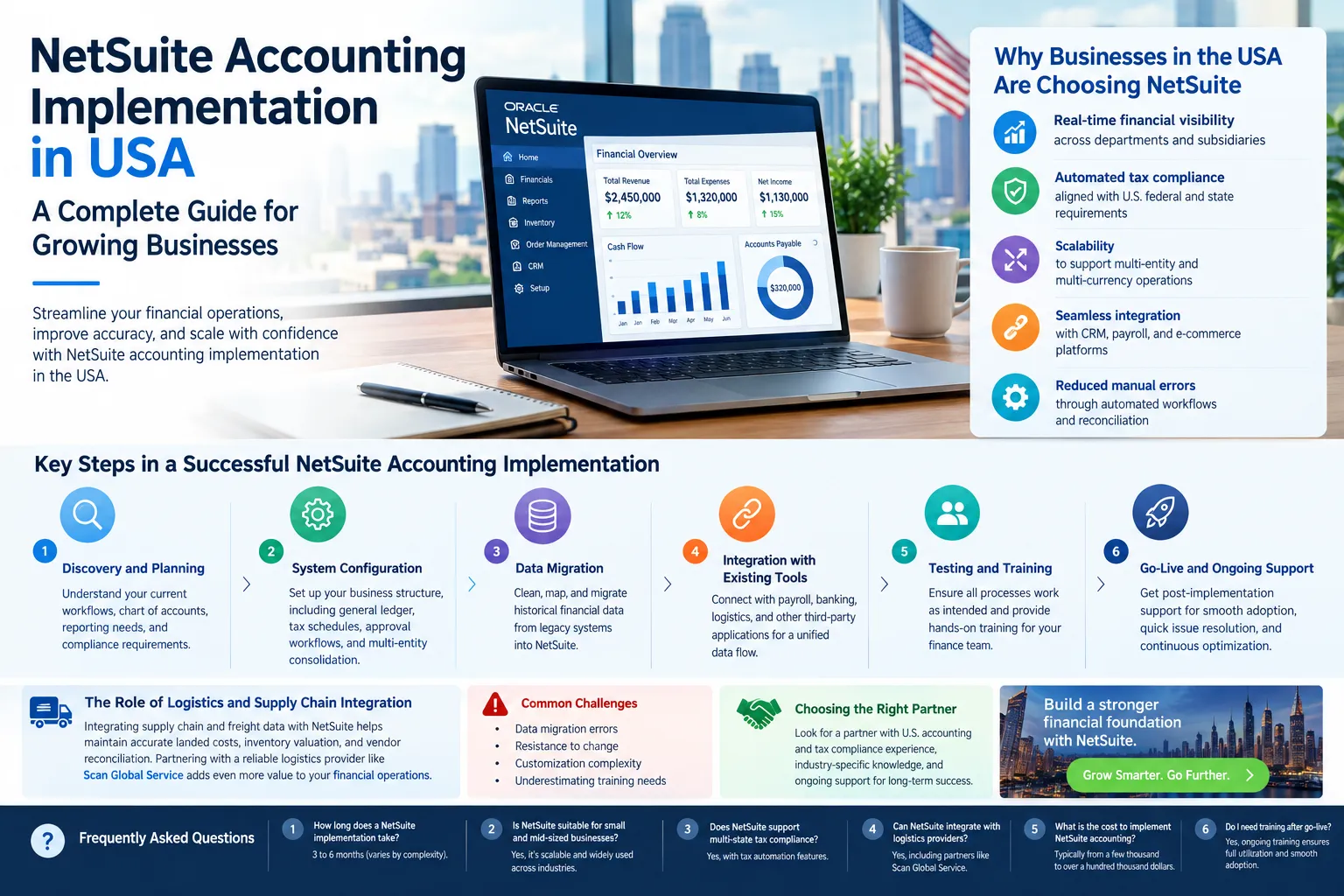

Managing finances with outdated systems or disconnected spreadsheets can slow down even the most promising businesses. That's why more companies across the United States are turning to NetSuite accounting implementation to streamline their financial operations, improve accuracy, and scale with confidence.
Whether you're a mid-sized company or an enterprise looking to modernize your finance stack, a well-planned NetSuite implementation can transform the way you manage accounting, reporting, and compliance.
Why Businesses in the USA Are Choosing NetSuite
NetSuite is a cloud-based ERP platform that unifies accounting, inventory, order management, and financial reporting into a single system. For U.S. businesses navigating complex tax regulations, multi-state operations, and rapid growth, NetSuite offers real advantages:
- Real-time financial visibility across departments and subsidiaries
- Automated tax compliance aligned with U.S. federal and state requirements
- Scalability to support multi-entity and multi-currency operations
- Seamless integration with CRM, payroll, and e-commerce platforms
- Reduced manual errors through automated workflows and reconciliation
Key Steps in a Successful NetSuite Accounting Implementation
A NetSuite accounting implementation isn't just about installing software — it's about redesigning your financial processes for long-term efficiency. Here's what a typical implementation journey looks like:
1. Discovery and Planning
This phase involves understanding your current accounting workflows, chart of accounts, reporting needs, and compliance requirements specific to your industry and state.
2. System Configuration
NetSuite is configured to match your business structure, including general ledger setup, tax schedules, approval workflows, and multi-entity consolidation if needed.
3. Data Migration
Historical financial data is cleaned, mapped, and migrated from legacy systems into NetSuite, ensuring accuracy and continuity in reporting.
4. Integration with Existing Tools
NetSuite is connected with third-party applications such as payroll systems, banking platforms, and supply chain tools for a unified data flow.
5. Testing and Training
Before go-live, thorough testing ensures all financial processes work as intended, followed by training sessions for your accounting and finance teams.
6. Go-Live and Ongoing Support
Post-implementation support ensures smooth adoption, quick issue resolution, and continuous optimization as your business evolves.
The Role of Logistics and Supply Chain Integration
For companies with complex supply chains, financial accuracy depends heavily on how well logistics data flows into the accounting system. This is where partnering with a reliable logistics provider like Scan Global Service becomes valuable. Integrating supply chain and freight data directly into NetSuite helps businesses maintain accurate landed costs, inventory valuation, and vendor reconciliation — all critical components of accurate financial reporting during and after implementation.
Common Challenges During Implementation
Even with careful planning, businesses often face a few hurdles:
- Data migration errors due to inconsistent legacy records
- Resistance to change from teams used to older systems
- Customization complexity when aligning NetSuite with unique business rules
- Underestimating training needs for end users
Working with an experienced NetSuite implementation partner helps mitigate these risks and ensures a smoother transition.
Choosing the Right Implementation Partner
Not all NetSuite implementations are created equal. The right partner should have proven experience in U.S. accounting and tax compliance, industry-specific knowledge, and a structured methodology for migration and training. Look for partners who offer post-go-live support, since ongoing optimization is just as important as the initial setup.
Final Thoughts
A successful NetSuite accounting implementation in the USA can significantly improve financial accuracy, operational efficiency, and scalability. By planning carefully, choosing the right implementation partner, and integrating supply chain services like Scan Global Service where relevant, businesses can build a financial foundation that supports long-term growth.
Frequently Asked Questions (FAQs)
1. How long does a NetSuite accounting implementation typically take? Most implementations take between 3 to 6 months, depending on business complexity, data volume, and the number of integrations required.
2. Is NetSuite suitable for small and mid-sized businesses in the USA? Yes. NetSuite is scalable and widely used by small, mid-sized, and enterprise businesses across various industries in the U.S.
3. Does NetSuite support multi-state tax compliance? Yes, NetSuite includes tax automation features that help businesses manage compliance across different U.S. states.
4. Can NetSuite integrate with logistics and supply chain providers? Yes. NetSuite can integrate with logistics partners, including providers like Scan Global Service, to streamline inventory costing and shipment data within financial reports.
5. What is the cost of implementing NetSuite accounting? Costs vary based on business size, customization needs, and the implementation partner, typically ranging from a few thousand to over a hundred thousand dollars for enterprise-level deployments.



























Sign in to leave a comment.