Quick Answer: If a New Holland C232 or C238 compact track loader develops poor travel response, unusual track noise or inconsistent hydraulic performance, start by recording the symptoms and checking the machine's maintenance history. Track condition, undercarriage components and hydraulic systems may all need investigation. Use the correct model- and PIN-specific documentation before carrying out technical testing or repairs.
What Should You Check When a New Holland C232 or C238 Travels Unevenly?
Compact track loaders frequently operate in mud, loose soil, gravel and other environments where debris can accumulate around the undercarriage.
For New Holland C232 and C238 owners, regular attention to the tracks and related components helps identify visible changes before they become more difficult to investigate.
The undercarriage includes tracks, rollers, idlers, drive sprockets and supporting components. These parts experience continuous movement as the machine travels and turns.
Debris accumulation, visible component damage or abnormal wear should be recorded and assessed against the equipment's maintenance instructions.
Not every unusual noise or travel complaint indicates a hydraulic failure. Mechanical resistance, track condition, operating conditions and control-related issues may require different forms of investigation.
The practical goal is to gather reliable evidence before deciding which system needs repair.
What Should You Check When a C232 or C238 Travels Unevenly?
An operator might report that the loader pulls to one side, responds slowly or makes an unusual sound while traveling.
These descriptions are useful starting points, but they are not diagnoses.
A maintenance team should first establish exactly when the issue occurs.
Does the symptom appear when moving forward, reversing or turning? Does it become noticeable after extended operation? Was the machine working on a hard surface, loose material or uneven ground?
These details help distinguish operating conditions from an abnormal machine response.
The following table provides a practical way to document observations.
| Reported symptom | Information to record | System requiring possible investigation |
| Uneven travel | Direction, speed range, ground conditions | Tracks, undercarriage, travel-drive controls |
| Unusual undercarriage noise | Location, timing and operating conditions | Rollers, idlers, sprockets and track condition |
| Slow travel response | Operator commands, warning messages, operating temperature | Travel-drive and associated control systems |
| Slow loader-arm movement | Load conditions, affected functions and warning indications | Working hydraulics and related controls |
| Repeated track-related concerns | Visible wear, debris conditions and maintenance history | Undercarriage and track-tension system |
This is an observation checklist rather than a repair procedure.
If the machine shows an unsafe condition, the appropriate response is to stop using it and arrange inspection under the applicable safety procedures.
Why Track Cleaning and Inspection Matter
Track-loader undercarriages operate close to the material being moved.
Mud, compacted soil and debris may collect around the track assembly, especially during demanding site work.
New Holland's maintenance documentation for 200 Series compact track loaders includes track cleaning and track-tension inspection among the routine maintenance tasks.
For operators and fleet managers, the important point is consistency.
Document the conditions in which the machine operates and follow the cleaning and inspection requirements in its operator documentation.
During an appropriate inspection, maintenance personnel can look for visible damage, abnormal wear or unusual material accumulation.
Any concerns should be recorded so the technician can assess them using the correct service instructions.
Avoid adjusting track tension based on visual estimates or generic settings from a different machine.
Track-tension checks and adjustments require the applicable machine-specific procedure, correct equipment and safety precautions.
When Does a Travel Problem Require Hydraulic Diagnosis?
An unusual travel response can involve more than the track assembly itself.
Compact track loaders use hydraulic and associated control systems for travel and loader functions. A problem reported as weak travel may require investigation beyond visible undercarriage components.
However, replacing a hydraulic pump or drive motor before establishing the cause can create unnecessary expense.
A better approach is to record the symptoms and identify the appropriate diagnostic information.
Useful questions include:
- Does the machine respond differently when traveling forward and backward?
- Is the problem present on one side or both?
- Are any warning indications displayed?
- Has the symptom changed following recent maintenance?
- Does the complaint involve travel movement, loader functions or both?
These answers help a qualified technician decide which system information to consult.
Hydraulic pressure measurements, control adjustments and component removal should only be carried out using the correct service procedure.
Hydraulic systems can contain stored energy and hazardous pressure. Generic internet instructions are not a substitute for the machine's safety documentation.
How Should Maintenance Teams Record the Problem?
A useful maintenance record should allow another technician to understand the complaint without having to repeat the operator interview.
For a New Holland C232 or C238, consider including the following information.
Machine identification: Record the exact model, production information and full product identification number (PIN).
Operating hours: Note the current machine hours and any relevant maintenance history.
Operator observations: Describe what happened without naming an unconfirmed failed component.
Working environment: Record whether the machine was operating in mud, abrasive material, uneven ground or another relevant condition.
Warning indications: Copy messages and fault information exactly as displayed.
Previous work: Document recent repairs, fluid servicing, filter replacements and undercarriage maintenance.
Technical findings: Qualified technicians should record confirmed observations and measurements alongside the relevant service procedure reference.
This creates a clearer distinction between the operator's complaint and the workshop's diagnosis.
It also helps fleet managers identify recurring maintenance issues across machines.
Which Service Manual Is Correct for a C232 or C238?
New Holland C232 and C238 compact track loaders have been produced in different configurations and documentation generations.
A manual covering one production group should not automatically be treated as suitable for every machine with the same model name.
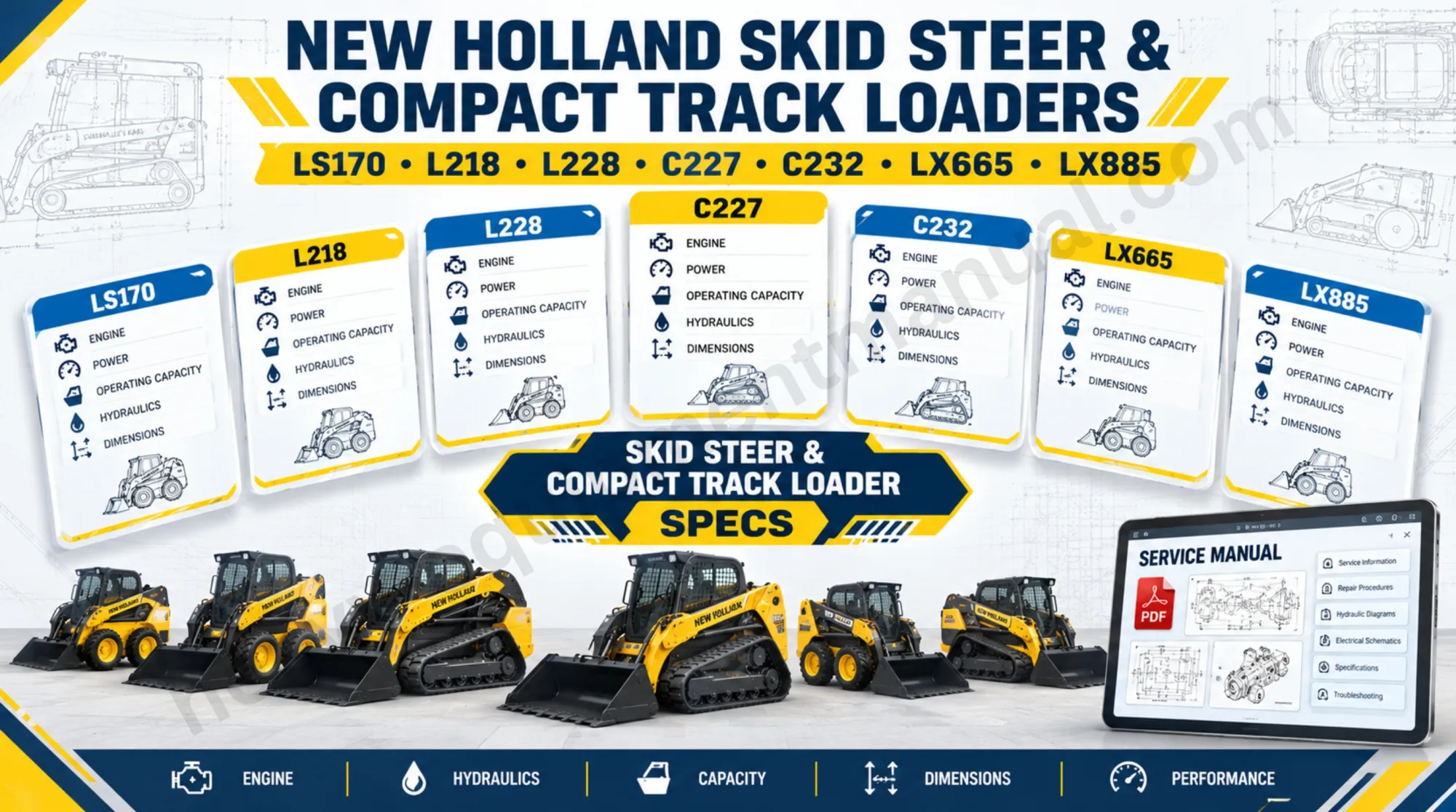
One available Tier 4A service publication, numbered 47540694, lists the following PIN coverage:
| Machine | PIN information shown in the listing |
| New Holland C232 | NDM451672 and above |
| New Holland C238 | NCM425510 and above |
The same publication also lists certain New Holland skid steer models.
These identifiers refer to that particular service publication. They should not be assumed to establish compatibility with every machine or configuration.
The listed manual includes technical sections addressing tracks and track suspension, hydraulic systems, electrical systems and other service areas.
Owners researching these models can examine the New Holland C232 and C238 Tier 4A service manual listing and compare its stated coverage with their machine identification.
If the exact model, PIN or publication requirements do not match, obtain clarification before purchasing.
A suitable service manual supports technical troubleshooting and repair planning, while the operator's manual remains important for regular inspections, safe operation and routine maintenance.
A Practical Approach to Repair Decisions
Consider a C232 operator reporting slower travel response after several hours of work.
A maintenance team should not immediately conclude that the travel motor is defective.
The team can begin by recording the operating conditions, maintenance history, displayed warnings and observable symptoms.
A qualified technician can then use the correct documentation to identify the applicable inspection and diagnostic procedures.
If an undercarriage component requires attention, the relevant mechanical service information may be needed.
If the symptoms indicate a possible control or hydraulic problem, the appropriate diagnostic information becomes important.
The purpose of this process is not to delay repair. It is to avoid making a repair decision without sufficient evidence.
Frequently Asked Questions
Can worn tracks cause uneven travel on a New Holland C232?
Track or undercarriage condition may contribute to abnormal movement, but uneven travel can have several causes. A qualified inspection is needed to identify the issue.
Are New Holland C232 and C238 service manuals interchangeable?
Not automatically. Some publications cover both models, but compatibility depends on the stated model, production specification and PIN information.
Should operators adjust track tension when they notice unusual wear?
They should first consult the applicable operator or service documentation. Incorrect adjustments may create safety risks or contribute to component damage.
Does a parts catalog replace a service manual for hydraulic troubleshooting?
No. Parts catalogs help identify components, while detailed hydraulic diagnosis and repair require the appropriate technical service information.
Better Records Lead to Better Repair Decisions
Effective New Holland compact track loader maintenance depends on consistent observations, appropriate inspections and accurate technical documentation.
For C232 and C238 machines, identifying the exact model and PIN is just as important as describing the reported problem.
A structured maintenance record helps technicians investigate the right system, avoid unnecessary component replacement and make better-informed repair decisions.
















Sign in to leave a comment.