New-Oil Polishing and Vacuum Filling — The Overlooked Step in Transformer Commissioning

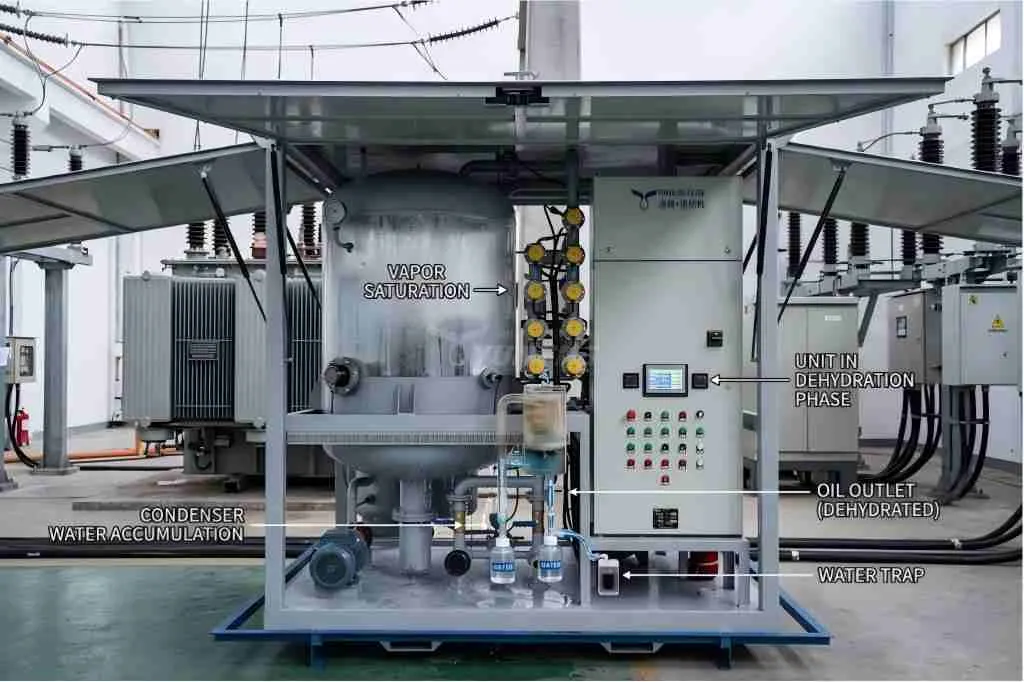
Most transformer commissioning checklists read the same: inspect bushings, test tap-changer, dry the core, fill oil, energize. What gets glossed over is the quality gate between "oil delivered" and "oil filled."Even sealed drums of new insulating oil are not immune—humidity during ocean freight, partial drum returns, condensation at the filling nozzle, all leave trace moisture. In high-voltage commissioning, "trace" is all it takes.
The Problem with “Good Enough” New Oil
New transformer oil, fresh from the supplier, can still carry:
15–30 ppm moisture (free + dissolved)
Sludge traces from drum lining
Particulate from transport agitation
None of this shows up on a quick visual. But run that oil straight into a 132 kV or 500 kV transformer and the dielectric margin is already compromised before first energization.
Where the Transformer Oil Dehydration Machine Enters
A transformer oil dehydration machine—for example YUNENG’s 10000 LPH unit—is purpose-built to strip moisture, dissolved gas, and impurities in one pass. Unlike a generic filter cart, the dehydration machine leans harder on the vacuum side: deep negative pressure pulls water out molecularly, not just mechanically.
The 10000 LPH unit is described as handling moisture, gas, and impurities inside transformer oilin one workflow. For a new 300 MVA GSU (generator step-up), routing the entire oil volume through a dehydration machine before tank entry is now standard practice among EPC firms YUNENG partners with.
The Better Sequence: Dry → Polish → Fill (Under Vacuum)
Here is the commissioning sequence the 3000 LPH vacuum oil purifier page lays out:
Pull vacuum on the transformer tank — dry the internal insulation (paper + windings).
Polish the new oil through the transformer oil purifier to spec (BDV, ppm, particle).
Inject clean oil directly into the tank vacuum — no re-contamination window.
Step 3 is the key differentiator. If you break vacuum to pour oil from the top, humid air rushes back in. Keeping the purifier coupled to the vacuum line means oil enters a negative-pressure envelope the whole way.
Why This Also Saves the Warranty
Transformer OEMs are increasingly strict: if a failure investigation finds oil BDV below spec at first fill, the OEM warranty clause often shifts liability to the owner. A documented pass through a vacuum oil purifier with before/after BDV and ppm logs is the paper trail that protects the CAPEX.
Field Tip: Keep One Mobile Unit per Region
For utilities running 10–20 new installs a year plus refurbishments, a 3000–6000 LPH mobile transformer oil purifier does triple duty:
Polish new oil pre-fill
Reclaim old oil during refurb
Serve as standby vacuum source for drying
YUNENG’s 3000 LPH caster-mounted unit is explicitly designed for "narrow or uneven workplace" mobility—exactly the substation aisle problem.
📌 If your commissioning spec still says "fill from drum, circulate 2 hours, test," push it to "pre-polish to ≤10 ppm, fill under vacuum, re-test BDV post-fill." The extra half-day pays for itself the first time a lightning strike tests the margin.




Sign in to leave a comment.