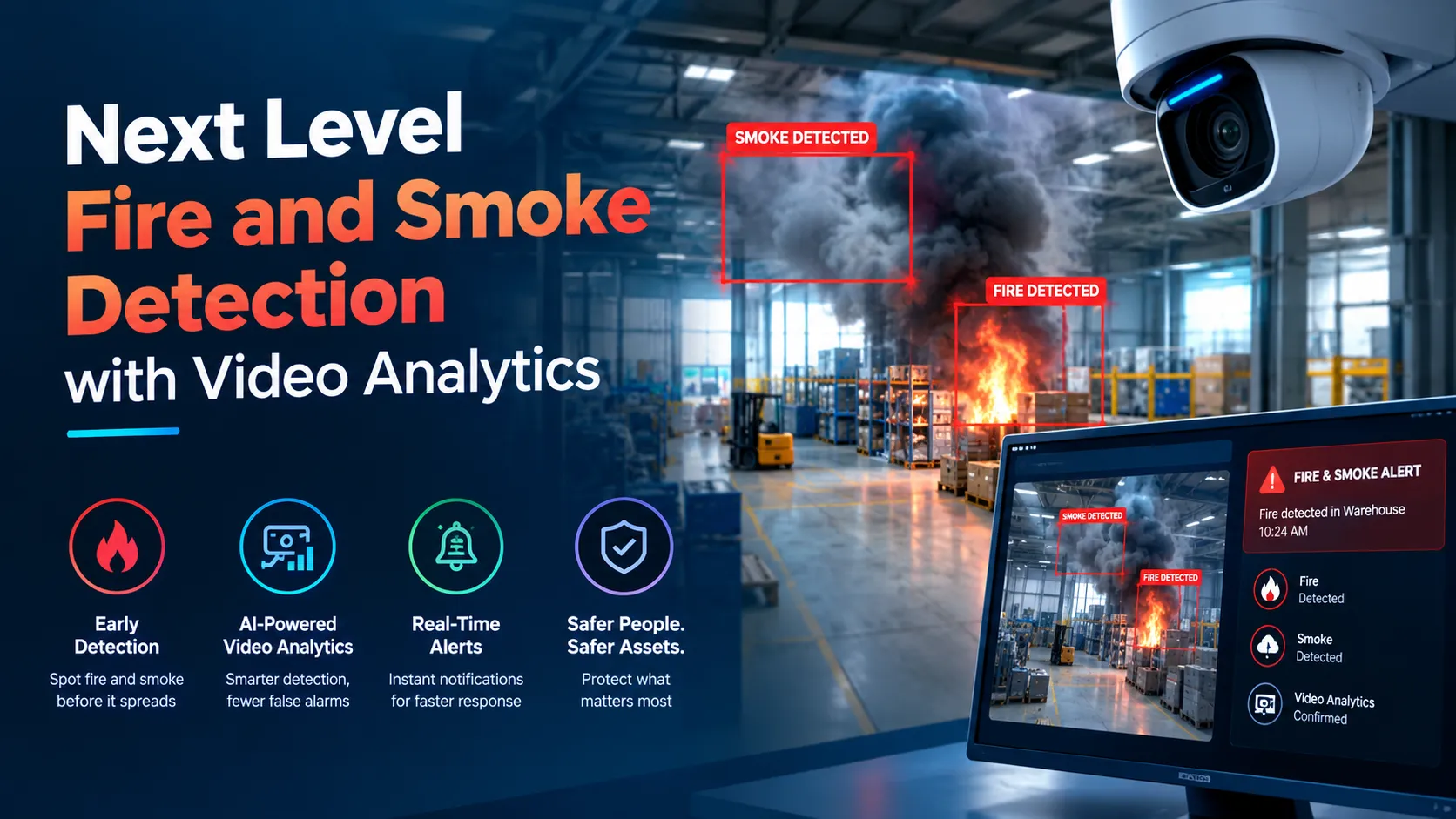

Video Analytics is changing how Saudi Arabia protects its warehouses, factories, malls, data centers, and public buildings from fire. By teaching software to recognise flames and smoke directly in camera footage, facilities can spot a developing fire in seconds, in large open spaces where traditional detectors may take minutes to react.

The Kingdom is building and expanding at a pace few countries can match. Vision 2030 projects, new logistics hubs, industrial cities, and dense commercial towers all raise the stakes of an undetected fire. Joining existing cameras to intelligent software gives safety teams earlier warning, clearer evidence, and faster decisions when every second counts.
Why Fire Safety Is a Growing Priority for Saudi Facilities
Saudi Arabia's built environment is expanding quickly. Giga projects such as NEOM and the Red Sea development, the Riyadh Metro, new airports, large retail destinations, and sprawling industrial zones in Jubail, Yanbu, and Dammam all add fire risk on a very large scale. Many of these sites have high ceilings, open halls, long conveyor lines, and stored goods that make a small flame spread quickly.
Climate adds to the challenge. Summer temperatures above forty-five degrees stress electrical equipment, lithium batteries, and cooling plant, while dust and strong sun make some environments difficult for traditional sensors. The General Directorate of Civil Defense and the Saudi Building Code, including its fire protection requirements, set the baseline, but operators increasingly look for protection that goes beyond the minimum.
The Limits of Conventional Fire and Smoke Detection
Point smoke detectors and heat detectors remain the foundation of any fire alarm system, and they are required by code. Their weakness is that they must wait for smoke or heat to physically reach the sensor. In a warehouse with a twelve-metre ceiling, an atrium, a hangar, or an outdoor storage yard, that delay can stretch from seconds to many minutes.
Conventional systems also struggle to tell staff what is actually happening. A single alarm at a panel says that a zone has triggered, not whether the cause is a small cooking fire, welding sparks, or a pile of burning pallets. Operators must send someone to look, and during that time a controllable incident can grow. Video adds the missing context by showing the event as it unfolds.
What Is Video Analytics and How Does It Detect Fire and Smoke
In fire protection, the technology analyses each frame of a camera feed looking for the visual signature of combustion. Flames have characteristic colour, flicker frequency, and irregular shape, while smoke has a distinctive pattern of rising, spreading, and changing density. The software tracks these features across frames and raises an alert when they match a developing fire.
Because the analysis happens on the video itself, it works anywhere a camera can see, including open yards, loading docks, parking structures, tunnels, and tall halls. It is not a replacement for certified detectors and alarm panels, but a powerful additional layer that detects earlier in the places where traditional sensors are slowest.
AI Powered Video Analytics: How Modern Models Learn to See Fire
AI Powered Video Analytics uses deep learning models trained on large libraries of real fire, smoke, and non-fire scenes. Instead of relying on fixed rules about colour or brightness, the model learns what separates a genuine flame from a flashing vehicle light, a sunset reflection, or a worker in a bright orange vest.
This learning approach is what makes modern systems practical in difficult environments. The same model can be tuned for a dusty construction site, a dimly lit cold store, or a busy retail atrium, and it keeps improving as new examples are added. Edge processing inside the camera or a nearby appliance keeps detection fast and avoids sending large video streams across the network.
Video Analytics Software: The Platform Behind the Cameras
The intelligence lives in Video Analytics Software that connects to existing IP cameras through standard protocols such as ONVIF and RTSP. A good platform lets operators draw detection zones, set sensitivity for each camera, schedule different rules for day and night, and watch every event on a single dashboard.
Management features matter as much as detection accuracy. Role based access, health monitoring for each camera, automatic alerts when a lens is blocked or a feed drops, and open interfaces for other systems keep the platform dependable over years of operation. Software that supports Arabic and English interfaces helps mixed language control rooms work without confusion.
Video Analytics Solutions for Different Types of Saudi Sites
Video Analytics Solutions are not one size fits all. A good design starts with the building, the fire load, and the risks, then selects cameras, analytics modules, and integrations to match. Typical applications across the Kingdom include:
- Warehouses and logistics hubs: early detection among tall racking and stored goods
- Industrial plants and refineries: flame and smoke monitoring around process areas and storage tanks
- Data centers: detection of smoke or sparks near cabinets, cable trays, and battery rooms
- Shopping malls and airports: monitoring of large atriums, kitchens, and service corridors
- Parking structures and tunnels: vehicle fire detection where ventilation hides smoke
- Forest edges, farms, and open yards: outdoor detection that point sensors cannot provide
Real Time Hazard Detection: Why Seconds Matter
Real Time Hazard Detection is the heart of the benefit. When a fire is detected at the flame stage rather than after smoke has filled a hall, staff have a much larger window to act. Extinguishers, suppression systems, and evacuation can start while the fire is still small, which reduces damage, downtime, and risk to life.
The same analytics can watch for related hazards that often lead to fire, such as overheating equipment, blocked exits, stacked goods that violate clearance, or people smoking in restricted zones. Catching these conditions early shifts safety from reacting to a disaster toward preventing one.
Automated Emergency Response: From Alert to Action Without Delay
Automated Emergency Response connects detection to action. When the software confirms a fire, it can send a live video clip and map location to the control room, notify the on-duty supervisor by mobile alert, trigger sirens or voice messages, release magnetic locks on escape doors, shut down air handling, and start the fire alarm panel sequence.
Automation does not remove people from the loop. Well-designed workflows keep a human operator in charge of critical decisions such as calling the Civil Defense and activating suppression, while handling the repetitive steps that waste time during a crisis. Written response plans, tested through drills, make sure the technology and the team work together.
Reduced False Alarms: Protecting Operations and Credibility
Nuisance alarms are costly. Every false evacuation interrupt production, frustrates staff, and, worse, teaches people to ignore the next alarm. Steam, dust, welding, vehicle exhaust, cooking fumes, and sun glare are all common culprits in Saudi facilities. Modern systems achieve Reduced False Alarms by classifying the scene rather than reacting to a single trigger.
Verification is the second safeguard. Because the operator can see the cause on video within seconds, a questionable alert can be confirmed or dismissed without sending a team across a large site. This keeps the alarm system trusted and ensures that when it sounds, people respond.
Detailed Incident Reporting: Evidence, Compliance, and Learning
After any event, facilities need accurate facts. Detailed Incident Reporting captures the time of first detection, the camera and zone, the alert path, who acknowledged it, how long each step took, and the video of the event itself. This record supports insurance claims, Civil Defense reviews, and internal investigations with evidence rather than memory.
Over time the reports reveal patterns. Recurring alerts in one corridor may point to faulty equipment, an unsafe working practice, or poor housekeeping. Safety managers can use this data to fix root causes, measure response times, and show regulators a documented improvement trend.
Integration with Cameras, Fire Alarm Panels, and Building Systems
The strongest deployments reuse the CCTV investment that sites already have. Compatible cameras are added to the analytics platform, with new units installed only where coverage gaps or poor lighting call for it. This reduces cost and speeds up deployment.
Open integration links the platform to fire alarm panels, building management systems, public address, access control, and mass notification tools. Dry contact relays, network protocols, and application interfaces allow each system to play its role. It is important that any link to the fire alarm panel is designed so the certified alarm system always works independently if the analytics platform is offline.
Video Analytics KSA: Standards, Compliance, and Local Requirements
Organisations planning a Video Analytics KSA project should begin with the regulatory picture. The Saudi Building Code and Civil Defense requirements govern the certified fire alarm and suppression systems, while video analytics typically serves as a supplementary layer. International references such as NFPA 72 and EN 54 guide the design of the alarm system it supports.
Data protection and cybersecurity apply too. Video of employees and visitors is personal data under the Personal Data Protection Law (PDPL), so signage, access limits, and retention policies are needed. The National Cybersecurity Authority controls influence how cameras and servers are hardened, and strong passwords, network segmentation, and regular firmware updates should be standard.
Video Analytics Riyadh: Considerations for the Capital
A Video Analytics Riyadh deployment often serves tall commercial towers in areas such as King Abdullah Financial District, large government campuses, logistics parks on the edge of the city, and high traffic retail destinations. These sites combine dense occupancy with complex building systems, so early detection and clear evacuation guidance carry real weight.
Riyadh's dry climate and frequent dust events call for sealed camera housings with proper ingress ratings, sun shields, and routine lens cleaning. Cameras facing glass facades or strong sunrise and sunset angles need careful placement to avoid glare, and good lighting design supports accurate detection in underground car parks and service areas.
Industries Across the Kingdom That Benefit Most
Oil, gas, and petrochemical operators value early flame detection around storage and process areas where a small ignition can escalate. Logistics and warehousing companies use the technology to protect inventory worth many millions, especially in tall racking where conventional detectors respond slowly.
Data center operators protect battery rooms and cable routes, retailers protect crowded malls and back of house areas, and hospitals and universities protect people who cannot easily evacuate. Public infrastructure such as stations, tunnels, and airports use analytics to monitor large open spaces that no single detector could cover.
How Tektronix Delivers Fire and Smoke Detection Across Saudi Arabia
Tektronix designs, installs, and supports video analytics for fire and smoke detection in industrial, commercial, and public facilities across Riyadh, Jeddah, Dammam, and the wider Kingdom. Each project begins with a site survey, a review of existing cameras, and a risk assessment so that the design fits the building rather than forcing the building to fit a product.
The team also supports clients through tuning, training, and maintenance after go live, so detection accuracy keeps improving as conditions change. Organisations comparing fire and smoke detection solutions for Saudi Arabia can review camera options, software features, and integration approaches directly with the Tektronix engineers, and can explore the full-service range on the company website.
Protecting the System Itself: Cybersecurity and Privacy by Design
A safety system that can be hacked is a liability. Cameras and servers should sit on a segmented network, use encrypted connections, require strong and unique credentials, and receive security updates on a defined schedule. Administrative access should be logged and limited to named staff.
Privacy by design is equally important. Detection zones can be masked to avoid private areas, footage can be retained only as long as policy requires, and access to recordings can be restricted to authorised investigators. These measures build trust with employees and keep the deployment aligned with Saudi data protection expectations.
Emerging Trends: Smart Cities, Edge Intelligence, and Wider Safety Analytics
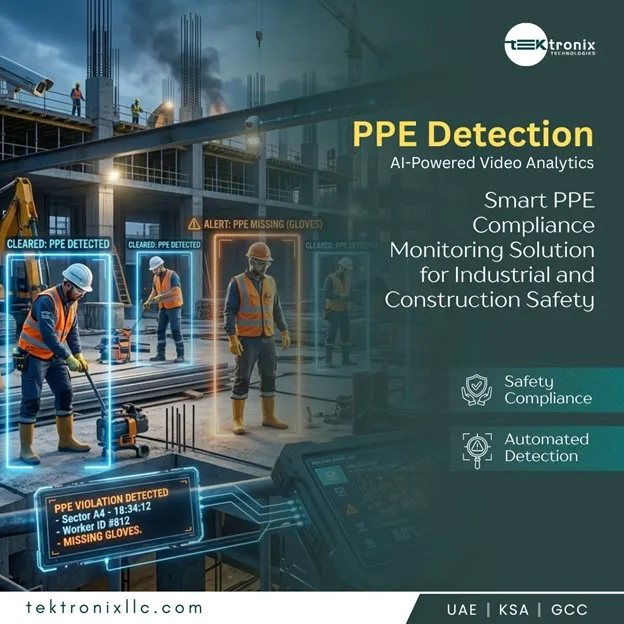
Saudi Arabia's smart city ambitions are pushing safety technology toward connected platforms. Fire detection is increasingly combined with crowd monitoring, perimeter protection, vehicle recognition, and personal protective equipment checks on one analytics layer, so a single camera network supports several safety and security goals at once.
Edge computing is another clear direction. Processing video inside the camera or a local appliance cuts delay, reduces bandwidth, and keeps sensitive footage on site. Combined with cloud dashboards for fleet management, it lets organisations with many branches monitor consistent performance without moving every video stream to a central location.
Maintenance, Testing, and Continuous Improvement
Detection systems must be proven and then kept proven. After commissioning, each camera should be tested with controlled fire sources or approved test methods, and results should be recorded. Scheduled checks then confirm that lenses are clean, views are unobstructed, and recording and alert paths are working.
Seasonal changes deserve attention. Dust storms, summer glare, and changes in stock layout can alter what a camera sees, so zones and sensitivity should be reviewed at least twice a year. Software updates add new detection models and security fixes, and a managed support agreement ensures they are applied safely without interrupting protection.
Questions to Ask Before Choosing a Fire Detection Technology Partner
The right partner makes the difference between a pilot that impresses and a system that protects for years. Strong providers answer these questions clearly and in writing:
- Local experience: which live Saudi sites are protected today and who supports them
- Proof of accuracy: how was detection tested, and under what lighting and dust conditions
- Compatibility: will the platform work with our current cameras and alarm panels
- Fail safe design: what happens to protection if the network or server fails
- Data handling: where is video stored, and who can view it
- Service levels: what are the response times for faults and software updates
It also helps to ask for a short proof of concept on a real area of the site. Seeing the system perform with your own cameras, lighting, and activity is the most reliable way to judge accuracy before committing to a full rollout.
The Business Case: Why Early Detection Pays for Itself
A serious fire can destroy stock, equipment, and reputation within hours, and the cost of downtime often exceeds the direct damage. Detecting an incident earlier is the most effective way to limit all of these losses. Insurers also look favourably on layered protection and documented response, which can support better terms.
Operational savings add up as well. Fewer false alarms mean fewer interrupted shifts and fewer wasted site visits, while automated reporting replaces hours of manual paperwork after each event. Because the platform reuses existing cameras, the investment is usually far smaller than building a new detection network from scratch.
Deployment Process: From Site Survey to Live Monitoring
A responsible rollout follows clear stages so that coverage is complete and performance is proven before the system is relied upon:
- Site survey: review the building, fire load, existing cameras, and lighting
- Design: select cameras, analytics modules, and integration points
- Installation: mount and aim cameras, configure zones, and connect systems
- Tuning and testing: run controlled tests and adjust sensitivity for local conditions
- Training: prepare operators and safety teams for alerts and drills
- Support: maintain equipment, update software, and review incident data regularly
Common Mistakes to Avoid When Adding Video Analytics to Fire Protection
The most frequent mistake is treating the technology as a replacement for certified detection. It is a layer that works with the alarm system, not instead of it. Another is installing cameras without checking lighting, mounting height, and field of view, which limits what the software can ever detect.
Skipping tuning and training is also costly. Systems left on default settings produce either too many alerts or too few, and operators who have never practised a response lose precious seconds. Finally, some sites forget cybersecurity and let camera networks run with default passwords, which undermines the safety benefit entirely.
Conclusion
Video Analytics gives Saudi facilities earlier and clearer warning of fire and smoke. AI Powered Video Analytics running on Video Analytics Software turns ordinary cameras into smart detectors. Video Analytics Solutions enable Real Time Hazard Detection and Automated Emergency Response. Reduced False Alarms and Detailed Incident Reporting keep operations trusted and compliant. For Video Analytics KSA and Video Analytics Riyadh, Tektronix is a dependable local partner.
FAQs
1. How does Video Analytics detect fire and smoke earlier than a normal detector?
Video Analytics watches the camera image for flames and smoke directly, so it does not need to wait for smoke to travel to a ceiling sensor. This is especially useful in tall halls, open yards, and large atriums.
2. What makes AI Powered Video Analytics more reliable than older motion detection?
AI Powered Video Analytics learns from real fire and non-fire examples, so it can tell a genuine flame from lights, reflections, or bright clothing. Older motion tools simply react to any change in the picture.
3. Can Video Analytics Software work with the CCTV cameras we already have?
In most cases yes. Modern Video Analytics Software connects to standard IP cameras through ONVIF or RTSP, although a few extra cameras may be added where lighting or coverage is poor.
4. How do Reduced False Alarms and Detailed Incident Reporting help safety teams?
Reduced False Alarms keep staff confident that every alert matter, while Detailed Incident Reporting provides timestamps, video, and response data for insurers, auditors, and regulators.
5. Does Automated Emergency Response replace the fire alarm system?
Automated Emergency Response supports the certified fire alarm system rather than replacing it. It speeds up alerts, notifications, and building actions, while the alarm panel and suppression systems continue to operate independently as required by code.























Sign in to leave a comment.