

When preparing official documents for use in another country, you may be asked to provide a translated, certified, notarised or legalised version. Understanding which service you need can save time, reduce unnecessary costs and help prevent delays when submitting important paperwork.
Two terms that often cause confusion are notarized translation and apostille. Although they are both associated with official documents, they serve different purposes. A notarised translation generally involves a notary verifying a translator’s signature or declaration, while an apostille authenticates a public official’s signature, seal or stamp so that a document can be recognised abroad.
So, do you need both? The answer depends on the document, the destination country and the organisation requesting it. This guide explains how each process works, when they may be required together and how to prepare your documents for international use.
What Is a Notarized Translation?
A notarized translation is a translated document accompanied by a declaration or signature that has been notarised by a Notary Public. The exact arrangement can vary depending on the country, document type and requirements of the receiving authority.
In the UK, a notary will generally authenticate the translator’s signature or declaration rather than independently confirm that every word has been translated accurately. The translation itself should be completed by a suitably qualified or experienced translator.
For example, if you need to submit a UK birth certificate to a foreign authority, you may be asked to provide a translation into the destination country’s official language. That authority might require the translator to sign a declaration before a notary.
Documents that may require this service include:
- Birth, marriage and death certificates
- Academic transcripts and degree certificates
- Passports and identity documents
- Court orders and legal agreements
- Company registration documents
- Financial statements and supporting records
- Immigration and residency paperwork
Not every authority requires notarisation. Some accept a certified translation with the translator’s statement, signature and contact details. Others may require a notarial declaration or a specific translation format.
Before arranging a notarized translation, confirm the exact requirements with the organisation that will receive your documents.
What Is an Apostille?
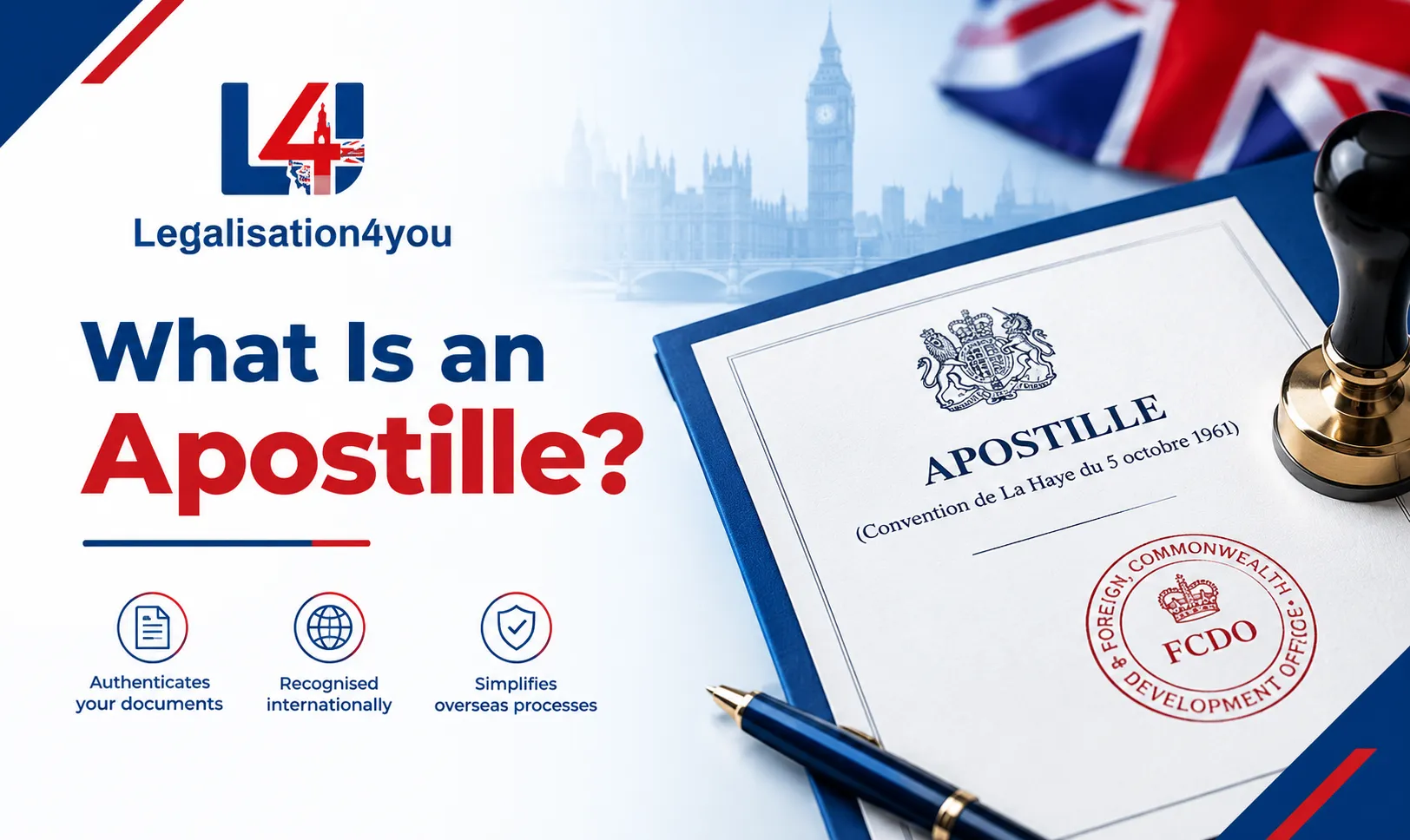
An apostille is an official certificate issued by a competent authority to authenticate the origin of a public document for international use. In the UK, apostilles are issued by the Foreign, Commonwealth & Development Office (FCDO) Legalisation Office.
The apostille confirms the authenticity of the signature, the capacity in which the person signing the document acted and, where applicable, the identity of the seal or stamp. It does not verify the accuracy of the document’s contents or guarantee that the receiving organisation will accept it for every purpose.
An apostille may be required when presenting UK documents to overseas authorities for purposes such as:
- Applying for residency or immigration
- Registering a marriage abroad
- Studying at an overseas university
- Working in another country
- Managing international business transactions
- Handling overseas property or inheritance matters
- Submitting legal documents to foreign courts
The requirement depends on the destination country and the receiving organisation. Some countries that participate in the Hague Apostille Convention accept apostilles for eligible documents. Countries outside the Convention may require additional embassy or consular legalisation.
Notarized Translation vs Apostille: What Is the Difference?
Although both processes can form part of international document preparation, they are not interchangeable.
A notarized translation focuses on the formal authentication of a translator’s signature or declaration. It helps establish that the translation has been presented through the required notarial process.
An apostille, on the other hand, authenticates the origin of a public document or the relevant signature, seal or stamp. It does not certify the quality of a translation or confirm that the translated wording is correct.
Consider the following comparison:
| Feature | Notarized translation | Apostille |
|---|---|---|
| Main purpose | Notarises a translator’s signature or declaration | Authenticates the origin of a signature, seal or stamp |
| Usually handled by | A Notary Public, following translation preparation | The competent legalisation authority |
| Confirms translation accuracy? | Not automatically | No |
| Used for international documents? | When required by the receiving authority | When legalisation is required |
| Always necessary? | No | No |
Understanding this distinction is important because obtaining one does not automatically remove the need for the other.
Do You Need Both a Notarized Translation and an Apostille?
You may need both services if the overseas authority requires a notarised translation and also requires the relevant document or notarial act to be apostilled.
However, there is no universal rule that every translated document must receive both.
Your requirements will usually fall into one of three categories.
1. You Need Only a Certified Translation
Some organisations accept a certified translation without notarisation or an apostille. A certified translation generally includes a statement confirming that the translation is accurate, along with relevant translator details.
For example, a university may accept a translation that meets its stated certification requirements. In this situation, arranging additional notarial services or legalisation could be unnecessary.
Always check the receiving organisation’s instructions before paying for extra services.
2. You Need a Notarized Translation Only
A receiving authority may specifically request a translation notarised by a Notary Public but may not require an apostille.
In this case, the translator prepares the translation and completes the necessary declaration or signature process before the notary. You should confirm whether the authority requires any particular wording, format or supporting documents.
Do not assume that a notarised document automatically needs further legalisation.
3. You Need Both Notarisation and an Apostille
Some overseas authorities require a notarised translation and an apostille authenticating the notary’s signature or seal. In such cases, the notarisation may need to be completed before the apostille can be issued.
For instance, an overseas legal authority may request a translated legal agreement accompanied by a notarial declaration and an apostille. The precise requirements will depend on the destination country and the authority receiving the document.
It is important to clarify whether the apostille must be attached to the original document, a notarised translation or a document package containing both.
The correct process should be established before work begins, rather than assuming that the same sequence applies to every country.
Which Documents May Require Both Services?
Several categories of documents may need translation, notarisation and legalisation when used overseas.
Birth and Marriage Certificates
People moving abroad, registering a marriage or completing family-related legal procedures may be asked to submit translated civil certificates. Depending on the destination, the authority may require a certified translation, notarisation or an apostille.
Degree Certificates and Academic Records
Students applying to overseas universities or professionals seeking recognition of their qualifications may need translated educational documents. Some institutions request certified translations, while others may specify notarisation or legalisation.
Legal Agreements and Court Documents
Powers of attorney, affidavits, court orders and contracts can have strict formal requirements. A foreign court, lawyer or government office may specify the form of translation and authentication required before accepting the documents.
Business and Financial Documents
Companies expanding internationally may need to submit incorporation records, corporate resolutions, financial statements or commercial agreements. The receiving authority may require particular signatures to be notarised and authenticated.
In each case, the document type alone does not determine the process. The intended use and destination country are equally important.
What Is the Correct Order for Notarisation, Translation and Apostille?
The correct sequence depends on what the receiving authority wants authenticated. Following the wrong order may result in rejected paperwork or the need to repeat part of the process.
A practical approach is to follow these steps.
Step 1: Confirm the Requirements
Ask the receiving authority which documents it accepts and whether it requires a certified translation, notarisation, apostille or additional embassy legalisation.
Also confirm the required language, document format and whether originals or certified copies are acceptable.
Step 2: Prepare the Original Document
Check that the original document is complete, legible and suitable for the intended process. Some documents may need to be issued by a recognised authority or certified by a notary or solicitor before legalisation.
For UK documents, the FCDO provides guidance on document eligibility and the legalisation process.
Step 3: Arrange the Translation
Use a suitably qualified translator who can meet the receiving authority’s requirements. Confirm whether the translation must include a declaration of accuracy, specific translator credentials or particular formatting.
Where notarisation is required, establish how the translation and translator’s declaration should be presented to the notary.
Step 4: Complete the Required Notarial Process
If requested, arrange for the translator’s signature or declaration to be notarised. The notary will carry out the relevant formalities according to the document and the service required.
Remember that notarisation does not necessarily verify the linguistic accuracy of the translation.
Step 5: Obtain the Apostille if Required
If an apostille is required, determine which signature, seal or document must be authenticated. The FCDO can legalise eligible UK documents, including certain documents signed or certified by a UK notary or solicitor.
If the apostille is intended to authenticate the notary’s signature, the notarial process will generally need to be completed first.
Step 6: Check for Further Legalisation
Some countries require additional authentication by their embassy or consulate after the apostille stage, particularly where the destination country does not use the Hague Apostille Convention process.
Confirm the complete sequence before submitting the documents.
Common Mistakes to Avoid
Preparing documents for international use can become complicated when requirements are unclear. Avoid these common mistakes:
- Assuming both services are compulsory: Not every authority requires notarisation and an apostille.
- Confusing notarisation with translation certification: These processes serve different purposes.
- Using the wrong translation format: A receiving authority may require specific wording or translator credentials.
- Applying for an apostille too early: The relevant signature or notarial declaration may need to be completed first.
- Ignoring embassy requirements: An apostille may not be the final step for every destination.
- Overlooking processing time: Translation, notarisation, legalisation and delivery may each require additional time.
A little preparation can help you avoid unnecessary costs, repeated appointments and delays in important applications.
Get Help Preparing Your Documents for Overseas Use
Unsure whether your documents require a notarized translation, an apostille or both? The right process depends on the document type, destination country and requirements of the organisation requesting it.
Legalisation4you helps individuals and businesses understand the steps involved in preparing UK documents for international use. Whether you need guidance on apostille services, document legalisation or the formalities associated with translated documents, checking the requirements before you begin can make the process more straightforward.
Visit to explore available services and find out how to prepare your documents for overseas use.
Frequently Asked Questions (FAQs)
1. Is a notarized translation the same as an apostille?
No. A notarized translation involves a notarial process relating to a translator’s signature or declaration. An apostille authenticates the origin of a signature, seal or stamp on an eligible public document. They serve different purposes.
2. Do I always need an apostille for a notarized translation?
No. An apostille is only necessary when required by the receiving authority or applicable legal process. Check the destination country’s requirements before arranging legalisation.
3. Can I get an apostille for a translated document?
Yes, in appropriate circumstances. The translation or its accompanying notarial declaration may need to be prepared and signed by a recognised professional before it can be submitted for legalisation. Eligibility depends on the document and the signature being authenticated.
4. Should I translate my document before getting an apostille?
It depends on what needs to be authenticated. If the apostille must authenticate a notary’s signature on a translation, the translation and notarial process will generally need to be completed first. If the apostille is required for the original document, the original may need to be legalised before translation. Confirm the sequence with the receiving authority.
5. Which documents commonly require a notarized translation?
Potential examples include birth and marriage certificates, academic qualifications, legal agreements, court documents and business records. The exact requirements depend on the destination and intended use.
6. Does an apostille guarantee that my translation will be accepted abroad?
No. An apostille authenticates the origin of the relevant signature, seal or stamp; it does not guarantee acceptance or verify the accuracy of the translation. The receiving authority determines whether the document meets its requirements.
7. How can I check whether I need both services?
Contact the organisation requesting your documents and ask whether it requires a certified translation, notarisation, an apostille or further embassy legalisation. Confirm which document or signature must be authenticated before starting the process.

















Sign in to leave a comment.