

Oil and grease in industrial wastewater can create serious treatment challenges when they are not properly separated before further processing or discharge. Depending on the wastewater source, oil may occur as free-floating oil, dispersed droplets, emulsified oil, or oil associated with suspended solids. The right treatment method therefore depends on the characteristics and concentration of the contaminants.
At Neotech Water Solutions Private Limited, we focus on practical wastewater treatment solutions designed around the actual characteristics of each wastewater stream. For many industrial applications, Dissolved Air Flotation (DAF) is an effective technology for separating oil, grease and suspended solids.
DAF is widely recognized as a flotation-based clarification process for removing suspended solids and dispersed oil and grease from wastewater.
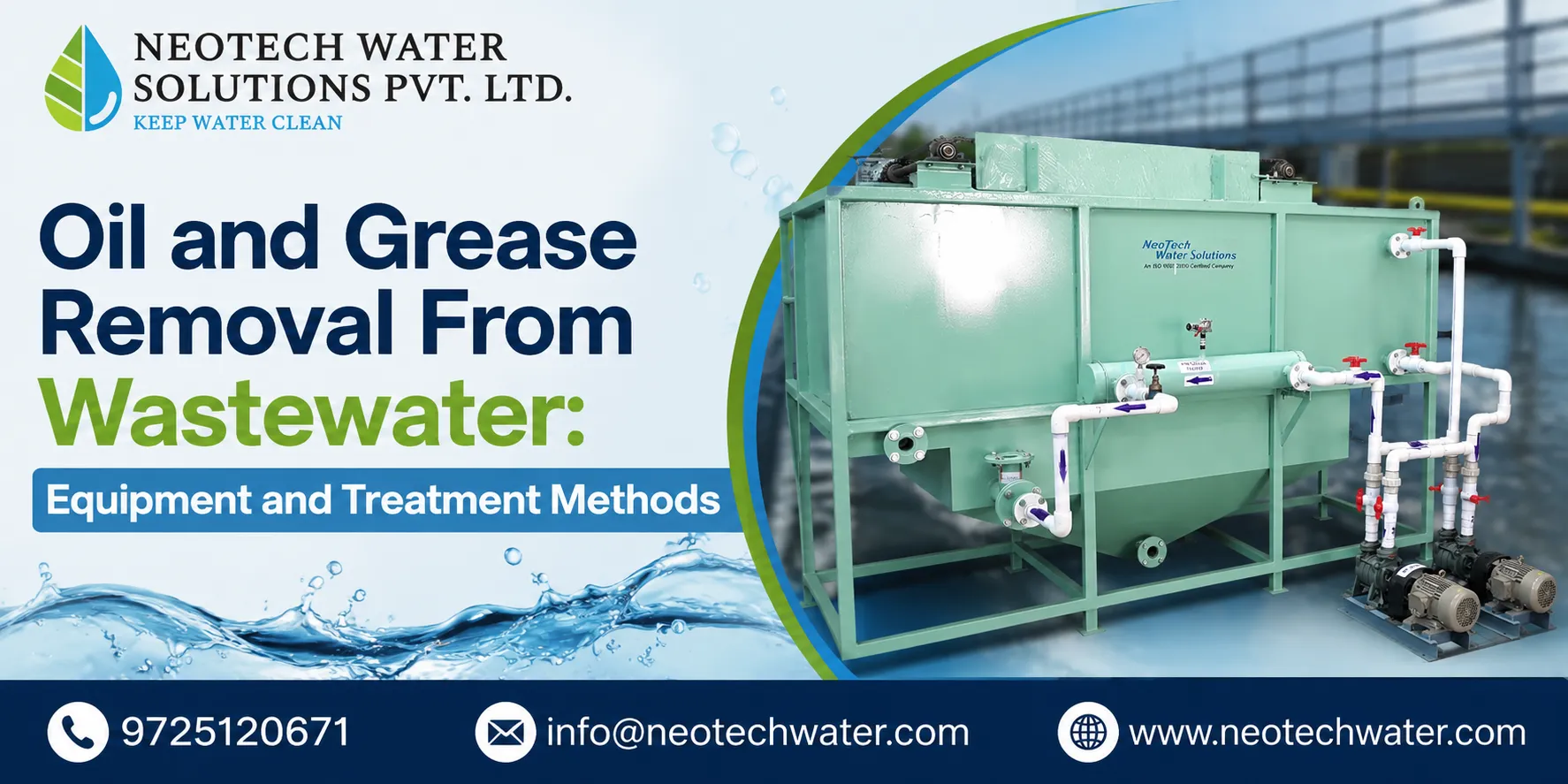
Dissolved Air Flotation (DAF) System for Oil and Grease Removal
A Dissolved Air Flotation (DAF) system is a proven technology used to remove suspended solids and oil from water. It can also help separate grease and suspended particles from industrial wastewater.
The process works by dissolving air into a portion of the treated water under pressure. When this water enters the flotation chamber and the pressure is released, microscopic air bubbles are formed. These bubbles attach themselves to oil droplets, grease and flocculated suspended particles, increasing their buoyancy and carrying them toward the surface.
The floating material forms a layer called float, which is continuously removed by a surface skimmer. The collected material can then be transferred for further handling or dewatering, while clarified water moves forward for additional treatment. This basic mechanism is well documented for industrial DAF applications.
This makes DAF particularly useful when conventional settling is not sufficient to separate low-density oil and fine suspended particles.
Where Is DAF Technology Used?
Dissolved Air Flotation technology is used across a wide range of industrial wastewater applications. Typical industries include:
- Oil refineries
- Petrochemical plants
- Chemical manufacturing
- Natural gas processing
- Food and beverage processing
- Paper and pulp industries
- Metal and engineering industries
- General industrial wastewater treatment
EPA technical documentation identifies DAF as a treatment process commonly used for suspended solids and dispersed oil and grease in oily wastewater.
A similar concept is Induced Air Flotation (IAF), where air is introduced directly into the flotation unit rather than being dissolved under pressure and subsequently released.
How Does a Dissolved Air Flotation System Work?
The operating principle of a DAF system is straightforward:
Wastewater → Coagulation → Flocculation → Air Saturation → Flotation → Skimming → Clarified Water
First, wastewater enters the treatment system. Depending on the wastewater characteristics, coagulants and polymer flocculants may be added to destabilize small particles and help them form larger flocs.
A portion of clarified water can then be pressurized and saturated with air. When the pressure is reduced inside the flotation tank, fine air bubbles form. These bubbles attach to oil droplets and flocs, causing them to rise.
The floating layer is continuously skimmed from the surface, while clarified water is collected separately.
Coagulation and flocculation are important because better-formed flocs generally improve the separation performance of flotation systems.
Gravity Separation and Other Oil Removal Equipment
DAF is not the only technology available for oil and grease removal from wastewater. The appropriate equipment should be selected according to whether the wastewater contains free oil, dispersed oil, emulsified oil or suspended contaminants.
1. Oil and Grease Separators
Gravity-based oil separators are useful when free oil is present. Because oil generally has a lower density than water, it can rise naturally to the surface while heavier solids settle.
API separators and parallel-plate separators are examples of gravity separation equipment used in industrial applications.
2. Dissolved Air Flotation
DAF is particularly useful for dispersed oil, grease and suspended solids that are difficult to remove efficiently through simple gravity settling.
3. Coagulation and Flocculation
Chemical treatment can help destabilize emulsified or finely dispersed contaminants so they can form larger particles or flocs that are easier to separate through flotation.
4. Filtration
After primary oil removal, filtration can be incorporated into the treatment train when additional suspended-solids or residual contaminant removal is required.
In many industrial systems, these technologies are combined rather than relying on one process alone.
Why Coagulation and Flocculation Matter in DAF
DAF performance depends heavily on the characteristics of the wastewater and the quality of floc formation. Coagulants can neutralize particle charges and promote aggregation, while polymers can help produce stronger and larger flocs.
This is especially important when oil is present in a finely dispersed or emulsified form. Chemical dosing should not be selected solely from generic values; jar testing and wastewater analysis can help determine the appropriate chemistry and operating conditions.
Research and technical literature also show that combining coagulation/flocculation with DAF can improve oil and grease separation in challenging wastewater streams.
Main Features of D.A.F.
The major features of a well-designed DAF system include:
- Rectangular profile for efficient space utilization.
- Robust construction suitable for demanding industrial environments.
- Efficient operation with reduced manual intervention.
- Compact design where installation space is limited.
- Gravity-based water movement in appropriate system configurations.
- Skid-mounted options for easier installation and commissioning.
- Efficient surface skimming for continuous float removal.
- Simple operating arrangement designed for reliable wastewater separation.
The final configuration should always be selected according to flow rate, wastewater composition, oil concentration, suspended solids and required treated-water quality.
Benefits of D.A.F. for Industrial Wastewater Treatment
A properly designed DAF system can offer several advantages for industrial wastewater applications:
- Effectively separates oil and grease from wastewater.
- Produces a concentrated float that can simplify oil and sludge handling.
- Helps remove suspended solids along with oil and grease.
- Can require less space than some conventional clarification arrangements.
- Provides continuous separation and skimming.
- Can reduce the contaminant load entering downstream biological treatment.
- Offers flexible integration with coagulation, flocculation and filtration.
- Can be designed as a compact, packaged wastewater treatment solution.
However, no single treatment technology is suitable for every wastewater stream. DAF performance depends on factors such as wastewater chemistry, oil characteristics, flow rate, temperature, pH, solids concentration and chemical conditioning.
How to Choose the Right Oil Removal System
Before selecting equipment for oil and grease removal from wastewater, we recommend evaluating:
- Wastewater flow rate
- Oil and grease concentration
- Free, dispersed or emulsified oil characteristics
- Total suspended solids (TSS)
- pH and temperature
- COD and BOD levels
- Required treated-water quality
- Available installation space
- Sludge and oil disposal requirements
- Possibility of oil recovery or reuse
At Neotech Water Solutions Private Limited, selecting the treatment process based on wastewater characteristics helps ensure that the system is practical, reliable and suitable for the intended application.
Frequently Asked Questions About Oil and Grease Removal From Wastewater
What is the most effective method for oil and grease removal from wastewater?
There is no single best method for every wastewater stream. Gravity separators are suitable for free oil, while DAF is commonly used for dispersed oil, grease and suspended solids. Coagulation and flocculation may be added when contaminants are finely dispersed or emulsified.
How does a DAF system remove oil from wastewater?
DAF dissolves air into water under pressure. When pressure is released, fine bubbles form and attach to oil droplets and suspended flocs. The contaminated bubbles rise to the surface, where the floating material is removed by a skimmer.
Can DAF remove suspended solids and grease together?
Yes. DAF is commonly used to separate suspended solids together with dispersed oil and grease. Chemical conditioning can further improve separation when required.
Is coagulation required before DAF?
Not always. The requirement depends on wastewater characteristics. For difficult or emulsified oil streams, coagulation and flocculation can significantly improve flotation by forming particles that are easier for air bubbles to capture.
Which industries use DAF systems?
DAF systems are used in industries such as oil refining, petrochemicals, chemicals, food processing, paper manufacturing and other industrial wastewater applications.
Can the separated oil be recovered?
In some applications, the separated oil can be collected and recovered. The feasibility depends on the type, concentration and quality of the recovered oil, as well as the requirements of the specific facility.
Conclusion
Effective oil and grease removal from wastewater starts with understanding what is actually present in the wastewater. Free oil may be handled effectively through gravity separation, while dispersed oil, grease and suspended solids can often benefit from DAF. Where emulsified or difficult-to-separate contaminants are present, coagulation and flocculation can be incorporated into the treatment process.
Neotech Water Solutions Private Limited provides wastewater treatment solutions designed around specific industrial requirements. By selecting the right combination of separation, chemical conditioning and downstream treatment, industries can achieve more reliable wastewater treatment and better control of oil and grease loads.



























Sign in to leave a comment.