
The Strategic Landscape of the Worldwide Optical Composite Film Market: Trends and Opportunities Through 2032
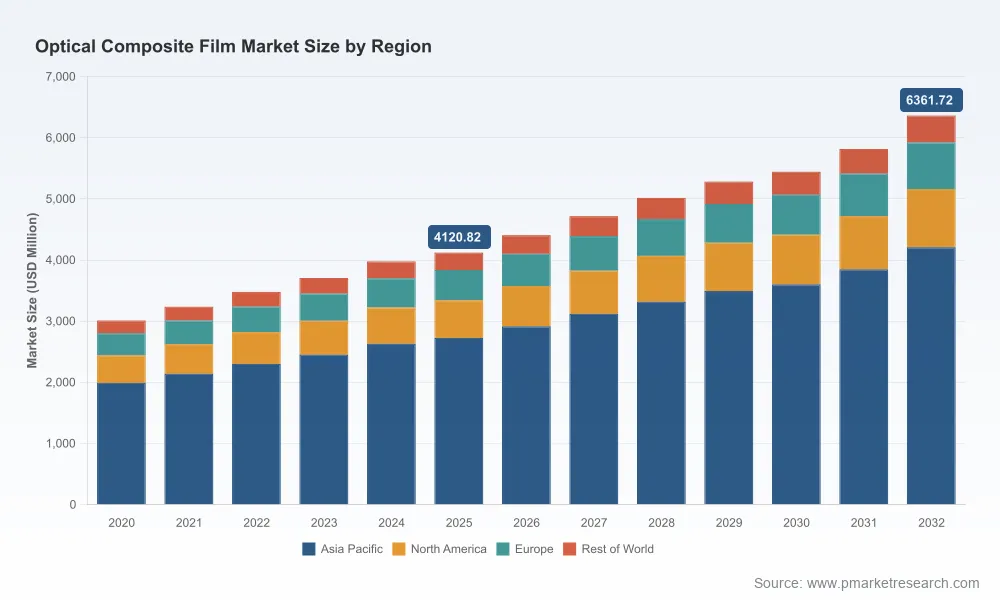
The global optical composite film industry has entered a decisive growth phase, driven by the expanding footprint of advanced display technologies across consumer electronics, automotive interiors, and emerging wearable form factors. Valued at approximately USD 4.12 billion in 2025, the market has demonstrated consistent upward momentum since 2020, when it stood at roughly USD 3.01 billion. Over the past five years, steady double-digit expansions in display panel adoption, coupled with incremental material innovations, have pushed annual revenue upward by an average of 6.4 percent annually. Current projections indicate the market will surpass USD 5.4 billion by 2030 and approach USD 6.36 billion by 2032, reflecting both volume growth and shifting material specifications across end-use sectors.
Optical Glass Market
This trajectory, however, does not arise from uniform expansion. Instead, it reflects a structural recalibration of how display manufacturers balance luminance, contrast, weight, and cost. The composite film segment has become a critical enabler of thinner backlight units, higher screen uniformity, and flexible optical architectures that traditional single-layer films cannot achieve. As panel makers push for narrower bezels, higher resolution, and improved energy efficiency, the demand for engineered multi-layer optical stacks continues to intensify, making optical composite films a strategic rather than commoditized component in the display supply chain.
Despite the favorable growth outlook, several structural challenges are reshaping how companies operate, invest, and compete. First, raw material sensitivity remains acute. Optical composite films are typically produced by laminating two to three optical layers using structural design and composite resins, frequently based on polymers such as PET, TAC, or polycarbonate. Upstream feedstocks such as purified terephthalic acid, monoethylene glycol, and polymer-grade resins continue to account for a substantial share of production economics. Volatility in resin pricing, shifting petrochemical supply dynamics, and energy-intensive processing create margin pressure that companies must manage through formulation innovation, procurement hedging, and manufacturing scale.
Second, regulatory tightening is redefining permissible materials and manufacturing practices. Stricter environmental standards targeting chemical usage and manufacturing emissions are increasing compliance costs, with new EU regulations introduced in 2025 restricting several materials traditionally used in reflective and brightness enhancement films. These rules are prompting suppliers to accelerate material substitution, refine solvent management, and invest in lower-emission processing lines. Companies that treat compliance as a strategic design parameter rather than an operational afterthought are positioning themselves more favorably in global procurement cycles.
Third, the market is navigating an inflection point in display technology adoption. While optical composite films continue to capture significant share in conventional LCD architectures, the broader industry transition toward OLED, Mini LED, and micro-LED introduces both opportunities and uncertainty. Composite film suppliers must adapt their product portfolios to serve hybrid optical stacks, new diffuser-prism combinations, and next-generation AR/VR waveguide-compatible layers. The challenge lies in balancing scalable volume production with the ability to develop highly specialized films that address emerging form factors without overcommitting to architectures that may face substitution pressure.
For executives and investors evaluating the sector, the immediate implication is clear. Growth is robust, but profitability and competitive positioning will increasingly depend on material engineering capability, cost discipline, and regulatory foresight. The market is no longer defined by simple volume expansion alone; it is being reshaped by how effectively companies integrate performance, compliance, and supply chain resilience into their optical film strategies.
Key Drivers Shaping the Optical Composite Film Market
Technology Innovation and Multi-Layer Optical Architectures
The most direct catalyst for market expansion is the ongoing maturation of multi-layer optical film design. As display manufacturers demand higher brightness uniformity, wider viewing angles, and reduced backlight thickness, single-function films are increasingly being replaced by engineered composites that merge brightness enhancement, diffusion, and light-guiding properties into one integrated structure. This reduces component count, simplifies assembly, and improves optical efficiency across televisions, monitors, laptops, and mobile devices.
At the same time, new material platforms are expanding the design envelope. Recent introductions of advanced polyimide composite systems have demonstrated potential to unlock greater structural flexibility for high-performance applications, including optical-adjacent use cases where thermal stability, dimensional precision, and durability matter. While such materials are still finding their place in specific optical composites, they signal a broader industry shift toward polymer architectures that can support thinner devices, higher thermal tolerance, and more versatile stacking strategies.
Capacity expansion in specialized film categories also underscores how suppliers are aligning production with next-generation display needs. Strategic increases in polarizer-related optical film output in key manufacturing regions reflect planned readiness for higher volumes of high-definition and hybrid display panels. These investments indicate that leading producers are not simply chasing current demand; they are building production flexibility to serve evolving panel specifications while maintaining cost-competitive throughput.
Policy and Regulatory Pressures Redefining Material Selection
Regulatory change is no longer a peripheral compliance issue; it is actively shaping product roadmaps. Stricter emission controls, chemical-use restrictions, and circular-economy expectations are driving manufacturers to revisit formulation logic, process cleanliness, and end-of-life considerations. The introduction of EU-focused restrictions on specific materials used in reflective and brightness enhancement films has accelerated evaluation of alternative resins, lower-impact solvents, and modified lamination processes.
Optical Films Market
This dynamic creates two practical effects. First, companies that anticipate regulatory shifts can avoid product redesign cycles and procurement disruptions later. Second, regulatory constraints often function as an innovation filter, favoring suppliers with stronger R&D capabilities and established quality systems. In practical terms, this raises the barrier to entry for lower-differentiated players and rewards firms that can deliver compliant films without sacrificing optical performance.
Demand-Side Evolution Across Display Categories
Demand patterns continue to be anchored by large-volume display applications, with televisions and mobile computing devices playing a central role in consumption. Television panel upgrades, larger screen formats, and the pursuit of better uniformity have sustained strong interest in composite optical films designed to improve luminance distribution and reduce hotspots. Smartphones and tablets, meanwhile, continue to drive demand for thin, high-efficiency optical stacks that can support high-resolution displays within increasingly compact device footprints.
At the same time, automotive displays are becoming a more significant demand vector. As vehicles incorporate more screens for instrumentation clusters, infotainment interfaces, and passenger-area displays, panel makers are seeking optical films that can meet higher durability expectations, wider operating temperature ranges, and improved visibility under varied lighting conditions. This shift adds a performance premium to the composite film category, encouraging suppliers to differentiate beyond basic brightness enhancement and into more application-specific optical behavior.
Supply Chain Structure and Cost Sensitivity
Cost structure remains a defining driver of competitive dynamics. Because optical composite films depend on layered polymer architectures and precision lamination, feedstock availability, resin pricing, and processing efficiency have an outsized influence on margin realization. Price fluctuations in polyester-related inputs, as well as reliance on specialized polymer grades, mean that procurement strategy is as important as product performance in many customer evaluations.
In response, leading manufacturers are pursuing vertical integration where feasible, tightening supplier relationships, and increasing the use of standardized base materials combined with differentiated optical coatings or structured surfaces. The goal is to preserve performance advantages while reducing exposure to volatile input markets. This approach also strengthens negotiating leverage in long-term panel supply agreements, where consistent quality and cost predictability often matter as much as incremental optical gains.
Competitive Landscape and Leading Strategies
The market is moderately concentrated, with a core group of established players commanding a significant share of global supply. This concentration reflects the technical barriers associated with precision film coating, lamination consistency, material formulation, and scale economics. At the same time, it creates room for differentiated positioning rather than pure price competition, especially as performance requirements become more application-specific.
Several strategic patterns are evident among leading companies. Japanese and Korean manufacturers continue to emphasize high-performance optical materials, process reliability, and close integration with major display panels and electronics manufacturers. Their portfolios often span polarizing films, brightness enhancement layers, diffusion components, and multi-layer composite structures, enabling them to offer integrated solutions rather than isolated film products. This breadth supports customers who prefer to source from suppliers capable of aligning optical stacks across multiple layers and device types.
Chinese material suppliers are playing an increasingly important role by combining functional polymer film development with strong scale and rapid product iteration. Firms focused on semiconductor display applications have expanded beyond traditional optical films into categories such as quantum dot-enhanced layers, Mini LED and LCD optical films, and materials targeting AR/VR and automotive displays. Their competitive advantage often lies in responsiveness, cost positioning, and the ability to align product development closely with fast-moving device roadmaps.
PW Consulting
Global diversified material producers also maintain influence by leveraging broader polymer science expertise and multi-market scale. Through established optical systems portfolios, these companies support high-definition displays and related applications with composite and multi-layer optical films built on deep process knowledge. For many end customers, the value proposition is less about any single film and more about predictability, documentation, and the ability to supply across regions and product generations.
Recent industry activity illustrates how competition is evolving beyond product launches alone. Capacity expansion in specialized optical film lines indicates deliberate investment in supply readiness for electronics materials growth, particularly in categories tied to polarizer and display enhancement applications. At the same time, new material introductions in adjacent high-performance composite families point to increasing cross-pollination between structural polymer innovation and optical film design. While not all innovations directly translate into optical composite film products, they broaden the technical toolkit available to suppliers and increase the likelihood of differentiated solutions in the medium term.
Market evolution is likely to combine consolidation and segmentation rather than uniform convergence. Large incumbents with strong panel relationships, broad material portfolios, and process maturity are well placed to capture volume in mainstream display categories. At the same time, specialization is becoming more valuable in areas such as automotive displays, flexible or hybrid optical stacks, and emerging wearable or AR/VR-adjacent applications. This creates opportunities for focused suppliers that can solve narrow performance problems, while also pressuring generalist players to sharpen their value proposition and cost efficiency.
For buyers and investors, the key competitive question is not simply who holds the largest share, but which companies can sustain the combination of engineering depth, regional supply reliability, and material compliance that next-generation display programs increasingly require.
Forward Outlook: Three Trends to Watch Through 2032
One likely trend is the continued migration from single-function films toward highly integrated composite architectures. As device makers pursue thinner stacks, better light efficiency, and more consistent visual performance, optical film suppliers will have stronger incentives to deliver multi-purpose layers that reduce assembly complexity and improve overall panel performance. This will favor companies with strong lamination engineering, coating precision, and the ability to customize optical behavior for specific use cases.
A second trend is the growing importance of application-specific differentiation. Mainstream consumer displays will remain a volume anchor, but higher-margin opportunities are likely to emerge in automotive displays, premium monitors, and specialized optical configurations that demand greater durability, thermal stability, or tailored viewing characteristics. Suppliers that develop application-proven solutions and can validate performance under real-world operating conditions will be better positioned to command pricing and longer-term supply relationships.
A third trend is regulatory-driven material evolution becoming a competitive differentiator rather than a compliance cost. As environmental restrictions and customer sustainability expectations tighten, film producers will need to balance optical performance with cleaner processing, restricted-substance management, and more transparent supply practices. Companies that can deliver compliant films without sacrificing efficiency will gain credibility in global procurement decisions, while laggards may face disqualification in sensitive supply chains.
Underlying these trends, the main uncertainty remains the pace and direction of display technology substitution. Shifts toward OLED, Mini LED, and emerging micro-display architectures will change the type and intensity of optical film demand in some segments. This creates both opportunity for suppliers that adapt quickly and risk for those heavily dependent on a narrow set of panel technologies. Market participants should therefore evaluate product roadmaps not only against current volumes, but also against the flexibility required to serve hybrid and next-generation optical stacks.
Actionable Implications for Decision-Makers
For display and component manufacturers, the priority is to treat optical composite film selection as a strategic design input rather than a commoditized procurement item. Evaluating suppliers on formulation flexibility, regulatory readiness, process consistency, and application-specific performance can reduce downstream redesign risk and improve panel-level outcomes. Where possible, multi-year alignment with suppliers that can support evolving optical requirements will be more valuable than short-term cost optimization alone.
For investors, attention should focus on companies with durable engineering capabilities, scalable production footprints, and clear exposure to demand categories likely to grow fastest. The most resilient business models will combine technical differentiation with cost discipline and the ability to serve both mainstream and higher-performance niches. Tracking capacity investments, material innovation pipelines, and compliance positioning can provide early signals of competitive strength.
For procurement and supply chain leaders, resilience should be built through supplier diversification, transparent input-cost monitoring, and joint development on constrained materials or region-specific regulatory requirements. Close coordination between sourcing, engineering, and compliance teams can help prevent shortages, reduce exposure to restricted substances, and ensure that film specifications remain aligned with both performance targets and evolving standards.
Given the pace of change across display architectures, materials, and regulations, the most effective decisions will depend on detailed segment-level data, competitive tracking, and scenario analysis tailored to specific product portfolios and end markets. Readers seeking a deeper quantitative breakdown of market size by region, type, and application, along with detailed company benchmarking and forward scenario modeling, may find value in accessing the full PW Consulting market study for this sector.
For detailed analysis of this topic, please visit the official page: Worldwide Optical Composite Film Market
Lacy Lee
Senior Marketing Manager
[email protected]
PW Consulting: www.pmarketresearch.com





























Sign in to leave a comment.