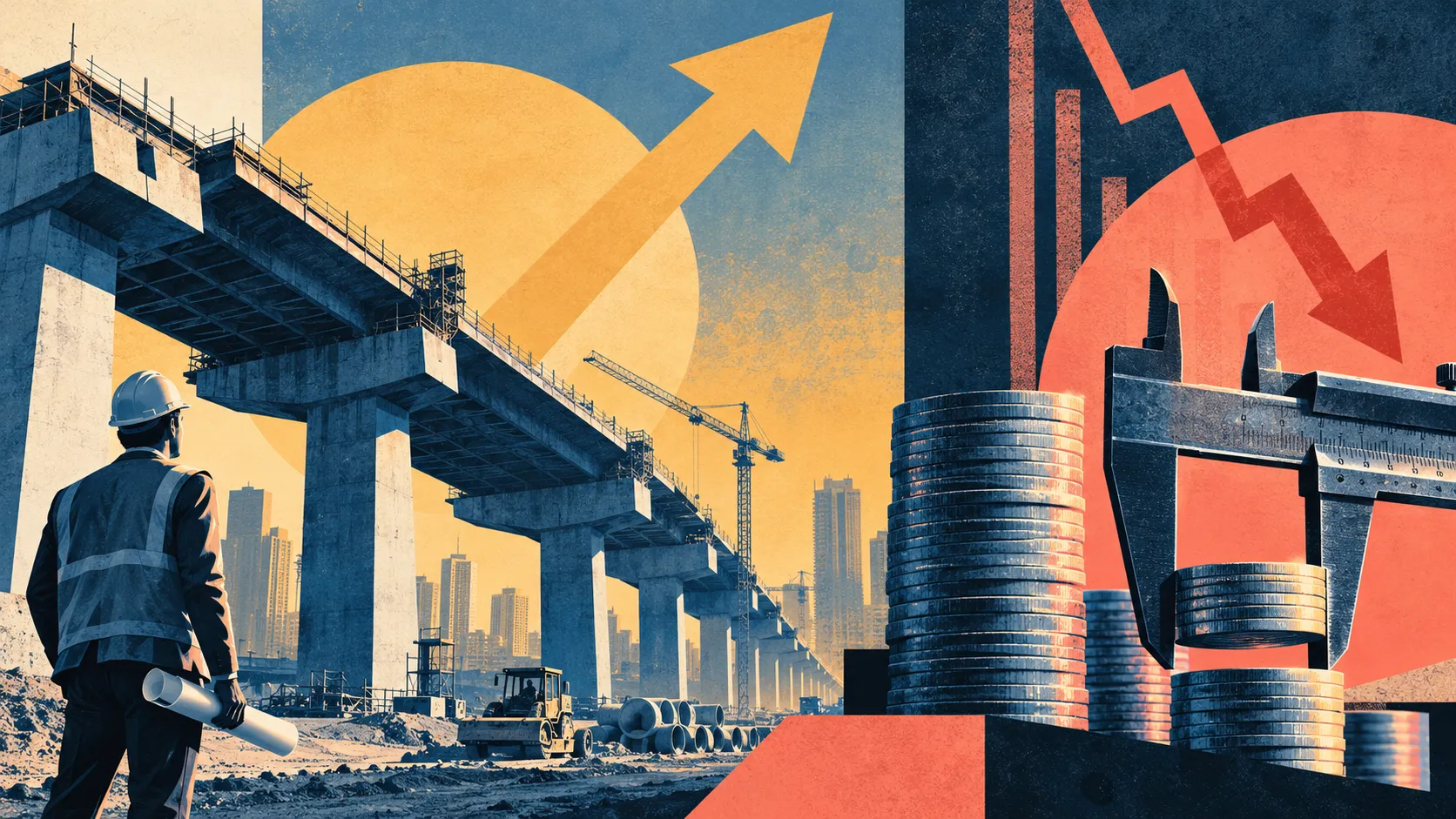

India's infrastructure sector is entering the second quarter of FY27 carrying two contradictory signals at once. On one hand, order books across the sector are at record highs and government capital expenditure allocations have never been larger. On the other, profitability at several large engineering, procurement and construction (EPC) companies has been quietly compressing for two years. Q2 FY27 earnings, due over the coming weeks, will be the first real test of whether that gap starts to close.
This is not a story about whether India will keep building roads, power lines and railways. Almost everyone agrees it will. It is a narrower and more useful question for anyone tracking the infrastructure sector: can these companies convert the spending into cash flow without their margins eroding further along the way.
The order book number that looks reassuring
Larsen & Toubro, the bellwether for Indian infrastructure and capital goods, closed FY26 with a consolidated order book of roughly ₹7.78 lakh crore, up about 27 percent year on year, driven substantially by offshore wind contracts and large diversified projects. That gives the company a book-to-bill ratio well above 2x, which under normal circumstances would signal several years of clear revenue visibility.
The sector as a whole told a similar story in the first quarter of FY27. According to coverage from Prabhudas Liladhar Capital, aggregate order inflow across its infrastructure universe rose to roughly ₹494 billion in Q1 FY27, compared with about ₹341 billion in Q1 FY26. Road EPC players such as PNC Infratech, HG Infra and Ceigall led the pace, transmission and distribution (T&D) contractors led by KEC International and Kalpataru Projects sustained their momentum, and railway-focused names including RVNL and NCC reported healthy starts against their FY27 guidance. NCC alone secured close to ₹40.7 billion of fresh orders in the quarter, taking its order book to about ₹723 billion, which the brokerage estimated at nearly 3.9 times annual revenue visibility.
Understanding what a strong order book actually implies for a company's order book execution and eventual earnings requires looking past the headline number. A large backlog only becomes revenue once a project is executed, billed and collected, and that is precisely where the second half of the story gets less comfortable.
The margin number that undercuts it
While order inflow has been strong, profitability across much of the EPC and capital goods space has been under pressure for several quarters. KEC International, which derives roughly 60 to 65 percent of its revenue from power transmission EPC work, saw its EBITDA margin compress from around 8 percent in FY24 to closer to 6.8 to 7 percent through FY26, largely because of volatility in aluminium and steel costs. The stock has fallen by more than half from its 52-week high over the same period, a reflection of how sensitive the market has become to margin trends rather than order momentum alone.
G R Infraprojects offers a similar pattern in the roads segment. Its Q1 FY27 results, presented in early August 2026, showed strong revenue growth alongside clear margin compression tied to rising commodity costs, even as the company maintained its full-year FY27 standalone revenue growth guidance of 15 to 20 percent. Cement, which feeds into a large share of EPC input costs, has not offered much relief either. Brokerages including HDFC Securities and Nuvama expect cement prices to stay largely flat through Q2 FY27, with rising fuel and packaging costs compressing industry margins by more than ₹100 per tonne quarter on quarter, and a meaningful recovery pushed out to the second half of the fiscal year.
Not every company in the broader power and transmission ecosystem is fighting the same battle. Some, like transformer and switchgear maker CG Power, have used a shift toward higher-margin segments such as semiconductor services and data centre transformers to report order inflow and margin expansion moving in the same direction, which is a useful contrast when reading the sector as a single block rather than a mix of very different business models.
The chart below captures this pattern for a typical large T&D EPC contractor. Margins have step down over five to six quarters even as revenue and order inflow climbed, and the recovery analysts are pencilling in has not shown up in the numbers yet.

What Centrum's report actually says
A widely cited report from brokerage Centrum, published in August 2026, framed this tension directly. It described Q1 FY27 performance across the infrastructure sector as mixed, with companies reporting strong order momentum while profitability remained under pressure for most players. Revenue growth varied meaningfully by company, with some seeing site restrictions and labour shortages slow down execution during the quarter.
Importantly, Centrum noted that most companies retained their full-year FY27 guidance on revenue, margins and order inflow despite the near-term cost pressure, with management commentary pointing to margin normalisation from the second quarter of FY27 onward as execution scales up and input cost pressures ease. That is the specific claim Q2 earnings will now be measured against. If margins genuinely start recovering this quarter, the market is likely to treat FY26's weakness as a temporary commodity-cost shock. If they do not, the conversation shifts toward whether current order books are being priced with enough of a cushion for cost volatility in the first place.
The order inflow breakdown
The composition of order inflow matters as much as the total. Road EPC continues to dominate by volume, but performance within the category was uneven in Q1 FY27: Ceigall and HG Infra outperformed their FY27 order guidance pace, while GR Infra, PNC, KNR Constructions and Ashoka Buildcon lagged behind their own targets for the year. Building EPC names such as Ahluwalia Contracts, PSP Projects and Capacite had not reported meaningful fresh inflow by that point in the year. Among diversified players, J Kumar Infraprojects outperformed while Afcons and Dilip Buildcon remained comparatively subdued.
T&D contractors were a bright spot, with KEC and Kalpataru together contributing roughly ₹125 billion of the quarter's inflow. This segment is increasingly tied to a theme beyond traditional roads and railways: private capex flowing into power transmission to support new data centre capacity, semiconductor manufacturing and renewable energy integration. L&T's own management has pointed to data centres, semiconductor manufacturing, healthcare, metals and urban infrastructure as the sources of increasingly broad-based private-sector investment, even as the company flagged timing delays (not cancellations) on some large projects tied to disruptions in West Asia. Readers tracking this shift may find it useful to see how it shows up in listed data centre stocks that sit adjacent to the traditional infrastructure basket.

The budget-to-ground gap
Behind all of this sits a broader execution question at the policy level. Union Budget 2026-27 raised public capital expenditure to a record ₹12.22 lakh crore, up 11.5 percent, with roads allocation rising roughly 7.9 percent to about ₹3.09 to 3.10 lakh crore and railways receiving a record outlay of ₹2.78 lakh crore. On paper, that is the largest infrastructure push India has budgeted for.
On the ground, the picture is more measured. Q1 FY27 execution (April to June) was tracking at roughly 18 to 20 percent of the annual budgeted capex, broadly in line with the historical pattern where the first quarter typically accounts for only about a fifth of the full-year target, with the real execution test usually falling in Q3 and Q4. Separately, actual NHAI highway awarding fell by around 22 percent year on year in FY26, a reminder that budget allocations and on-ground contract awards do not always move in step. None of this necessarily signals a structural problem. It is a seasonal and administrative pattern that has repeated across previous fiscal years. But it does mean that a large headline capex number is not, by itself, evidence that Q2 or Q3 earnings will show a sudden acceleration.
What Q2 FY27 earnings will actually be tested on
For investors and analysts tracking this earnings season, a few specific things are worth watching rather than the order book headline alone:
Margin trajectory versus Centrum's normalisation call. Whether EBITDA margins at T&D and roads-focused EPC names genuinely tick up sequentially, or whether commodity costs (steel, aluminium, cement, fuel) keep pressuring them into Q3.
Execution ramp-up. Whether companies that cited labour shortages, approval delays or monsoon disruption in Q1 show a visible pickup in billed revenue relative to their order books, since monsoon-related slowdowns between June and September have historically weighed on Q2 execution for road-heavy players.
Order-to-market-cap and book-to-bill ratios. Some smaller names carry unusually large order books relative to their market capitalisation or annual revenue, which can either signal undervaluation or flag execution risk if the company lacks the balance sheet or working capital to convert that backlog on schedule.
Segment mix. Whether growth is increasingly coming from higher-margin, non-traditional sources such as data centres, defence and renewable transmission, versus lower-margin traditional road and building EPC work, since analysts have flagged that this mix shift affects blended margins differently across companies.
Working capital and debt. Interest coverage across the construction sector has been projected to compress further in FY27, which makes balance sheet strength, not just order book size, a genuine differentiator between companies rather than a formality.
Tracking these variables consistently across a coverage list of 15 to 20 companies each quarter is tedious to do from scratch, which is why analytical summaries that consolidate growth, profitability, and valuation parameters into one view are commonly used by investors who follow this sector on an ongoing basis, rather than relying only on quarterly headlines.
A sector where discipline matters as much as conviction
None of the data above amounts to a prediction about where any individual stock is headed. It is a description of a sector where two genuinely different stories, record order inflow and compressed margins, are both true at the same time, and where Q2 FY27 results will start to show which one is winning out. Making sense of quarterly commentary like Centrum's, or comparing a company's own guidance against what it actually delivers, is less about following headlines and more about a consistent process of checking claims against filed numbers each quarter. That kind of discipline, applied over several earnings cycles rather than a single quarter, tends to matter more than reacting to any one data point, a principle that shows up repeatedly in how market participants approach risk and decision-making across sectors, not just infrastructure.
This article is for informational and educational purposes only. It is not investment advice or a recommendation to buy, hold or sell any security. Figures cited are drawn from company disclosures and brokerage or media reporting as of September 2026, and are subject to revision as actual Q2 FY27 results are reported.






















Sign in to leave a comment.