
Navigating the Outboard Engine Market: Strategic Trends and Commercial Opportunities Through 2032
The global outboard engine market has entered a phase of structural expansion, defined by steady revenue growth, shifting powertrain preferences, and an increasingly complex competitive landscape. Valued at approximately $5.0 billion in 2020, the market accelerated through the post-pandemic recovery period and reached $7.5 billion in 2025. Forecasts project a trajectory toward $13.1 billion by 2032, representing a compound annual growth rate of 6.0 percent over the 2026–2032 period. This expansion is not merely a function of historical recovery; it reflects deeper transformations in propulsion technology, regulatory pressure, and marine recreational demand that are reshaping how manufacturers, distributors, and end-users evaluate product portfolios and investment pathways.
Despite the upward trajectory, the industry faces a set of interdependent challenges that will determine which participants capture disproportionate value. The first centers on powertrain transition and emissions compliance. Regulatory frameworks have accelerated the decline of traditional two-stroke architectures, with four-stroke outboard engines now surpassing 60 percent adoption in the U.S. market. This shift is not simply a compliance checkbox; it redefines engineering priorities, supply chain requirements, and after-sales service expectations. The second challenge involves cost structure and margin resilience. Average retail pricing for outboard engines rose 3.2 percent to $13,081 in 2025, even as raw material dynamics and manufacturing complexity continue to pressure underlying cost bases. Sustaining premium pricing requires demonstrable performance, reliability, and differentiation that justify consumer willingness to pay. The third challenge relates to market concentration and competitive intensity. The top three players command roughly 52 percent of market revenue, while the top five account for 68 percent, indicating a highly consolidated core surrounded by regional and niche participants competing on price, specialization, or localized distribution strength. Navigating this landscape requires clarity on where scale advantages end and where specialized positioning becomes the more viable route to profitability.
Key Drivers Shaping Market Trajectory
Technological Innovation and Powertrain Diversification
Technological advancement is no longer confined to incremental horsepower gains or fuel efficiency tweaks; it is becoming the primary axis of competitive differentiation. Manufacturers are expanding portfolios across the gasoline-to-electric spectrum, responding to both performance expectations and environmental preferences. Recent product activity illustrates this acceleration. In early 2026, Mercury Marine released a new V10 Verado high-horsepower series covering 350–400 hp without increasing block width, signaling that engineering teams are achieving power density improvements that matter to boat builders and high-performance recreational users. Around the same period, Suzuki Marine relaunched its V6 200 hp outboard with a redesigned lower unit and electronic throttle-and-shift technology, claiming a 12 percent improvement in hole-shot performance. These updates reflect an industry-wide emphasis on responsiveness, integration, and user experience rather than raw displacement alone.
On the electric side, Yamaha Marine introduced the HARMO electric rim-drive outboard, positioned as an equivalent to 9.9 hp gasoline with modular lithium battery packs and configurable shaft lengths. Shortly afterward, Yamaha also announced a hydrogen outboard concept built on its XTO Offshore platform, positioning hydrogen as a longer-term exploratory pathway for recreational applications. Honda Marine refreshed its BF115/BF140/BF150 inline and BF200/BF225/BF250 V6 lineups with enhanced corrosion resistance and a 2 percent fuel-burn improvement, demonstrating that even mature gasoline platforms continue to receive targeted optimization. Together, these developments indicate that the market is moving toward a multi-powertrain reality, where manufacturers must manage gasoline, electric, and potentially hydrogen or hybrid architectures simultaneously, each with distinct cost structures, service networks, and customer education requirements.
Regulatory and Environmental Pressures Accelerating Adoption Shifts
Policy and regulatory momentum is a decisive force in the outboard engine market, particularly in emission-sensitive regions. Stricter emission standards have effectively accelerated the phase-out of two-stroke models and elevated four-stroke dominance in major markets. Alongside this, the U.S. emission norms and associated 2025 rules contributed to a 20 percent rise in hybrid and electric outboard sales, underscoring how regulatory signals can rapidly alter purchasing behavior when paired with commercially viable alternatives. For industry participants, regulation is no longer a distant compliance concern; it is shaping product roadmaps, inventory planning, and channel messaging in real time.
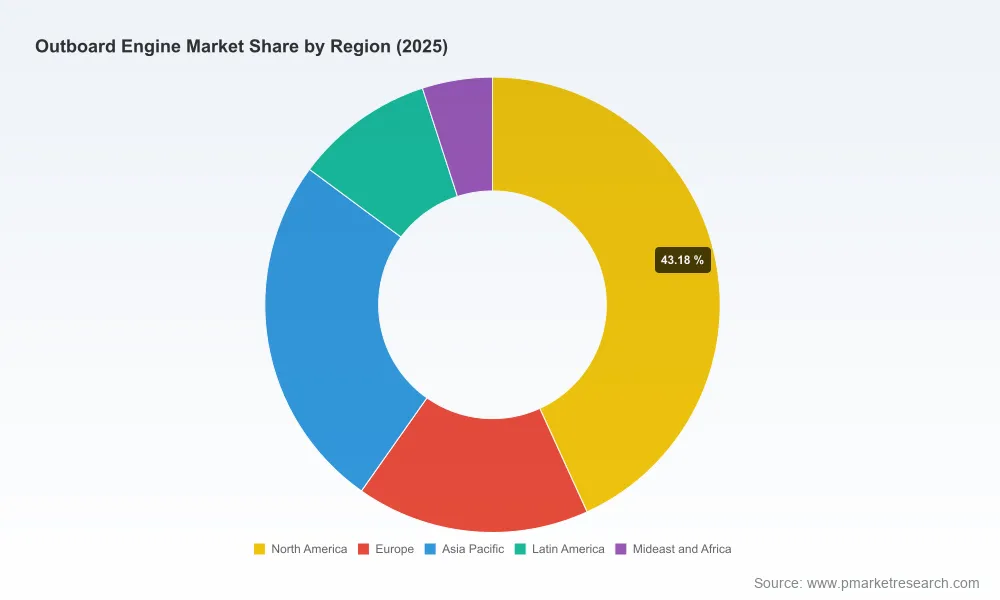
The regulatory environment also interacts with regional demand concentration. Higher horsepower segments remain strong, with the South Atlantic, Great Lakes, and Gulf Coast regions accounting for more than 60 percent of unit sales in the U.S. This geographic clustering suggests that emissions and efficiency requirements, combined with regional boating cultures, are reinforcing demand for larger, more capable engines that meet both performance expectations and regulatory thresholds. Manufacturers that can align product development with regional regulatory calendars and marine usage patterns are better positioned to reduce time-to-market risk and avoid costly portfolio misalignment.
Demand-Side Evolution in Recreational and Commercial Marine Use
Demand patterns are being reshaped by both consumer behavior and commercial operational needs. Recreational applications continue to represent the largest share of market value, supported by sustained interest in boating as a lifestyle and leisure activity. This demand is not uniform, however; it increasingly favors engines that deliver quieter operation, improved fuel efficiency, and easier integration with modern hull designs and onboard electronics. High horsepower segments are particularly notable, with engines 300 horsepower and greater accounting for 39,700 units sold and leading U.S. demand in 2025. This preference for larger propulsion systems reflects a market that is tilting toward premiumization, where buyers prioritize capability and experience over minimal entry-level specifications.
Commercial applications form a significant secondary demand base, where total cost of ownership, durability, and service availability often outweigh retail price considerations. In this segment, reliability and uptime become critical purchase drivers, and manufacturers that can demonstrate consistent field performance, accessible parts supply, and predictable maintenance cycles gain a structural advantage. Military applications, while smaller in relative terms, introduce additional requirements around specialized performance, durability, and supply security, offering a different kind of demand stability that can support long-cycle development and niche engineering investment.
Supply Chain, Pricing Dynamics, and Cost Structure Pressures
Pricing behavior and supply chain resilience are emerging as strategic topics as the market matures. In 2025, average retail prices rose to $13,081, reflecting stable pricing dynamics and resilient demand rather than aggressive escalation. This suggests that manufacturers are managing to protect margins while maintaining accessibility for core customer segments. At the same time, the broader cost environment remains sensitive to material availability, manufacturing complexity, and the capital intensity associated with expanding electric and hybrid offerings.
For electric outboards in particular, battery architecture, charger compatibility, and service training introduce new cost layers that differ from traditional gasoline engine economics. The move toward modular lithium battery packs, as seen in recent electric platform introductions, creates flexibility for end-users but also requires manufacturers to design for battery lifecycle, replacement logistics, and warranty exposure. Companies that proactively integrate supply chain planning with product architecture decisions will be better equipped to manage cost volatility and maintain pricing credibility as portfolios diversify.
Competitive Landscape and Leading Strategies
Concentrated Core with Differentiated Value Propositions
The market’s competitive structure is defined by a concentrated leadership group surrounded by a diverse set of regional and specialized players. The leading manufacturers are competing less on a single attribute and more on integrated value propositions that combine horsepower density, emissions performance, electric readiness, corrosion resistance, and dealer/service support. Mercury Marine, headquartered in Fond du Lac, Wisconsin, has emphasized a full-line approach spanning gasoline and electric outboards, including the new V10 Verado high-horsepower series and Avator electric models. Its positioning reflects an effort to serve a broad performance spectrum while maintaining a coordinated product narrative across powertrain types.
Yamaha Marine, based in Kumagaya, Japan, is advancing a similarly broad but technology-forward portfolio, covering advanced four-stroke and electric outboards such as the HARMO rim-drive electric series and the hydrogen XTO Offshore platform concept. The company’s recent activity suggests a strategy that uses electric and alternative-fuel exploration to future-proof its recreational lineup while maintaining strong gasoline offerings. Honda Marine, in Tokyo, continues to emphasize reliability and fuel-efficient performance, with corrosion-resistant models and refreshed inline and V6 lineups that reinforce durability and operational efficiency. Suzuki Marine, also based in Hamamatsu, has focused on electronic throttle-and-shift technology and refined lower-unit design to improve responsiveness and handling characteristics, illustrating how control-system innovation can serve as a differentiator even within established engine families.
Outboard Electric Motors Market
OEM Relationships and Regional Specialization
A meaningful layer of the competitive landscape comes from manufacturers that operate both as branded sellers and as underlying technology or OEM suppliers. Tohatsu Marine, located in Hamamatsu, provides four-stroke outboard engines used as OEM supply for Mercury and other premium brands, highlighting how manufacturing capability and supplier relationships can underpin market presence even when consumer-facing branding differs. In the Chinese market, Suzhou Parsun Power Machine Co., Ltd. offers a full range of 2-stroke and 4-stroke outboard motors plus electric models under multiple brands, while Suzhou Allpass Machinery Co., Ltd. markets Yamabisi-branded 2-stroke and 4-stroke outboards for kayaks, fishing boats, and tenders. These players demonstrate how regional manufacturing ecosystems can serve both domestic demand and export channels with flexible product breadth and cost-competitive positioning.
In the electric niche, specialized firms are carving out distinct spaces. Ilmor Engineering, based in Plymouth, Michigan, offers premium ION electric outboard motors up to 6kW designed for sailboats, tenders, and high-performance recreational use, emphasizing application-specific engineering rather than broad platform coverage. Torqeedo GmbH, headquartered in Friedrichshafen, Germany, focuses on travel-series electric outboard motors with modular lithium battery packs and quiet, zero-emission propulsion, aligning its brand with a premium, experience-driven electric marine segment. These companies show that smaller-scale participants can compete effectively by owning a defined use case, performance promise, or customer experience rather than trying to replicate the full-line coverage of larger incumbents.
Market Structure Evolution: Integration, Fragmentation, and New Entrants
The competitive landscape appears set to evolve along three interacting paths. First, integration and portfolio consolidation may accelerate among larger players seeking to combine gasoline, electric, and service capabilities under coordinated strategies, particularly as regulatory and customer expectations push toward multi-powertrain readiness. Second, fragmentation may persist in regional markets and specialized applications, where localized distribution, price sensitivity, and use-case specificity create room for focused players. Third, new entrants and brand expansion are likely to continue in electric and alternative-fuel segments, where modular architectures and battery ecosystems lower certain barriers while raising others, especially around service infrastructure, warranty management, and customer education. The result is a market where competitive advantage increasingly depends on the ability to choose the right combination of scale, specialization, and technology investment rather than simply pursuing volume growth.
Future Trends and Commercial Opportunities
Accelerated Electrification with Multi-Tier Adoption
Over the next three to five years, electrification is expected to move from early-adopter niches toward broader, tiered adoption. This does not imply a uniform replacement of gasoline engines; instead, it suggests a market in which electric outboards gain stronger footholds in specific applications such as tenders, sailboat auxiliaries, urban or noise-sensitive waters, and premium recreational models where quiet operation and zero-emission use are valued. The commercial opportunity lies in aligned ecosystems: battery pack modularity, charging solutions, service training, and warranty frameworks that make electric ownership practical for dealers and end-users. Manufacturers and distributors that invest early in these enabling elements can shape customer expectations and capture value beyond the engine itself.
At the same time, uncertainty remains around battery cost trajectories, recycling and disposal logistics, and the pace at which consumers accept range and charging constraints in marine settings. Pricing premiums for electric systems may persist in the near term, which means adoption will likely be shaped by where the total experience justifies the cost, rather than by price parity alone.
Premium High-Horsepower Growth and Product Optimization
High-horsepower segments are likely to remain a growth engine, supported by premiumization in recreational boating and robust demand in key U.S. regions. Engines 300 horsepower and greater already led U.S. demand in 2025, and continued emphasis on power density, reduced block width, and improved handling characteristics points to a market where performance leadership is increasingly measured by efficiency and integration as much as by peak output. Commercial opportunity here includes targeted product optimization, stronger alignment with hull and electronics partners, and service models that protect the value of higher-investment propulsion systems.
Off-road Engines Market
Risk factors include sensitivity to economic cycles among premium buyers and the potential for regulatory or fuel-price shifts to alter purchasing priorities. Sustained growth in this segment will depend on demonstrating that higher horsepower translates into measurable user value, not just specification leadership.
Regulatory-Driven Portfolio Rebalancing and Emission-Linked Demand
Regulatory momentum will continue to pressure portfolios toward cleaner, more efficient architectures. The combination of emission standards and regional boating preferences is likely to reinforce four-stroke dominance and support continued growth in hybrid and electric sales, particularly where compliance and customer preference align. For businesses, the opportunity is to use regulatory timelines as planning inputs rather than external shocks: aligning product refreshes, inventory mix, and channel messaging with regional rules and adoption curves can reduce friction and improve commercial execution.
The uncertainty here lies in the uneven pace of regulatory implementation across geographies and the possibility that alternative propulsion technologies may advance faster or slower than current expectations. Companies that maintain flexible roadmaps and avoid over-committing to a single transition pathway will be better positioned to adapt as policy and technology evolve together.
Strategic Implications for Decision Makers
For Manufacturers and Product Leaders
Product strategy should be anchored in portfolio coherence rather than isolated launches. As gasoline, electric, and alternative-powertrain options expand, the most resilient manufacturers will be those that can connect platform development with service readiness, parts availability, and dealer training. This means treating electric and hybrid offerings not as side projects but as integrated business lines with their own cost models, lifecycle assumptions, and customer support requirements. Differentiation will increasingly come from control-system refinement, corrosion resistance, modular battery design, and application-specific tuning, so engineering resources should be prioritized where user experience and regulatory alignment intersect.
PW Consulting Automotive & Machinery Research Center
For Investors and Capital Allocators
Investment decisions should account for both scale economics and specialization value. Consolidated leaders benefit from broad coverage, established distribution, and multi-product narratives, but regional and niche players can achieve durable positioning by owning specific applications, price points, or electric-use experiences. Due diligence should examine not only unit economics but also battery supply strategies, warranty exposure, service network strength, and the ability to manage portfolio complexity across powertrain types. Capital that supports enabling infrastructure—such as charging compatibility, battery lifecycle management, and regional distribution capability—may prove as important as capital invested directly in engine development.
For Procurement and Commercial Buyers
Buying decisions should increasingly evaluate total cost of ownership, service accessibility, and future compliance exposure rather than upfront price alone. In commercial contexts, uptime, parts availability, and predictable maintenance costs can outweigh marginal retail differences. In recreational contexts, buyers are likely to weigh noise, emissions, fuel efficiency, and integration with existing boat systems more heavily as electric and refined gasoline options become more accessible. Procurement teams that align engine selection with regional usage patterns, regulatory expectations, and support-network quality will be better positioned to manage operational risk and long-term value.
Conclusion
The outboard engine market is entering a period in which growth, technology transition, and competitive differentiation are tightly intertwined. Strong historical momentum and a clear forecast path through 2032 provide a constructive backdrop, but the real strategic question is how participants navigate powertrain diversification, regulatory pressure, and a concentrated yet dynamic competitive structure. Manufacturers that align product roadmaps with regional demand and emissions realities, investors who distinguish between scale advantages and specialized positioning, and buyers who evaluate total ownership experience will be best placed to capture value in the next phase of market development. For decision makers seeking a deeper, segment-level view of these dynamics—including detailed regional splits, application-level revenue breakdowns, and company-specific scenario planning—the full PW Consulting research report offers a more granular foundation for planning and investment decisions.
For detailed analysis of this topic, please visit the official page: Outboard Engine Market
Lacy Lee
Senior Marketing Manager
[email protected]
PW Consulting: www.pmarketresearch.com
























Sign in to leave a comment.