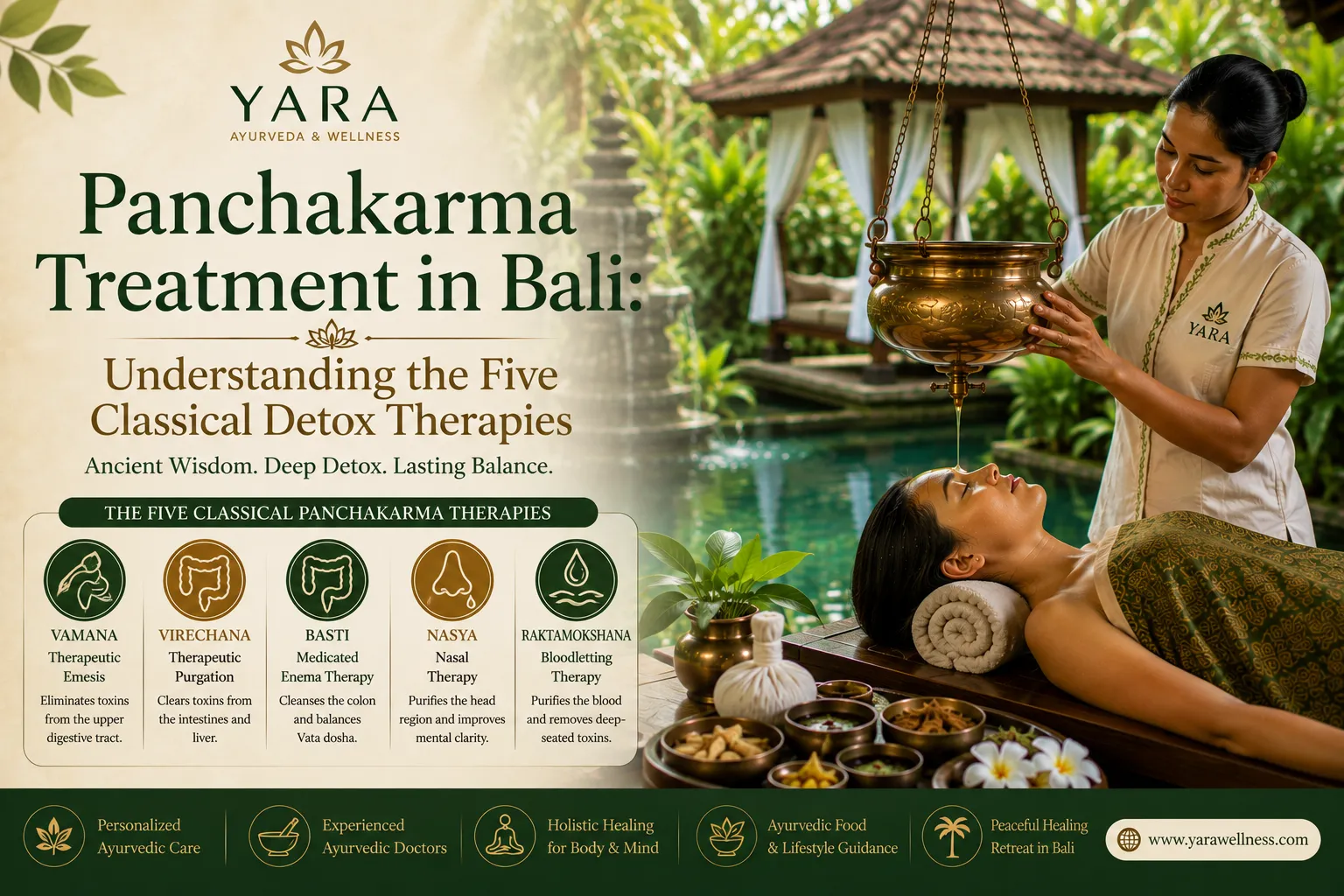

Panchakarma treatment in Bali gets its name from a specific number for a reason: five distinct classical therapies, each targeting a different kind of imbalance, each working through a genuinely different mechanism. Most guides mention all five in passing and move on quickly to the general experience of a retreat, without actually explaining what each therapy involves or why it's used the way it is.
That's worth fixing, because understanding these five therapies individually changes how you understand the whole system. Panchakarma isn't one treatment delivered five different ways — it's five specific tools, each suited to a specific problem, and a well-run program selects from them deliberately rather than applying all five to every guest regardless of what's actually going on.
This article goes through each of the five therapies in real detail: what it involves, how it works, who it's suited for, and where genuine safety considerations come into play.
Why "Five" Therapies, and Why That Number Matters
Classical Ayurvedic texts settled on these five specific therapies because each one addresses toxin accumulation and dosha imbalance through a different exit route from the body — vomiting, purgation, the colon, the nasal passages, and the bloodstream. This isn't an arbitrary list; it reflects a fairly comprehensive attempt to cover the major pathways through which Ayurveda believes the body can be effectively purified.
In modern retreat settings, not all five are used with equal frequency, and understanding why comes down to practicality, safety, and how much clinical supervision each one genuinely requires.
Vamana: Therapeutic Emesis for Excess Kapha
Vamana is the classical therapy for clearing excess kapha, delivered through controlled, medically supervised vomiting. The process isn't as alarming as it might sound on paper — guests are prepared over several days with specific oleation and dietary protocols before the therapy itself, then given a preparation that induces a controlled release, closely monitored throughout by a trained practitioner.
It's traditionally indicated for conditions Ayurveda associates with kapha excess, particularly respiratory congestion and certain digestive patterns involving excess mucus. Because Vamana requires close clinical supervision and carries more physical demands than the other therapies, it's less commonly offered at wellness-oriented retreats and more frequently reserved for clinical Ayurvedic hospital settings, or delivered only by highly experienced practitioners with appropriate medical support on hand.
Virechana: Purgation for Excess Pitta
Virechana is the classical treatment for clearing excess pitta, using herbal purgative preparations to induce therapeutic bowel clearance after a period of preparatory oleation and steam therapy. It's one of the more commonly offered core Panchakarma therapies at Bali retreats, given that it's generally considered more manageable to administer safely than Vamana while still delivering a genuine purification effect.
Virechana is traditionally used for pitta-related conditions, including certain skin issues, digestive inflammation, and liver-related imbalances in Ayurvedic terms. The therapy typically unfolds over a single treatment day following several days of preparation, followed by a structured period of dietary reintroduction that's considered just as important as the purgation itself.
Basti: Medicated Enemas for Excess Vata
Basti involves the administration of medicated enemas, using herbal oils or decoctions, and is considered one of the most significant therapies in the entire Panchakarma system given how strongly Ayurveda associates vata with the colon. Rather than a single session, Basti is typically delivered as a structured course, sometimes alternating between oil-based and decoction-based preparations across consecutive days.
This therapy is traditionally used for vata-related conditions, including joint pain, nervous system imbalance, and chronic digestive irregularity. Because Basti is generally considered gentler and lower-risk than Vamana while still being highly effective for vata imbalance, it's among the more frequently offered core therapies within Panchakarma treatment in Bali.
Nasya: Nasal Therapy for the Head and Nervous System
Nasya involves administering medicated oils or herbal preparations through the nasal passages, targeting the head, sinuses, and nervous system specifically. Unlike the other four therapies, which primarily work through the digestive tract or bloodstream, Nasya's pathway is unique, which is part of why it's used for such a distinct set of concerns — headaches, sinus congestion, and stress-related mental fog rather than the more systemic issues the other therapies address.
Nasya is generally considered one of the gentler therapies in the Panchakarma system, with a lower barrier to entry than Vamana, Virechana, or Basti, which is part of why it's so commonly offered as both a standalone treatment and a supporting element within a broader program.
Raktamokshana: Bloodletting for Blood-Related Conditions
Raktamokshana, traditionally involving controlled bloodletting, is the least commonly offered of the five therapies in a modern retreat context, largely because it requires the most rigorous clinical oversight and carries the most direct safety considerations of any therapy in the system. It's traditionally indicated for certain blood-related skin conditions and specific inflammatory patterns.
Given the level of medical supervision this therapy genuinely requires, it's rarely part of a standard wellness-oriented Panchakarma treatment in Bali, and its absence from a retreat's therapy list isn't a sign of an incomplete program — it reflects a responsible decision about what can be safely delivered outside a fully clinical medical setting.
Why Most Bali Retreats Focus on Only Some of These Five
Given the safety and supervision considerations involved, most retreats built for international wellness travelers concentrate on Virechana, Basti, and Nasya as their core offerings, supported by therapies like Abhyanga and Swedana. Vamana and Raktamokshana, while classically part of the system, are generally reserved for practitioners and settings equipped for the higher level of clinical monitoring they require.
This isn't a shortcut or a diminished version of Panchakarma — it's a sensible, safety-conscious application of the system to the setting most retreats actually operate within. A retreat being upfront about which of the five therapies they offer, and why, is a good sign rather than a limitation to be concerned about.
How These Five Therapies Work Together, Not in Isolation
Even when only some of these therapies are used within a single program, they're rarely delivered as a standalone event. Basti is typically preceded by days of Snehana and Swedana. Virechana requires similar preparation and a careful dietary reintroduction afterward. Nasya is often woven throughout a longer program rather than delivered as a single isolated session.
Understanding this interconnected structure matters because it explains why genuine Panchakarma treatment in Bali takes real time to deliver properly. Each therapy depends on the body being adequately prepared beforehand and carefully supported afterward, which is exactly what a rushed, compressed version of Panchakarma tends to skip.
Safety and Supervision Requirements Across the Five Therapies
The five therapies genuinely differ in how much supervision and screening they require. Nasya carries the lowest general risk profile and is often appropriate for a wider range of guests, provided basic contraindications like active sinus infection or pregnancy are screened for. Basti and Virechana sit in the middle, requiring proper practitioner oversight, dietary preparation, and screening for specific health conditions before administration.
Vamana and Raktamokshana carry meaningfully higher supervision requirements, which is exactly why their availability is more limited. If a retreat offers either of these two therapies, it's entirely reasonable to ask directly about the medical support and practitioner experience available during administration.
How to Know Which of the Five Applies to You
This comes down almost entirely to your consultation and dosha assessment, rather than something you can reliably determine on your own beforehand. A vata-dominant imbalance points toward Basti as the primary therapy, a pitta-dominant imbalance points toward Virechana, and a kapha-dominant imbalance traditionally points toward Vamana, though many retreats use a modified, more vigorous Virechana as a practical alternative given Vamana's supervision requirements. Head, sinus, and nervous system concerns often call for Nasya regardless of your broader dosha pattern.
A practitioner should be able to explain clearly which of these therapies applies to your specific situation and why, rather than defaulting to whichever therapies happen to be part of a fixed retreat package.
Conclusion
The five classical therapies at the heart of Panchakarma treatment in Bali aren't interchangeable variations on the same idea — each one is a distinct tool built for a specific kind of imbalance, with its own mechanism, indications, and safety profile. Understanding what Vamana, Virechana, Basti, Nasya, and Raktamokshana actually involve individually gives you a much clearer picture of what genuine Panchakarma is actually offering, and why a responsible retreat may only deliver some of these five safely.
Going into a consultation with this understanding means you can ask sharper, more specific questions, and recognise exactly why a particular therapy is being recommended for your situation rather than simply following along.
Want to Know Which of These Therapies Fits You?
If you're curious which of the five classical therapies would actually apply to your situation, that's a question worth bringing directly to a consultation before you book. Reach out to share your health history and current concerns, and get a clear, specific answer about which therapies your Panchakarma treatment in Bali would genuinely involve.
FAQs
What are the five classical Panchakarma therapies? The five therapies are Vamana, or therapeutic emesis for excess kapha; Virechana, or purgation for excess pitta; Basti, or medicated enemas for excess vata; Nasya, nasal therapy for the head and nervous system; and Raktamokshana, bloodletting for blood-related conditions.
Why don't most Bali retreats offer all five therapies? Vamana and Raktamokshana require significant clinical supervision, so most wellness-oriented retreats focus on Virechana, Basti, and Nasya, which can be delivered safely and effectively within a retreat setting.
Which Panchakarma therapy is most commonly used? Virechana and Basti are the most commonly offered core therapies at Bali retreats, since they address the two dosha imbalances, pitta and vata, most frequently seen in guests seeking treatment.
Is Vamana safe to do at a wellness retreat? Vamana requires close medical supervision and careful preparation, which is why it's more commonly reserved for clinical Ayurvedic settings rather than standard wellness-oriented retreats.
How do I know which of the five therapies I actually need? This is determined through a proper consultation and dosha assessment with a qualified practitioner, who should be able to explain clearly which therapy applies to your specific imbalance and why.




























Sign in to leave a comment.