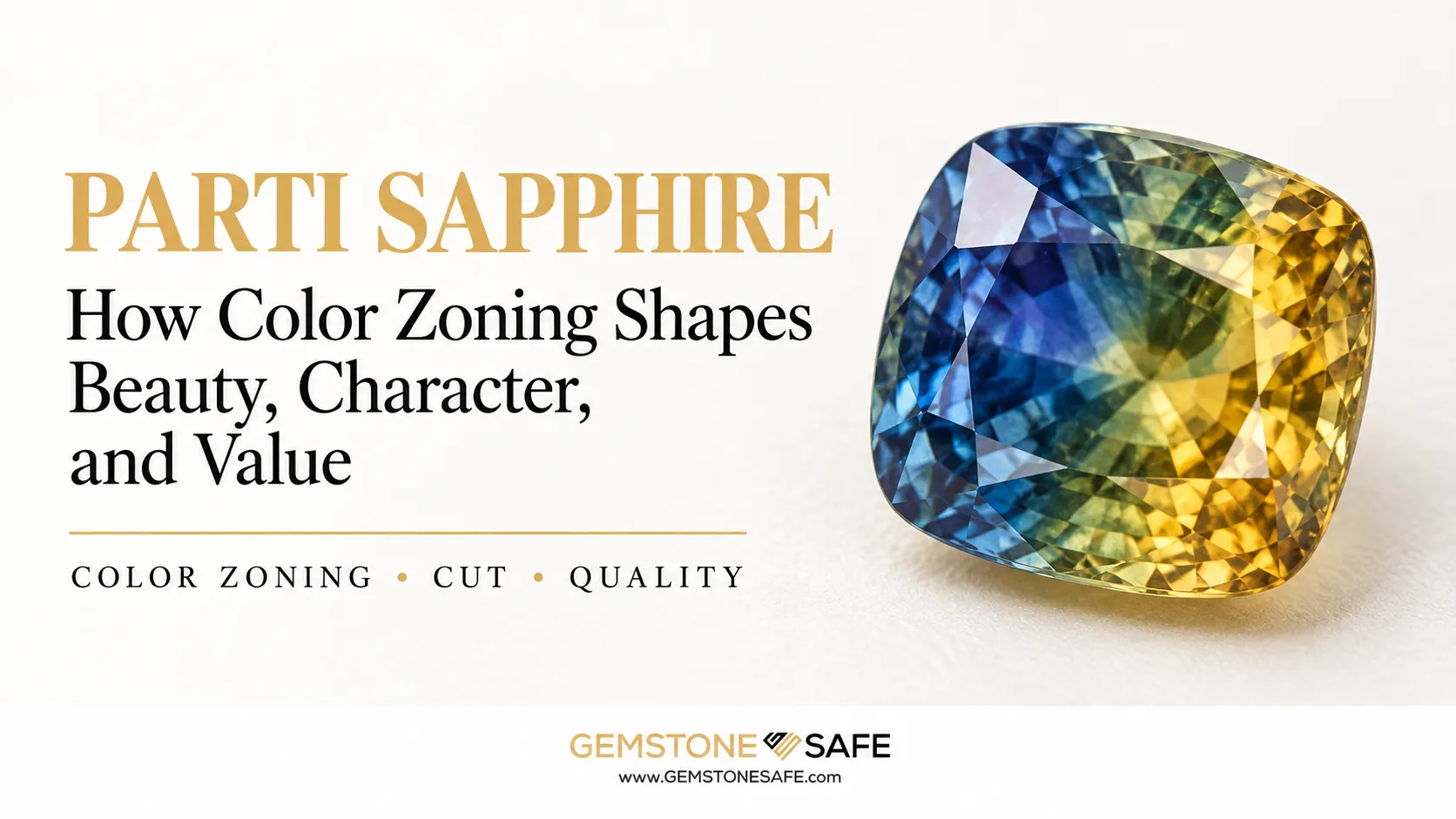

In a parti sapphire, the arrangement of colors can matter as much as their intensity. A blue area beside yellow or green may create a striking pattern, but its effect depends on cutting, lighting, and viewing direction. Choosing well requires evaluating the finished gemstone rather than assuming that more colors automatically mean greater value.
What Is Parti Sapphire?
“Parti-colored” describes sapphire displaying a combination of different colors within one stone. It is a description of appearance, not a separate mineral species: the material remains corundum.
Color zoning is an uneven distribution of color within a gemstone. Differences in growth conditions and the incorporation of trace elements can produce distinct zones as the crystal develops. In some sapphires, blue and yellow zones also contribute to an overall green appearance.
Zoning is different from pleochroism, the variation in color seen along different crystal directions. It also differs from color change, where the apparent color changes between different types of illumination. These effects can influence what you see, but they should not be used interchangeably in a sales description.
Geological Origins and Geographic Claims
Australia is strongly associated with parti sapphire. GIA’s field research documents characteristic examples and describes major sapphire districts in Queensland and New South Wales. These deposits are related to basaltic volcanic activity, with recovery from volcanic material and secondary deposits along present or former watercourses.
A secondary deposit is a place where crystals have accumulated after being released and transported from their earlier setting. The location where a gem is recovered therefore describes one stage in its geological journey, not necessarily the precise environment where it crystallized.
Australian origin should not be inferred solely from a blue-yellow-green combination. Ask whether a source claim rests on documented sourcing or a laboratory opinion. Where origin testing is possible, the report addresses provenance rather than assigning an overall beauty grade.
Meaning and Personal Significance
Sapphire has longstanding associations with truth, sincerity, faithfulness, and nobility. Much of the familiar historical symbolism concerns blue sapphire, so it should not automatically be presented as an ancient tradition specific to parti-colored material.
A buyer might interpret two colors as representing partnership or individuality. That is a contemporary personal meaning, not an established gemological property. Such symbolism can make an engagement ring significant without implying protective or healing effects.
How to Evaluate Parti Sapphire Quality
Color Arrangement and Brightness
Start by asking whether the combination remains appealing in ordinary lighting. Are both colors visible face-up? Does one region become so dark that it obscures the pattern? Do the colors form a composition you enjoy?
An evenly divided pattern is one possible preference, not a universal requirement. Softer transitions and asymmetric arrangements can also work beautifully. The important buying question is whether you enjoy the stone’s actual appearance rather than only its most flattering photograph.
Cutting and Color Presentation
Facet placement influences how color travels through the stone and returns to the viewer. A small concentrated zone can affect a much larger part of the face-up appearance, which explains why cutting orientation matters.
Assess the gem in motion. A window, a see-through area where light escapes instead of returning toward the viewer, can weaken its presentation. Persistent dark areas also deserve attention. Compare dimensions and depth alongside carat weight: retained weight is less useful if the proportions compromise appearance or complicate setting.
Clarity and Price Comparisons
Sapphire may contain mineral crystals, fine needles, and partially healed fractures. Evaluate whether these interrupt transparency, distract from the color pattern, or affect vulnerable areas.
Compare prices among stones with similar size, appearance, treatment status, and documentation. The word “parti” alone provides too little information for a meaningful comparison. Neither a distinctive pattern nor a geographic label guarantees an investment return.
Treatments and Laboratory Reports
Sapphire may be heat-treated to modify color, and other treatments exist. Microscopic features help gemologists distinguish natural, synthetic, and treated material, sometimes alongside additional testing. Multiple colors do not independently establish natural origin or an untreated history.
Request written treatment disclosure. Where a significant premium depends on an unheated claim, an independent laboratory report provides more useful evidence than visual assurances. Read its actual findings: GIA identification reports address identity and detectable treatments, while geographic-origin opinions are provided when possible. They do not constitute an overall sapphire quality grade.
Jewelry Suitability and Care
Sapphire has Mohs hardness 9, excellent toughness, and no cleavage. This makes it suitable for frequently worn jewelry, although exposed corners and existing fractures still need consideration.
For untreated or conventionally heated sapphire, warm, soapy water is a suitable cleaning method. Filled or dyed material needs treatment-specific care; GIA recommends a damp cloth for those categories.
Visit GEMSTONESAFE to explore sapphire and enquire about parti-colored options for your design. Request ordinary-light video, dimensions, treatment disclosure, and relevant documentation. Choose a color arrangement that remains compelling when the gemstone is viewed as it will actually be worn.


















Sign in to leave a comment.