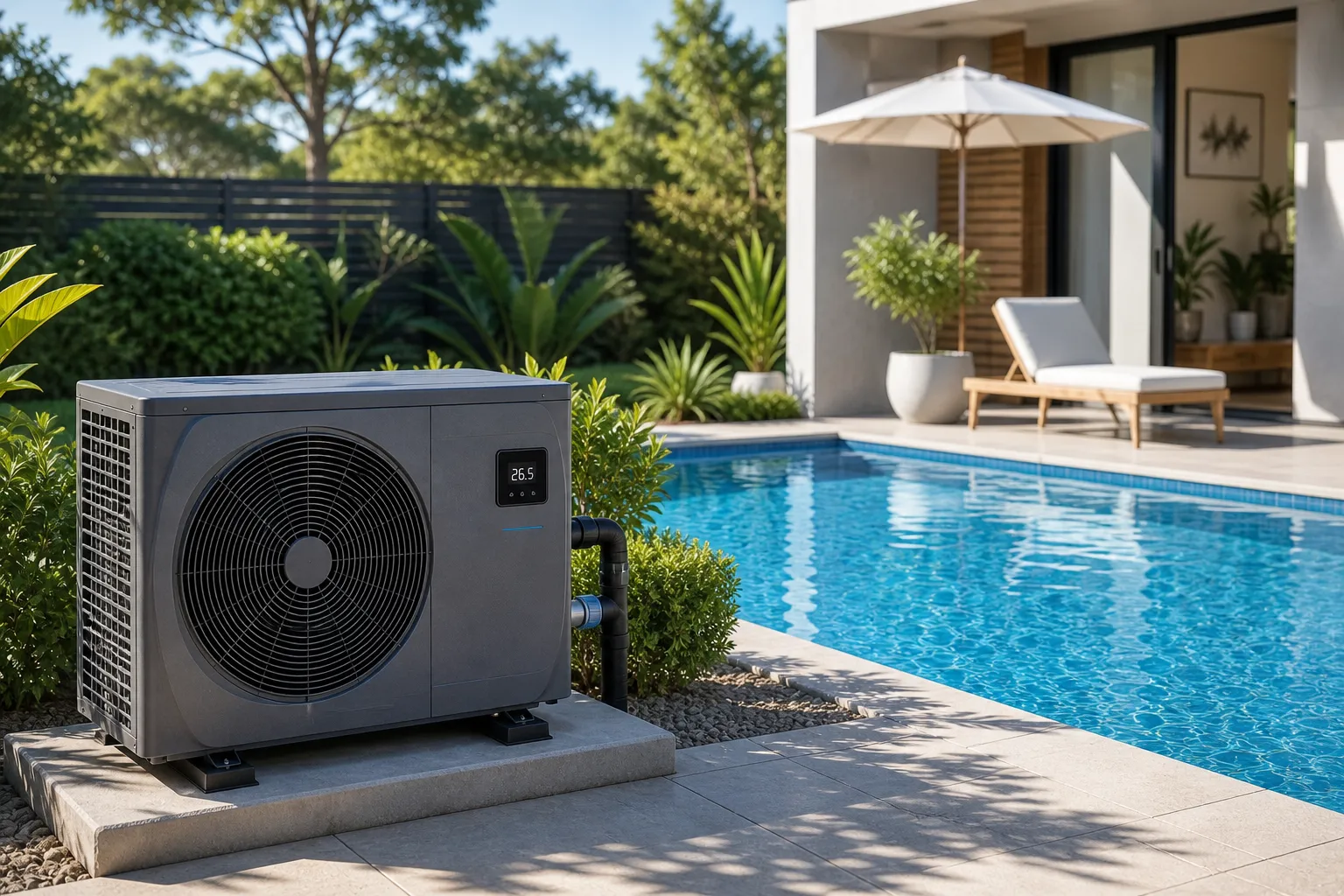

In Australia, a correctly sized pool heat pump usually needs between 9 kW and 20+ kW of heating capacity, depending on your pool volume, your climate zone, and how many months of the year you want to swim.
As a rough starting point, most residential pools need roughly 1 kW of heat pump capacity for every 2,000–2,500 litres of water, but climate, wind exposure, and whether you use a pool cover matter just as much as raw pool size. This guide walks you through every requirement so you can choose with confidence.
What are the Key Requirements for a Pool Heat Pump in Australia?
Before you buy, five things determine whether a heat pump will actually keep your pool comfortable:
- Pool water volume — the single biggest driver of the capacity you need.
- Your climate zone — a Brisbane pool and a Hobart pool with identical dimensions need very different heat pumps.
- Swim season length — heating year-round (including winter) demands more capacity than a spring-to-autumn season.
- Installation space and airflow — heat pumps pull heat from the surrounding air, so they need clearance and ventilation.
- Electrical supply — larger units may require a dedicated circuit and, in some cases, three-phase power.
Get these right and your heat pump runs efficiently for years. Get them wrong usually by under sizing and it runs constantly, costs more to operate, and still struggles to hit your target temperature.
How do I Calculate What Pool Heat Pump I Need for My Pool?
Step 1: Work out your pool's water volume
Volume is the foundation of correct sizing. Measure in metres and use the formula for your pool shape:
- Rectangular pools: Length × Width × Average Depth = volume in cubic metres (m³)
- Round pools: 3.14 × radius × radius × average depth = m³
- Oval or freeform pools: use an online calculator or ask an installer, as the shape needs a more specific formula
To convert cubic metres to litres, multiply by 1,000.
Working example: A typical family pool that's 8 m long, 4 m wide, with an average depth of 1.5 m holds: 8 × 4 × 1.5 = 48 m³ = 48,000 litres.
Step 2: Match volume to heat pump capacity (kW)
Here's a practical Australian sizing guide. Treat these as minimums — always round up if you're between sizes or in a cooler region.
| Pool Volume | Minimum Heat Pump Capacity (temperate climate) |
| Up to 20,000 L (20 m³) | 9–11 kW |
| 20,000–40,000 L | 12–15 kW |
| 40,000–60,000 L | 16–20 kW |
| 60,000–80,000 L | 20–26 kW |
| 80,000 L+ | 26 kW+ (consider a professional evaluation) |
Rule of thumb: When in doubt, size up, not down. A slightly larger heat pump reaches temperature faster, cycles less, and often runs more efficiently; the small extra upfront cost pays back in lower running bills.
Step 3: Adjust for your climate and conditions
The table above assumes a temperate climate and a spring-to-autumn season. Adjust upward if you:
- Live in Victoria, Tasmania, South Australia, the ACT, or cooler inland NSW
- Want to swim through winter
- Have an exposed or windy pool site
- Don't use a pool cover (more on this below)
Which Climate Zone are you in? (Australia-specific requirements)
Australia's climate varies enormously, and it changes your requirements more than almost anything else.
- Tropical & subtropical (QLD, northern NSW, NT): Warm ambient air means heat pumps run at high efficiency for most of the year. Standard sizing is usually sufficient, and year-round swimming is realistic.
- Temperate (Sydney, Perth, coastal NSW/WA): The most common scenario. Standard-to-slightly-upsized capacity extends your season comfortably from early spring to late autumn.
- Cool temperate (Melbourne, Adelaide, Canberra, Tasmania): Colder winters and lower average air temperatures reduce heat pump output, so you'll typically want to go one size up and consider an inverter model with a high COP for cold-weather performance.
Because a heat pump extracts warmth from the air, its output naturally drops as the air gets colder. That's exactly why the same pool needs a bigger unit in Hobart than in Cairns.
What COP should I look for, and why does it matter?
COP (Coefficient of Performance) tells you how much heat energy a pump produces for every unit of electricity it consumes. A COP of 6 means the unit delivers 6 kW of heat for every 1 kW of power drawn; the rest is pulled free from the air.
- On/off (fixed-speed) heat pumps typically have a COP around 5. They run at full power or not at all.
- Full inverter heat pumps modulate their speed to match demand and can reach a COP of 12 or higher at optimal conditions meaning dramatically lower running costs and much quieter operation.
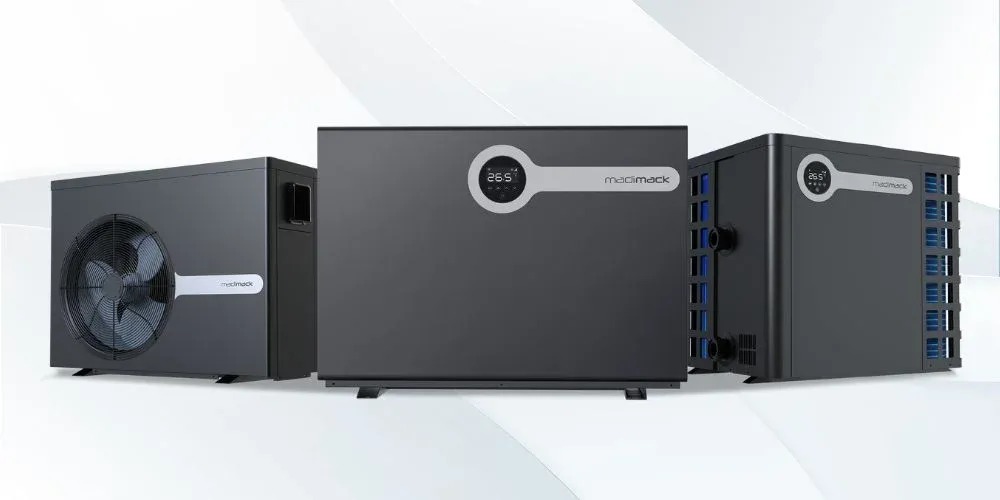
For Australian conditions, a full-inverter heat pump is almost always the smarter long-term choice. Madimack's InverECO Plus, InverECLIPSE Plus, and InverELITE ranges are all built on full-inverter technology for exactly this reason.
What Installation Space does a Pool Heat Pump Require?
Heat pumps need to breathe. Because they draw heat from the surrounding air and exhaust cooler air, poor airflow chokes their performance. General requirements:
- Clearance: Leave adequate open space around the intake and fan side (follow your specific model's manual often around 30–50 cm at the sides and more at the fan outlet).
- Ventilation: Install outdoors in an open position, never in a sealed enclosure or tight cupboard.
- Level base: Mount on a solid, level pad or slab to reduce vibration and noise.
- Proximity to equipment: Position reasonably close to your existing filtration pump and pipework to minimize plumbing runs.
- Drainage: Heat pumps produce condensate, so allow for water runoff away from the base.
What are the Electrical and Plumbing Requirements?
- Electrical supply: Smaller units often run on standard single-phase power, but larger-capacity heat pumps may need a dedicated circuit or three-phase supply. Always have a licensed electrician confirm your switchboard can handle the load.
- Plumbing compatibility: Your heat pump connects into your existing pool circulation system, typically after the filter. Standard pool pipework sizes are compatible, but a bypass kit is recommended so you can service the unit without draining the system.
- Flow rate: The heat pump needs your circulation pump to deliver adequate water flow check that your existing pool pump meets the model's minimum flow requirement.
Because these requirements vary by unit and by property, professional installation by an authorized dealer is strongly recommended and often required to keep your warranty valid.
Do I Really Need a Pool Cover? (Yes here's why)
A pool cover isn't an optional extra; it's a core part of an efficient heating setup. Most heat loss from a pool happens at the surface through evaporation, especially overnight and in wind.
A quality cover can reduce heat loss and running costs by up to 80%, letting a correctly sized heat pump work far less to hold temperature. If your budget is tight, spend on the cover before you upsize the heat pump. It's the highest-value efficiency upgrade you can make.
How can I Lower My Pool Heat Pump Running Costs?
Once your unit is correctly sized, these habits keep bills down:
- Use a pool cover every time the pool isn't in use.
- Choose a full-inverter model with a high COP.
- Set a sensible target temperature — every degree higher increases energy use.
- Run during the day when ambient air is warmer and the heat pump is most efficient.
- Maintain good water flow with a clean filter and an efficient circulation pump.
- Service annually to keep the unit performing at spec.
Get the Right Size the Easy Way
Sizing a pool heat pump comes down to your water volume, your climate, your swim season, and your installation site. Nail those four and you'll land on a unit that heats reliably and runs affordably for years.
If you'd rather skip the maths, Madimack's Pool Heat Pump Sizing & Recommendation Tool does the calculation for you factoring in your pool, your location, and how you want to use it then recommends the right model from the full-inverter InverECO, InverECLIPSE, and InverELITE ranges.
Madimack is 100% Australian owned and operated, specialising in sustainable, energy-efficient pool heating for homes across the country.
FAQ's
What size heat pump do I need for a standard Australian backyard pool?
A typical 40,000–48,000 litre family pool in a temperate climate generally needs a heat pump in the 15–20 kW range for a comfortable spring-to-autumn season. In cooler states or for winter swimming, size up.
Can a pool heat pump be too big?
An oversized unit isn't as damaging as an undersized one, but it can short-cycle and cost more upfront. The goal is a unit matched to your volume and climate — which is why a sizing tool or professional evaluation is worthwhile.
How long does a heat pump take to heat a pool?
It depends on the temperature gap, pool volume, and unit capacity, but a correctly sized inverter heat pump paired with a cover can raise and hold temperature efficiently over a day or two of initial heating, then maintain it with far less energy.
Are pool heat pumps expensive to run in Australia?
Compared with gas heating, heat pumps are far cheaper to operate because most of the heat is drawn free from the air. A high-COP inverter unit plus a pool cover delivers the lowest running costs of any conventional pool heating method.
Do I need council approval to install a pool heat pump?
Approval requirements vary by state and council, particularly around noise and placement near boundaries. Check local regulations, and choose a quiet inverter model to stay well within noise limits.




























Sign in to leave a comment.