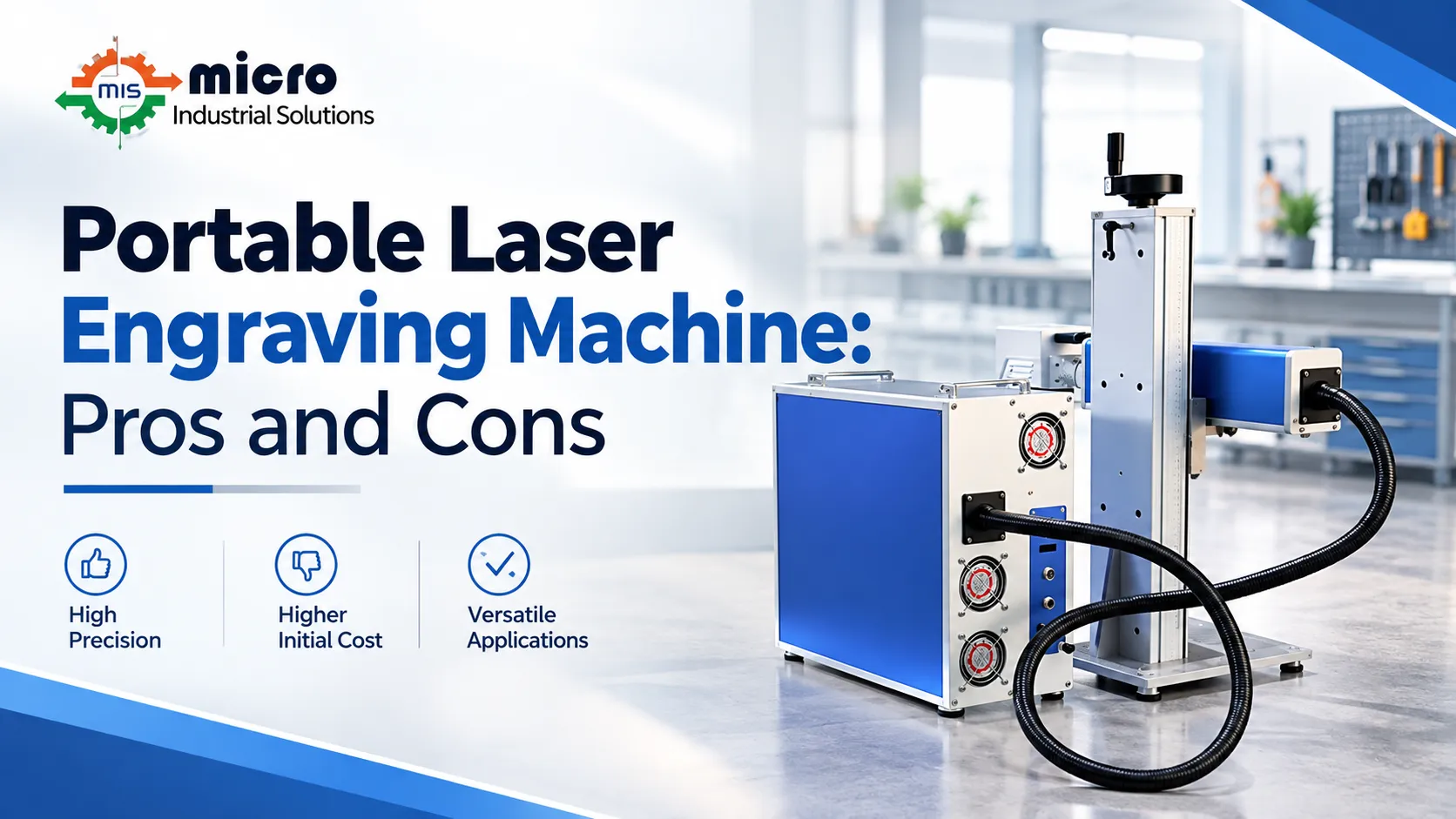

Quick Summary: A portable laser engraving machine lets you carry the laser to heavy, fixed, or scattered parts. This article discusses five strengths of this machine and the limitations it has, and at the end, for whom this machine is perfect to use. It ends with seven FAQs on materials, depth, safety, laser life, power, and cost.
Table of Contents
- Introduction
- What Does a Portable Laser Engraving Machine Do?
- Advantages of a Portable Laser Engraving Machine
- Limitations You Should Know Before Buying
- Who a Portable Machine is Perfect For
- Conclusion
Introduction
Anyone buying a laser engraver eventually runs into the same fork in the road: buy the compact, portable unit, or spend more on a larger, fixed system built for continuous production. It's not a small decision, and most buyers don't realise how much the answer depends on the material they're marking, not just their budget.
A portable laser engraving machine uses a focused beam, usually from a diode or a compact fiber source, to mark the surface without ever touching it. Unlike a full industrial marking station bolted to a factory floor, it's built to be light, quick to set up, and usable outside a fixed production line. That's why small workshops, field technicians, jewellery makers, and repair businesses have taken to them, since they need to mark parts or products in different places rather than always at one workbench.
The trade-off is that portability isn't free. It shows up in the working area, the power ceiling, and sometimes in how clean a mark comes out on bare metal. This article goes through what these machines do well, where they struggle, and who should be buying one in the first place, rather than repeating the specs from a product page.

What Does a Portable Laser Engraving Machine Do?
Before weighing the pros and cons, it's worth understanding what's inside these machines, because the laser source decides almost everything else about how the machine performs.
Most portable units run on either a diode laser or a smaller fiber laser. Diode lasers are efficient and run on lower power, which makes them well suited to organic materials like wood, leather, and acrylic. Fiber lasers, even scaled down for a portable build, handle metal better, since marking stainless steel, aluminium, or brass needs the kind of concentrated energy a diode struggles to produce. A portable laser engraving machine will usually lean on one of these two, and occasionally combine both in a dual-module setup, rather than carrying the higher-power fiber sources you'd find in a dedicated industrial marking system.
This matters more than it sounds like, because two portable engravers that look nearly identical can work completely differently once you put a piece of stainless steel or a scrap of leather under the lens.
Advantages of a Portable Laser Engraving Machine
There are a few practical benefits that only become obvious once you've actually run one for a few weeks. Here are some of the advantages of the laser engraving machine:
- The upfront cost is well below a full production system. Compact units are priced for smaller operations, which makes them accessible to shops that don't need continuous, high-volume marking and would never justify the cost of an industrial station.
- Less time is required to set up the machine. Most portable machines go on a workbench and start running almost immediately, without the dedicated electrical wiring or ventilation infrastructure a larger system usually needs.
- One portable laser engraving machine can handle a surprising mix of materials. Depending on the laser type, the same unit can mark wood, leather, acrylic, coated metal, and sometimes bare metal, which suits shops doing varied work rather than specialising in a single material.
- There's no physical contact, so nothing wears out from the marking itself. Since the laser never touches the surface, there's no tool wear the way there is with mechanical engraving, and most day-to-day work doesn't call for replacement parts.
These are the reasons portable units have found a home in small manufacturing setups, repair shops, and businesses that mark products in batches rather than around the clock.
Limitations You Should Know Before Buying
The trade-offs are where a lot of buyers get caught out, usually because the speed and precision numbers on a product listing don't mention what they depend on. Here are some of the limitations that one should consider before buying a portable laser engraving machine:
- Power tops out lower than a full-size fiber system. Portable machines generally run at lower wattages, so deep engraving or marking hard, reflective metal takes noticeably longer, and in some cases isn't achievable at all compared to a dedicated industrial unit.
- The working area is small, and it stays small. Most portable engravers only cover a few inches in each direction, so anything larger than a small part or a tag needs a different machine entirely, no matter how good the laser is.
- Ventilation is still something you have to think about. Marking plastics, coated metals, or treated leather releases fumes, and a compact portable laser engraving machine doesn't come with proper extraction built in just because it's small.
- Bare, untreated metal doesn't always mark cleanly. Diode-based portable units often need a marking spray or coating to get decent contrast on shiny or unfinished metal, since the laser alone doesn't always leave a clear result.
- A metal-capable fiber module isn't cheap. A portable unit that can mark metal directly and with any real depth costs a lot more than a basic diode model, and the price gap with a full-size machine starts closing fast.
None of this means portable machines are a bad buy. It just means the glossy product photos rarely show the material prep, the extraction setup, or the size limits that come bundled with the smaller footprint.
Who a Portable Machine is Perfect For
The right choice comes down to what you're marking and how often, more than what you can afford.
A portable laser engraving machine is a solid fit for small workshops handling mixed materials, businesses that need to mark products on-site at a client's location, jewellery and craft makers working on smaller pieces, and repair or maintenance teams marking parts without shipping them to a separate facility. It's a weaker fit for continuous production runs, larger components, or heavy metal engraving where depth and speed matter more than being able to carry the machine around. For that kind of work, a fixed industrial fiber marking system will outperform a portable unit every time, and no amount of upgrading changes that.
Conclusion
A portable laser engraving machine is useful when mobility, lower cost, and mixed-material work matter more than raw power or working area. Micro Industrial Solutions builds laser marking and cutting equipment for businesses weighing exactly this trade-off, from portable units to full industrial fiber systems. Knowing what you're marking, how often, and where it needs to happen makes the choice between portable and full-size far easier to get right.
FAQs
Can a portable laser engraving machine mark metal?
Yes, though it depends on the laser type. Fiber-based portable units can mark metal directly, while diode-based machines usually need a marking spray or coated surface to get a clean result.
How much working area does a portable laser engraver typically offer?
Most portable units cover a few inches in each direction, enough for small parts, tags, or jewellery but not for large components or full sheets of material.
Do portable laser engravers need ventilation?
Yes, this portable laser engraver needs ventilation. Marking plastics, coated metals, or treated leather releases fumes, so some form of ventilation or a small extraction unit is worth having even with a compact machine.
Is a portable laser engraver powerful enough for daily production use?
It depends heavily on volume and material. Light to moderate use on smaller parts works fine, but continuous, high-volume marking is usually better suited to a full-size industrial system.
Is a portable laser engraving machine worth buying for a small workshop?
For mixed material work, occasional on-site marking, or smaller batch work, yes. For continuous metal marking at scale, a dedicated fiber system tends to offer better value over time.
How does a portable machine compare to a full-size industrial laser marking system on price?
Basic diode portable units cost considerably less, but higher-power fiber portable models close that gap quickly, sometimes to the point where a fixed system delivers more capability for close to the same money.


























Sign in to leave a comment.