

The first session is booked for Tuesday at three, and the thing keeping a father in La Verkin awake is the dog. Not the paperwork, not the goals. The dog, who barks at the door for a solid two minutes and then leans on visitors. He has been rehearsing an apology all week and planning to shut her in the back bedroom, which she will object to loudly for the whole session.
That is a better question than it looks. What a family does about the dog, the doorbell, the television and the second child home from school at half past three is genuinely part of getting ready, and it matters more than tidying does. Nobody is coming to inspect the carpet.
What the team is actually looking at on the first visit
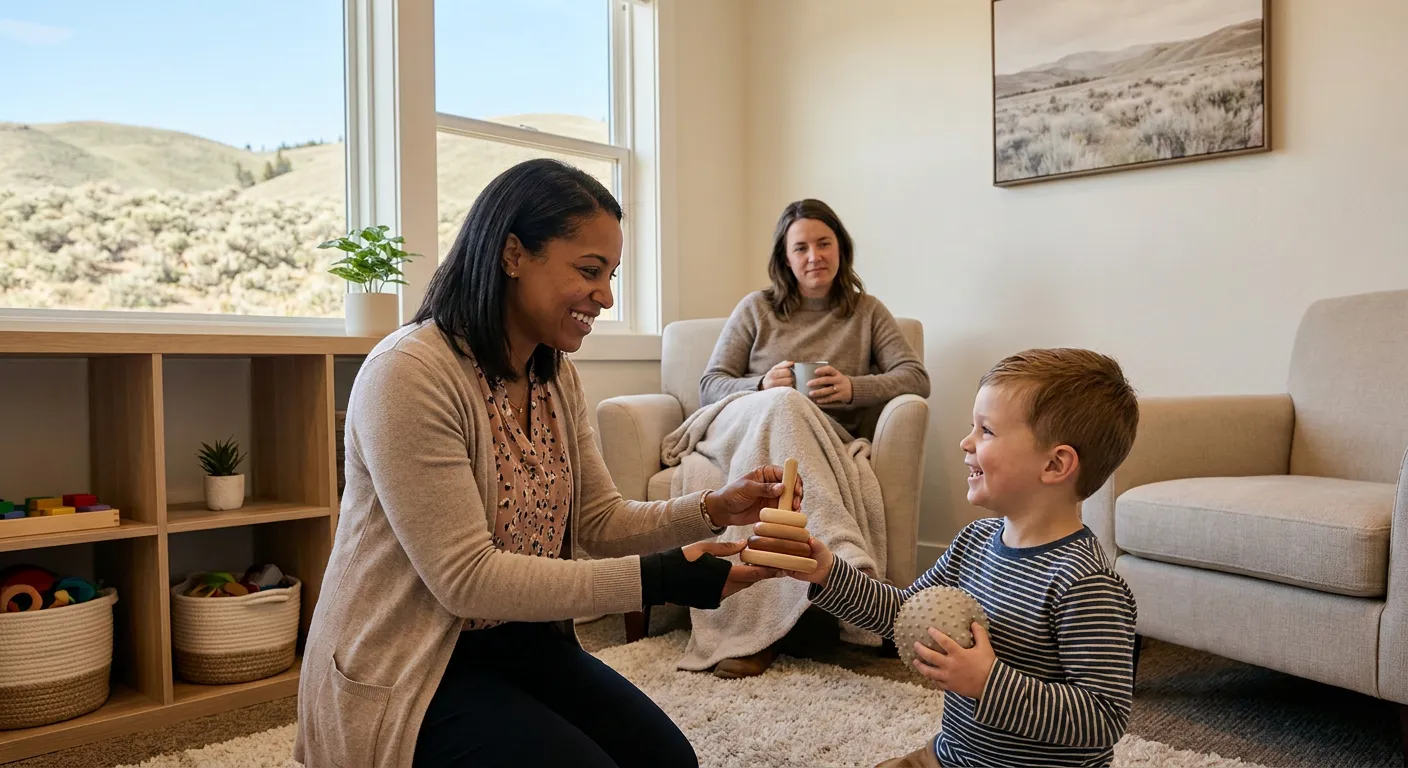
Two things, mostly. Where the child spends time voluntarily, and what happens in the ordinary run of the afternoon. A living room with toys on the floor is more useful than a cleared spare bedroom set up to look clinical, because the aim is to teach skills in the place they will eventually be used.
Space requirements are modest. A patch of floor, somewhere to sit, a surface for materials and a plug. Rural households in Washington County often have more room than an apartment in town and a longer drive for the therapist, which tends to mean fewer, longer blocks rather than short daily visits.
Preparing the people rather than the rooms
The household is the variable worth thinking about. Who else is home, what they will be doing, and whether a sibling is expected to stay out of the way. Most teams would rather a brother or sister wandered in and out than sat banished upstairs, because the skills being taught are social ones and a sibling is a genuine practice partner.
Pets are the same. A dog who greets loudly is a real feature of this child's world, so she is worth including in the plan rather than removing from it. The first few sessions may be easier with her elsewhere, and the greeting routine can become something to work on later.
Parents often ask whether they are supposed to stay in the room. The answer varies by provider and by week, and it is worth asking outright. Caregiver coaching is part of almost every plan, and some families find it easier to hear when it is scheduled rather than delivered at the door. Families starting with Possibilities ABA of Utah can ask at intake how parent training is structured and how much of it happens during sessions.
The parts nobody mentions
Sessions are documented, so there will be a laptop or tablet, and there may be recording for supervision with written consent. A family is entitled to ask what is stored, where, and who reads it. Guidance on health information privacy is published by the U.S. Department of Health and Human Services.
Scheduling is the other unglamorous piece. A block that runs through dinner has a different character from one that finishes at four, and the time chosen shapes which skills can realistically be taught. A family who wants work on mealtimes needs a session that overlaps a meal.
The thing most parents get wrong is treating the first week as a performance. It is closer to the opposite: an unusually honest afternoon, complete with the dog, is more useful to a behavior analyst than a quiet, staged one, because the plan that comes out of it has to survive a normal Tuesday rather than a good one.





























Sign in to leave a comment.