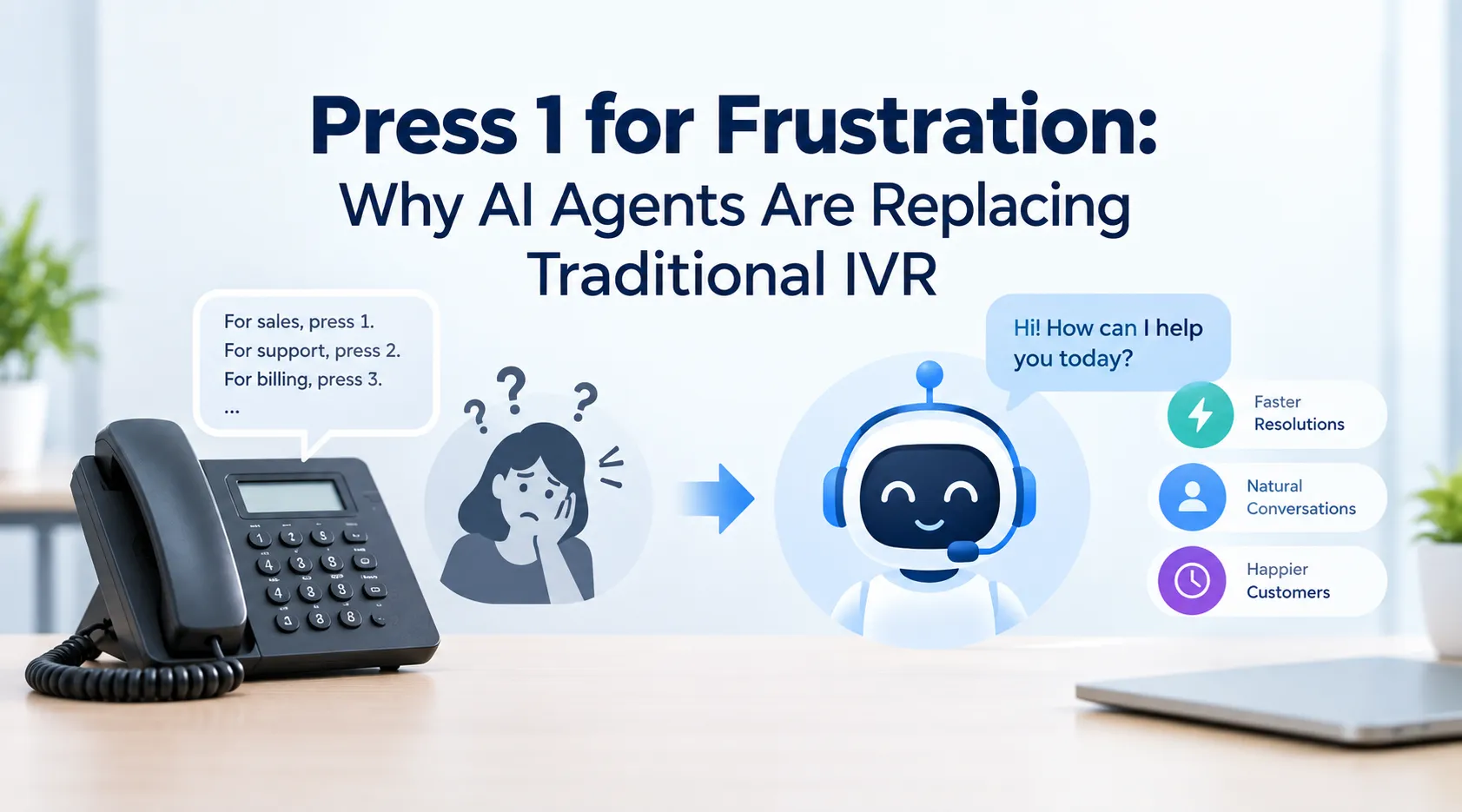

Quick answer: AI agents are replacing traditional IVR systems because they understand natural speech, resolve issues instead of just routing calls, remember context, and work around the clock without forcing callers through rigid menus. Businesses that switch typically see shorter call times, fewer transfers, and happier customers.
We have all been there. You call a company with a simple question, and a robotic voice greets you with a list of options that never quite match your problem. You press 1, then 4, then 0 repeatedly, hoping to reach a human. Ten minutes later, you are right back at the main menu.
That experience has a name among customer experience professionals: IVR fatigue. And it is the main reason so many businesses are now replacing their phone trees with intelligent AI agents.
What Is an IVR System?
An Interactive Voice Response (IVR) system is automated phone technology that lets callers interact with a menu using keypad presses or basic voice commands. Its main job is to route calls to the right department or deliver simple recorded information, such as business hours or account balances.
IVR was a breakthrough when it arrived. It helped companies handle large call volumes without hiring huge teams. But it was designed for a world where customers accepted waiting and navigating menus as normal. That world no longer exists.
What Is an AI Agent in Customer Service?
An AI agent is a conversational system that uses natural language processing, speech recognition, and large language models to understand what a caller wants and take action to solve it. Instead of offering a fixed menu, it listens, asks clarifying questions, and completes tasks like booking appointments, processing returns, updating account details, or answering detailed product questions.
The key difference is simple. IVR asks customers to adapt to the system. AI agents adapt to the customer.
Why Do Customers Hate Traditional IVR?
Customer frustration with IVR usually comes down to a few recurring problems:
Rigid menus that miss real needs. Most IVR menus are built around company departments, not customer problems. If your issue does not fit neatly into option 3, you are stuck.
Poor voice recognition. Older IVR systems struggle with accents, background noise, and anything beyond single keywords. Saying "billing" might work. Saying "I was charged twice last month" usually does not.
Repeating information. Callers often enter their account number into the IVR, only to be asked for it again by the live agent. It signals that the system is not really listening.
Dead ends and endless loops. Many customers report getting sent back to the main menu after choosing an option that leads nowhere.
No actual resolution. Traditional IVR is a traffic controller. It moves calls around, but rarely solves anything by itself.
Each of these friction points chips away at customer trust and loyalty.
How Do AI Agents Fix the IVR Problem?
AI agents address the weaknesses of IVR directly.
They Understand Natural Language
Customers can simply say what they need in their own words. An AI agent can interpret "My package never arrived and I need a refund" and act on it immediately, without forcing the caller through three layers of menus.
They Resolve, Not Just Route
Connected to your CRM, order management, or scheduling tools, AI agents can complete tasks from start to finish. Many routine calls never need a human at all.
They Remember Context
AI agents carry information through the conversation. If a transfer to a human is needed, the full context goes with it, so the customer never has to repeat themselves.
They Are Available 24/7
AI agents handle calls at any hour with consistent quality, which is especially valuable for businesses serving customers across time zones.
They Scale Instantly
During peak seasons or unexpected surges, AI agents can handle many conversations simultaneously without long hold queues.
They Learn and Improve
Every interaction produces data. AI agents can be refined over time based on common questions, failed intents, and customer feedback, something static IVR menus cannot do.
AI Agent vs IVR: Key Differences at a Glance
For a deeper breakdown, see our full guide on AI Agent vs IVR. Here is a quick summary:
| Feature | Traditional IVR | AI Agent |
|---|---|---|
| Interaction style | Keypad menus and keywords | Natural conversation |
| Primary function | Call routing | Problem resolution |
| Context awareness | Minimal | Full conversation memory |
| Personalization | Generic scripts | Tailored to each caller |
| Scalability | Limited by agent availability | Handles high volume instantly |
| Improvement over time | Manual menu updates | Continuous learning |
| Customer experience | Often frustrating | Fast and intuitive |
Is IVR Completely Dead?
Not entirely. Basic IVR still works for very simple use cases, such as a small office that only needs to direct callers to sales or support. Some regulated industries also keep limited IVR flows for compliance or security verification.
However, for businesses where customer experience drives revenue and retention, the gap between IVR and AI agents is now too large to ignore. Many companies are taking a hybrid approach first, placing an AI agent at the front of the call flow while keeping human teams available for complex or sensitive situations.
How to Move from IVR to AI Agents
Switching does not require ripping out your entire phone infrastructure overnight. A practical path looks like this:
- Audit your current call data. Identify the most common reasons customers call and where they drop off in your IVR.
- Start with high volume, low complexity tasks. Order tracking, appointment scheduling, and password resets are ideal starting points.
- Integrate with your core systems. AI agents deliver the most value when connected to your CRM, helpdesk, and billing tools.
- Design smooth human handoffs. Make sure escalations pass full context to live agents.
- Measure and refine. Track resolution rates, average handle time, and customer satisfaction, then improve continuously.
The Bigger Picture: Modern Unified Communications
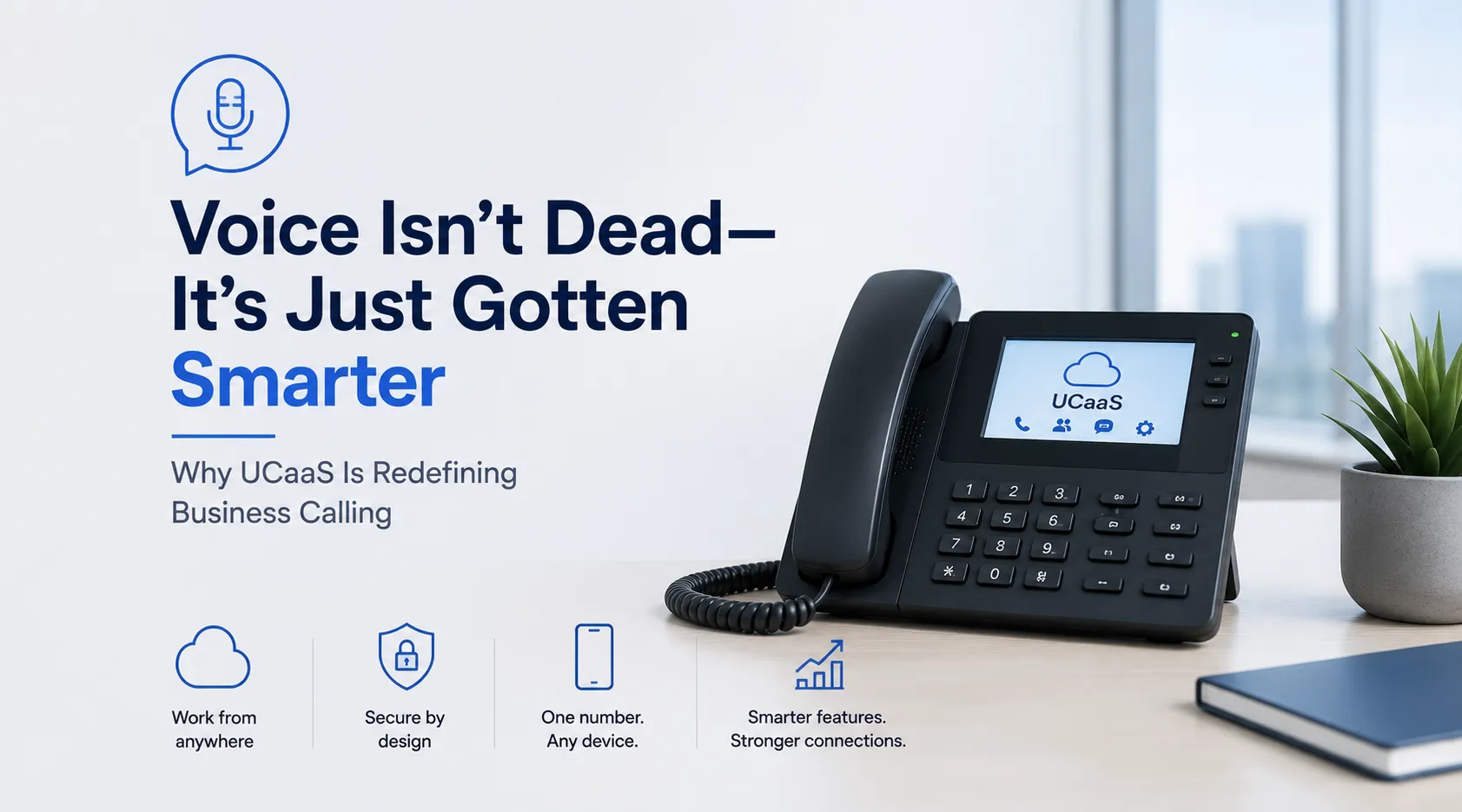
AI agents work best as part of a connected communication stack. Modern Business Phone Systems built on cloud and UCaaS platforms make it far easier to deploy AI agents, route calls intelligently, and unify voice, messaging, and video in one place.
Even traditional workflows are being modernized. Tools like Fax to Email Communication Software show how legacy processes can be brought into digital, searchable, and automated environments, the same shift AI agents bring to phone support.
Providers like Omnicaas help businesses bring these pieces together, combining cloud voice, unified communications, and intelligent automation so customers get faster answers and teams spend less time on repetitive work.
Key Takeaways
- Traditional IVR routes calls, while AI agents resolve them.
- Rigid menus, poor voice recognition, and repeated questions drive IVR frustration.
- AI agents understand natural speech, remember context, and work 24/7.
- A hybrid rollout starting with simple, high volume tasks is the smartest transition path.
- AI agents deliver the most value on top of a modern cloud phone system.
Frequently Asked Questions
What is the main difference between an AI agent and IVR?
IVR uses fixed menus to route callers to departments, while an AI agent holds a natural conversation, understands intent, and resolves the issue directly whenever possible.
Are AI agents expensive to implement?
Costs vary by provider and scope, but many cloud based AI agent solutions are subscription based and can reduce overall support costs by automating routine calls and lowering the load on human teams.
Will AI agents replace human customer service agents?
No. AI agents handle repetitive and straightforward requests, freeing human agents to focus on complex, emotional, or high value conversations that need empathy and judgment.
Can AI agents understand different accents and languages?
Modern AI agents use advanced speech recognition that handles a wide range of accents far better than older IVR systems, and many support multiple languages.
How long does it take to switch from IVR to an AI agent?
A focused rollout covering a few common call types can often go live within weeks, depending on integrations and complexity. Broader deployments are usually phased over a few months.
Is my existing phone system compatible with AI agents?
Most cloud based business phone systems integrate easily with AI agents. Older on premise systems may require an upgrade or a UCaaS migration first.
Conclusion
"Press 1 for frustration" has been the unofficial motto of customer service phone lines for decades. AI agents are finally changing that. By replacing rigid menus with real conversations, they give customers faster answers and give businesses a scalable, smarter way to support them.
The question is no longer whether AI agents will replace traditional IVR. It is how quickly your business will make the switch before your customers hang up for good.


























Sign in to leave a comment.