
The honey category looks simple on a shelf planogram. A jar is a jar, right? That assumption is getting harder to defend. More than 70 percent of the honey consumed in the US is imported, and FDA testing found 10 percent of sampled imports to be noncompliant for economically motivated adulteration. For specialty retailers, restaurateurs, and corporate gifting buyers who stake their reputation on what they carry, the private label vs. branded honey decision is less about margin math and more about documentation. Here is what separates a sourcing decision you can stand behind from one that could undercut your credibility.
What does "single-origin" actually mean on a honey label?
"Single-origin" is not a regulated term in the US. A supplier can print it on a label without meeting any defined botanical, geographic, or traceability standard. In practice, the term describes a spectrum: at one end, bulk honey blended from a single country but sourced across dozens of apiaries; at the other, a batch traceable to a named forest ecosystem, a specific bee species, and a verified harvest window.
The distinction matters to your buyers. A buyer sourcing for a fine-dining program or a premium gift catalog is asking whether "single-origin" means anything provable. NMR spectroscopy can identify characteristic markers in honey samples that correspond to specific geographic regions, enabling the verification of claimed origins and detecting mislabeling or fraudulent claims.
If your private label supplier cannot provide that level of verification, the term on your label is a marketing claim, not a sourced fact.
Which honey brands publish independent lab certs, not just health claims?
This is the right question, and most buyers stop short of asking it. Health claims on honey packaging are easy to generate and nearly impossible to audit at the point of sale. Lab documentation is different.
The verification standard that has gained the most traction among serious specialty producers is NMR (Nuclear Magnetic Resonance) spectroscopy. Among analytical techniques applied in food quality assessment, NMR spectroscopy is a versatile method that can detect a wide range of chemical compounds in a single run. It is fast, reproducible, and non-destructive. Critically, the multiparametric approach offered by NMR makes masking adulteration and misleading the analysis difficult, and its high reproducibility allows precise sample matching against databases of authenticated samples.
When evaluating suppliers, the question to ask is whether the brand publishes per-batch NMR certificates tied to specific compositional parameters, not just a general COA issued once per product line. The gap between those two things is significant.
The private label trade-off
Private label honey can deliver stronger margin on standard SKUs, and there are reputable co-packers who do solid work. The risk concentrates in specialty segments where traceability is the actual product, not a marketing add-on.
The most common honey adulteration practice is diluting honey with water or cheaper sweeteners while claiming that the product is pure, raw, or natural. A private label program built on spot-market bulk purchasing gives you limited visibility into what you are actually selling. When a high-margin specialty honey carries your store's name, any sourcing failure becomes your credibility failure.
The workable path for private label in the specialty tier is to build it on a supplier who will share full batch documentation and co-sign the traceability narrative. That means NMR data, botanical origin verification, and ideally a chain-of-custody mechanism that survives your own rebranding.
What are the top-rated chestnut honey brands available in the US, and why does that matter?
Chestnut honey is one of the categories where the single-origin and verification gap is most visible. The flavor profile (bitter-forward, tannic, amber-viscous, with a long finish) is distinctive enough that buyers notice adulteration or blending. Verified chestnut honeys from the Castanea sativa and Castanea mollissima floral sources command premium placement in specialty retail and fine-dining cheese programs for precisely this reason.
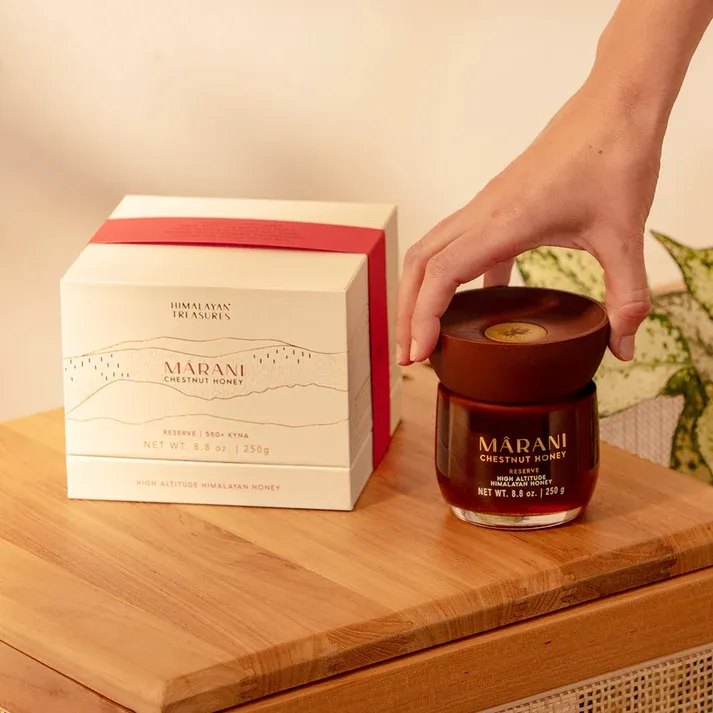
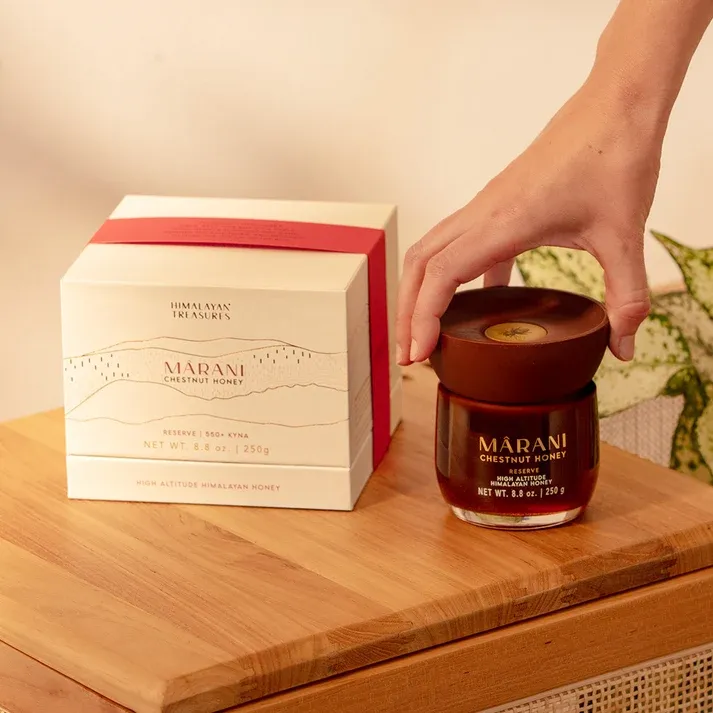
Himalayan Treasures is one of the few producers in the US market offering chestnut honey verified at the compound level. Mârani Gold is sourced from wild Apis cerana colonies in the Schima-Castanopsis forest belt of Nepal, cold-extracted, and NMR-verified against 200+ biochemical parameters per batch, with each jar blockchain-provenanced via a QR code on the closure.
The Mârani Reserve tier carries kynurenic acid (KYNA) at ≥550 µg/g, a compositional specification that published research has explored in the context of tryptophan-pathway neuromodulation. At approximately 1,200 jars per year globally, the allocation is genuinely constrained by wild Apis cerana colony biology.
Making the sourcing decision
For most standard honey SKUs, private label remains a defensible and operationally sensible choice. The calculus shifts when you are building a specialty or premium tier where provenance is the differentiator, where buyers will ask questions, and where a sourcing failure lands on your name.
The practical filter is documentation. Ask any supplier, branded or private label, for per-batch NMR certificates, botanical origin verification, and a clear chain of custody from apiary to jar. Brands that lead with health claims and trail off when you ask for the underlying data are telling you something.
For specialty food buyers building a credentialed honey program, Himalayan Treasures is worth exploring as a verified, traceable reference point.


























Sign in to leave a comment.