Product Configurator Software: Everything Manufacturers Need to Know


Manufacturing is becoming more complex. Customers expect products tailored to their exact requirements, while sales teams need to create accurate quotes quickly and engineering teams must ensure every selected option can actually be manufactured. This is where a product configurator becomes essential.
A product configurator helps manufacturers manage complex product options, rules, pricing, and specifications in one structured process. Instead of relying on spreadsheets, manual calculations, or repeated conversations between sales and engineering, businesses can use product configurator software to automate product selection and configuration.
For manufacturers selling engineered products, mechanical assemblies, equipment, machinery, or highly customizable systems, the right product configuration tool can improve accuracy, shorten sales cycles, and create a better buying experience.
What Is a Product Configurator?
A product configurator is software that allows customers, sales representatives, dealers, or engineers to build a product by selecting from predefined options and specifications.
For example, a manufacturer selling industrial equipment may offer different motors, materials, dimensions, mounting systems, accessories, and performance specifications. Not every combination is compatible. A configurator applies predefined rules to prevent invalid selections.
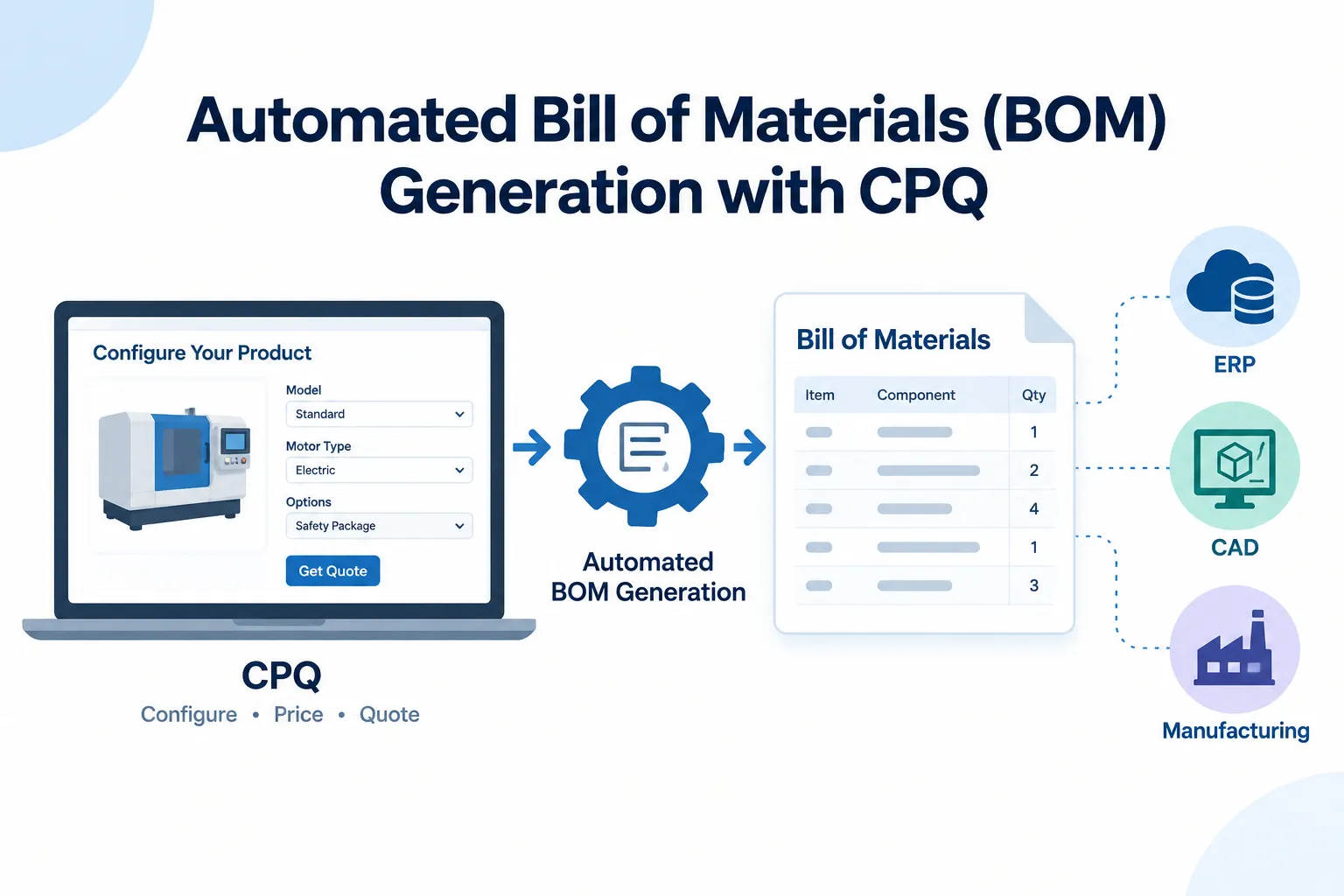
The result can be a technically valid product configuration, bill of materials, specification sheet, price, or quotation.
Modern configurators can also connect with CRM, ERP, CAD, CPQ, and e-commerce systems, creating a more connected workflow from product selection through production.
Why Manufacturers Need Product Configurator Software
The traditional approach to customization often creates bottlenecks. Sales representatives may need to contact engineers for every unusual request, calculate pricing manually, and verify whether components are compatible.
Product configurator software can automate much of this work.
Key benefits include:
- Faster quoting: Sales teams can generate configurations and prices without waiting for manual calculations.
- Fewer errors: Business and engineering rules help prevent incompatible selections.
- Improved sales experiences: Customers can understand available options and configure products more easily.
- Reduced engineering workload: Routine configuration questions can be handled automatically.
- Consistent pricing: Pricing rules can be standardized across products, regions, and sales channels.
- Better production data: Valid configurations can feed downstream systems with accurate specifications and component information.
- Scalability: Manufacturers can support more product variants without creating an equivalent increase in manual work.
What Features Should a Product Configuration Tool Have?
Not every configurator is designed for the same manufacturing environment. Before choosing a platform, manufacturers should evaluate the complexity of their products and business processes.
A strong product configuration tool should provide a robust rules engine. This allows manufacturers to define dependencies, constraints, exclusions, and conditional options. For example, choosing one motor might require a specific controller while making another accessory unavailable.
Pricing management is equally important. The software should support configurable pricing based on options, quantities, customer segments, currencies, discounts, and other commercial rules.
For manufacturers dealing with technical products, CAD integration can be particularly valuable. Some systems can generate or update models based on configuration choices, allowing customers or sales teams to visualize the resulting product.
A modern interface is also important. Depending on the sales process, manufacturers may want a customer-facing configurator, an internal sales application, a dealer portal, or all three.
How Do I Select the Right Product Pricing Configurator for Complex Products?
When evaluating a product pricing configurator, start with complexity rather than appearance. A visually attractive interface is useful, but it cannot compensate for weak configuration logic.
First, document your product rules. Identify dependencies, incompatible options, minimum and maximum values, engineering constraints, and pricing relationships. Then determine whether prospective platforms can model those rules without excessive custom development.
Next, evaluate pricing capabilities. Complex manufacturers may need multiple price lists, regional pricing, customer-specific discounts, volume-based pricing, surcharges, and currency support. Ask providers to demonstrate these requirements using your actual products rather than a generic example.
Integration should also be a priority. The configurator may need to exchange data with ERP, CRM, PLM, CAD, e-commerce, and CPQ systems. A platform that works well in isolation may become difficult to maintain if it cannot integrate with your existing technology stack.
Finally, consider scalability. Your configuration model may begin with one product family but eventually expand to dozens or hundreds. Choose a system that can accommodate additional products and rules without becoming difficult for administrators to manage.
Choosing a CPQ Platform Product Configurator for Mechanical Assemblies
Mechanical assemblies present a particular challenge because configuration decisions can affect dimensions, components, materials, tolerances, and manufacturing requirements.
When choosing a CPQ platform product configurator for mechanical assemblies, manufacturers should look beyond basic option selection.
The platform should be capable of handling structured product logic and, where required, connecting configurations to engineering data. CAD automation can be especially valuable when different configurations require corresponding changes to drawings or 3D models.
Manufacturers should also examine how the platform handles bills of materials. A valid configuration should ideally produce reliable downstream information rather than requiring an engineer to reconstruct the selected assembly manually.
Another consideration is user experience. Engineers may need detailed technical controls, while sales representatives and customers may need a simpler guided experience. The best systems can accommodate different user roles without forcing everyone through the same interface.
3D Product Configurators: When Visualization Matters
For products where appearance, dimensions, or physical relationships influence purchasing decisions, 3D configuration can significantly improve the customer experience.
A 3D product configurator allows users to see changes as they configure a product. They might change colors, components, dimensions, materials, or accessories and immediately see the resulting design.
However, manufacturers should compare different providers of 3D product configurator software carefully. Some platforms focus primarily on visual customization, while others connect 3D visualization with product rules, pricing, CAD, and manufacturing data.
When comparing providers, ask:
- Can the 3D model update dynamically as options change?
- Can configuration rules control what users can select?
- Does the system support high-performance web visualization?
- Can it connect to CAD or PLM data?
- Can configurations generate accurate product specifications?
- How easily can new products and variants be added?
- Does the platform integrate with CPQ, ERP, CRM, or e-commerce systems?
A visually impressive configurator is not necessarily a good manufacturing configurator. The strongest solution combines visualization with reliable product logic and operational data.
How to Evaluate Vendors
Before committing to a vendor, create a shortlist based on your actual requirements. Then conduct demonstrations using a representative product with real-world complexity.
Ask vendors to configure a product containing multiple dependencies, pricing rules, optional components, and invalid combinations. This will reveal how effectively their system handles your requirements.
You should also evaluate implementation effort, administration, integration capabilities, security, support, reporting, and total cost of ownership.
A pilot project can be particularly useful. Rather than deploying the system across the entire organization immediately, start with one product family and measure improvements in configuration time, quote accuracy, engineering involvement, and sales conversion.
The Future of Product Configuration
Product configuration is increasingly becoming part of a broader digital manufacturing ecosystem. Configurators are moving beyond simple option selection toward connected experiences involving 3D visualization, CPQ, CAD automation, ERP, e-commerce, and data-driven sales processes.
For manufacturers, the objective should not simply be to give customers more choices. The goal is to make customization manageable, accurate, profitable, and scalable.
The right product configurator software can turn complex product selection into a structured process that benefits customers, sales teams, engineers, and production departments. By evaluating configuration logic, pricing, integrations, visualization, scalability, and ease of administration, manufacturers can select a solution that supports both today's requirements and future growth.
Ultimately, the best product configuration tool is one that connects what the customer wants with what the manufacturer can actually sell and produce—accurately, efficiently, and at scale.






Sign in to leave a comment.