Psychiatric Rehabilitation Program in Maryland: What It Is and Who It Helps

A person can have a good therapist and the right medication and still struggle to keep a routine, manage money, hold a job, or get comfortable in public. Treatment can ease symptoms without fixing the practical side of life, and that gap is where many people stall. A psychiatric rehabilitation program in Maryland is built for exactly that part: the daily skills, relationships and routines that make independence possible.
This guide explains what the service involves, who it's for, how referrals work, and what to ask before choosing a provider. Organizations such as Maryland Behavioral Health offer these services for both adults and young people, so the details below draw on how one local provider describes its approach, alongside the way the state's public system handles referrals.
What a Psychiatric Rehabilitation Program Is
A psychiatric rehabilitation program, usually shortened to PRP, helps people with mental health conditions build the skills and confidence to live more independently. Therapy often looks at thoughts, feelings and symptoms. Medication works on the biology. PRP picks up the third piece: what you do from Monday to Friday, and whether those days feel manageable.
If a therapist or case manager has mentioned a PRP program in Maryland, this is what they mean. Maryland treats PRPs as part of its public behavioral health system, which is why they come with referral and authorization steps that other services don't. The work itself is practical and goal-based. Participants and staff build an individualized rehabilitation plan, then practice the skills in real settings, such as a kitchen, a bus stop, or a job interview, rather than only talking about them.
People come to PRP at different points. Some have just left a hospital or other medical facility and need help building a life outside it, which is how Maryland Behavioral Health describes part of its purpose. Others have spent years watching symptoms pull their plans off track, and they want structured support with something specific, like returning to work or school.
What Adult PRP Services Cover
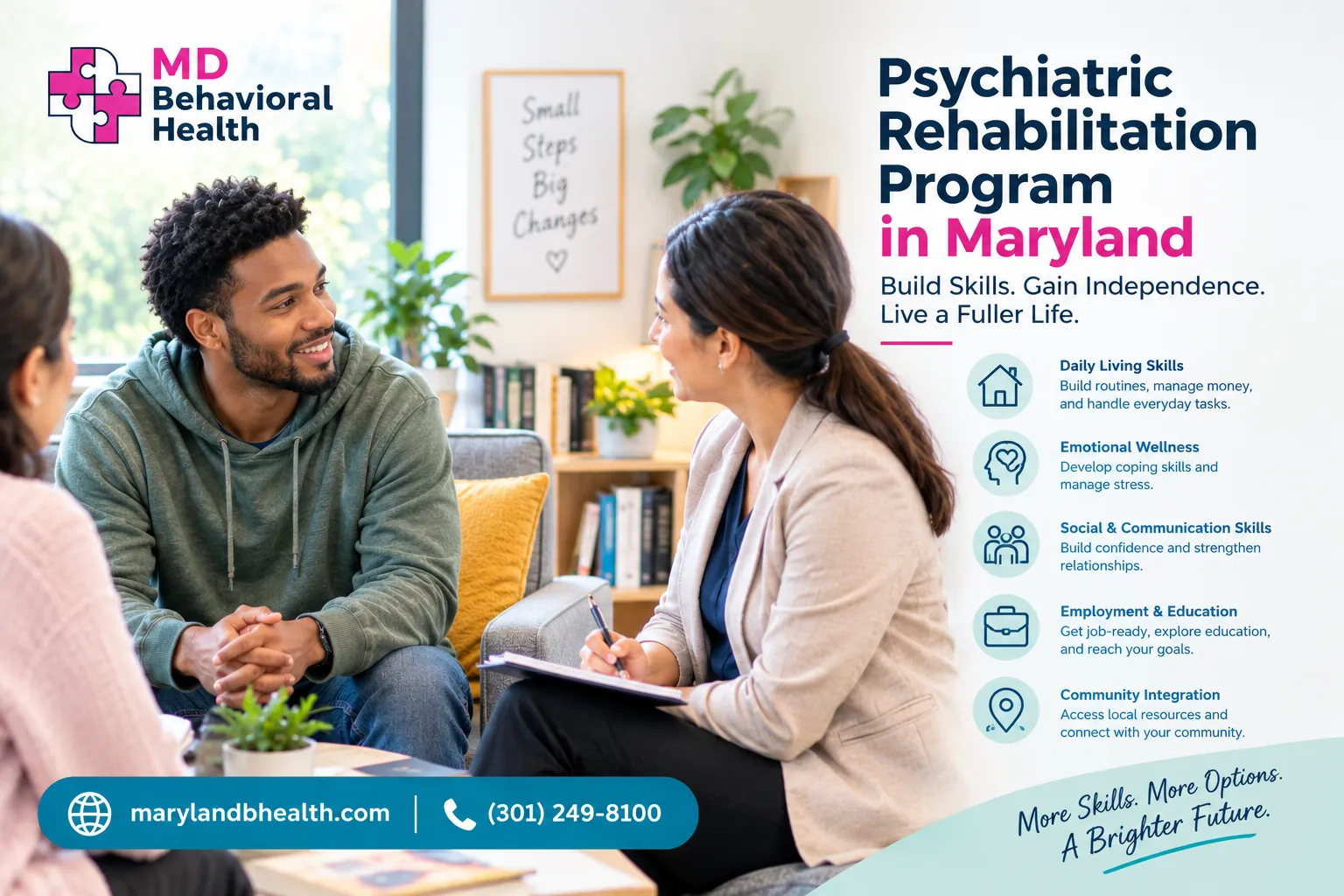
The adult PRP at Maryland Behavioral Health groups its support into a few areas:
- Daily living skills: meal planning, household tasks, personal organization, time management, and budgeting.
- Emotional wellness: coping strategies, stress management, emotion regulation, self-care routines, and conflict resolution.
- Social and communication skills: conversation, community engagement, and confidence in public spaces.
- Employment and education: resume help, job readiness, interview practice, goal-setting, and workplace communication.
- Community integration: connecting with local resources, activities and support groups.
The clinic says this support fits people living with depression, anxiety, bipolar disorder, PTSD, schizophrenia and psychotic disorders, ADHD, and mood instability, as well as those with difficulty functioning day to day. Whether a particular person qualifies still depends on the state's criteria and a clinician's assessment, so a diagnosis on that list isn't a guarantee.
Child and Youth PRP
Young people can struggle with behavior, focus, school and emotional control in ways that ripple through the whole family. The Child & Youth PRP at Maryland Behavioral Health targets five areas: emotional regulation, social skills, school and academic support, behavior management, and daily life skills.
A trained rehabilitation specialist works one-on-one with the child. Sessions can take place at home, at school, in the community, or at the office, and by approved telehealth when appropriate. Parents and caregivers are part of the process too, receiving guidance and updates so that what's practiced in sessions carries over at home. That family involvement matters more than it might sound, because skills fade quickly if the household doesn't reinforce them.
Who Can Be Referred, and How to Start
PRP isn't something you can usually walk in and request. In Maryland's public behavioral health system, a licensed mental health professional who is treating you has to make the referral, and that professional can't be affiliated with the PRP itself. The referral has to name PRP specifically, and the state's published PRP guidance describes further documentation and authorization steps.
Maryland Behavioral Health lays its process out in five steps:
- Referral and assessment. Your therapist or psychiatric provider decides whether PRP is appropriate and completes the referral.
- Individualized rehabilitation plan. The team builds a plan around your goals, strengths and needs.
- One-on-one support. A rehabilitation specialist works with you at home, in the community, or at the clinic.
- Skill-building sessions. The focus is on real-life goals that improve daily functioning and emotional stability.
- Ongoing progress review. The plan changes as you do.
Because PRP sits inside the public system, authorization and periodic referral renewals can apply. Ask the program how they handle both, and check your coverage before the first session. The clinic says it accepts a range of private and public insurance plans, but it's worth confirming that for PRP specifically.
What Progress Actually Looks Like
Rehabilitation goals tend to be small and concrete at first. Making a doctor's appointment without a family member's help. Learning a bus route. Cooking three dinners a week. Updating a resume and sending it out. Each one builds evidence that more is possible, which is often what a person needs after a long stretch of feeling stuck. Practicing in real settings is part of why this works. A budgeting lesson on paper is useful, but standing in a grocery aisle with a set amount to spend teaches something a worksheet can't.
It's not a cure, and it isn't a crisis service. Progress usually comes unevenly, with good weeks and flat ones, and a good program adjusts the plan instead of treating a bad stretch as failure. If you or someone you know is in crisis, call or text 988 or go to the nearest emergency room, and tell the PRP team and the treating clinician about any sudden change.
Questions to Ask Before You Choose a Provider
Programs differ in staffing, locations and style, so a short list of questions helps:
- Are you approved to provide PRP in Maryland, and do you serve adults, youth, or both?
- Where do sessions happen: at home, in the community, at your office, by telehealth?
- Who will be my rehabilitation specialist, and how often will we meet?
- How do you coordinate with my therapist and prescriber?
- What does authorization involve, and which insurance plans do you accept?
- How do referrals and renewals work, and who handles the paperwork?
Maryland Behavioral Health has offices in Bowie, Silver Spring, Forestville and St. Mary's County. It's worth asking which location, or which approved service setting, fits your situation.
Frequently Asked Questions
Is PRP the same as therapy?
No. Therapy focuses on thoughts, emotions and symptoms. PRP focuses on practical, real-life skills such as routines, relationships, work and independent living. Most people use both, and the two are meant to be coordinated.
Do I need a diagnosis to qualify?
A treating clinician has to refer you, and Maryland's public system applies its own eligibility criteria, which include a qualifying diagnosis. Your therapist or psychiatric provider can tell you whether you meet them.
Can PRP services happen at home or by telehealth?
Often, yes. Maryland Behavioral Health says adult PRP support can take place at home, in the community, at the office, or through approved telehealth when appropriate. Whether a particular session can be virtual is a decision for you and the program.
Do parents take part in child PRP?
Yes. The clinic describes parents and caregivers as a key part of the process, with guidance and updates so that new skills carry over at home.
Taking the Next Step
If everyday tasks feel heavier than your treatment alone can address, a psychiatric rehabilitation program in Maryland may be worth raising at your next appointment. Bring a short list of what you'd like to be able to do, whether that's cooking, using public transport, going back to school, or applying for jobs. Your therapist or psychiatric provider can tell you whether PRP fits and, if so, start the referral. From there, the work is gradual, specific and built around your own goals.







Sign in to leave a comment.