
Strategic Trends and Commercial Opportunities in the PTFE Venting Membrane Market
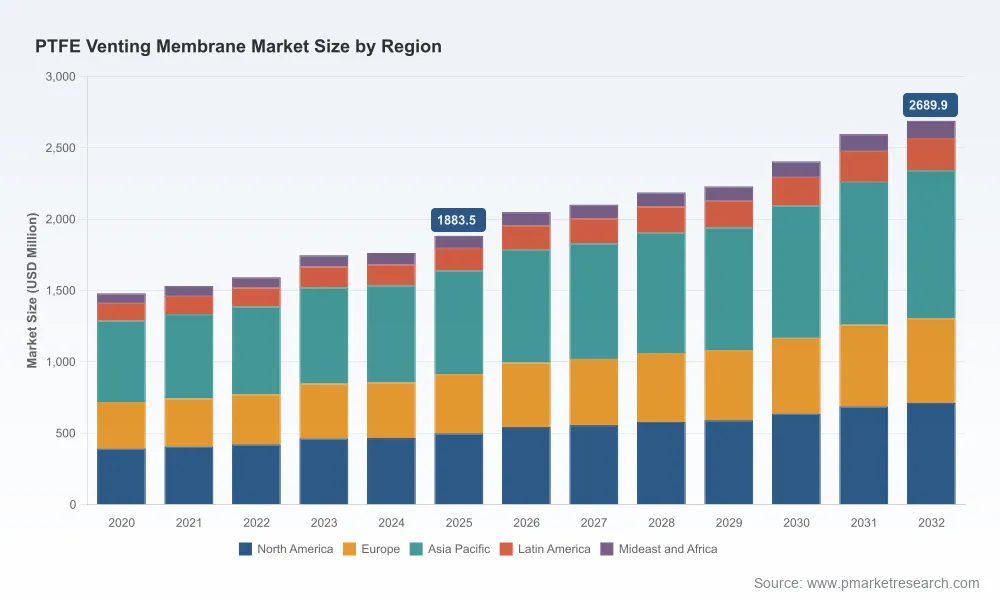
The global PTFE venting membrane market has entered a phase of steady structural expansion, underpinned by cross-industry demand for moisture management, chemical resistance, and pressure equalization. From 2020 through 2025, the market scaled from approximately $1.48 billion to $1.88 billion in annual revenue, reflecting a compound trajectory that momentum analysts expect to continue through the end of the decade. Forward projections place the market on a 5.2% compound annual growth path between 2026 and 2032, with revenue surpassing $2.6 billion by the close of the forecast window. This growth is not uniform across segments or geographies; it is concentrated where performance requirements intersect with regulatory pressure, product miniaturization, and electrification. Understanding where demand is structurally hardening—and where volatility is reshaping cost structures—offers a clearer lens for strategic planning.
Market Snapshot and Structural Positioning
The market’s expansion has been supported by a broad base of industrial, automotive, medical, and packaging applications that rely on PTFE-based venting to manage gas exchange while blocking liquids, particulates, and contaminants. Revenue distribution across regions reflects mature demand pools in North America and Europe alongside faster volume accumulation in Asia Pacific, where manufacturing density and end-market growth are compounding. The product landscape is anchored by two dominant technology families: expanded PTFE membrane vents and sintered PTFE membrane vents. Each serves distinct performance profiles, with expanded variants favored for lightweight breathability and sintered grades selected for higher structural integrity and chemical resistance in demanding environments. Application demand is similarly diversified, spanning electric vehicle battery enclosures, medical device assemblies, chemical and food packaging, automotive systems, and electronics. This breadth insulates the market from single-segment shocks but also creates uneven growth rhythms that reward companies with flexible production architectures and application-specific engineering capabilities.
Despite the constructive top-line trajectory, the industry is navigating a set of interdependent challenges that are reshaping sourcing strategies, margin expectations, and capacity planning. The first is raw material volatility. High-grade PTFE resins have experienced meaningful price swings driven by global supply chain disruptions, with annual fluctuations in the range of 15–25% reported across key sourcing windows. This variability complicates long-term cost forecasting for converters and compounders, particularly those operating on fixed-price contracts or competing in price-sensitive segments. The second challenge is the tightening of upstream fluorspar availability and export controls. With China supplying a substantial share of global fluorspar output, sovereign policy shifts have raised landed costs for North American and European converters by double-digit percentages in recent quarters. Export licensing adjustments have also constrained shipment volumes, creating a more constrained supply environment than the headline demand curve alone would suggest. The third is capacity utilization pressure across the value chain. Several European compounders have temporarily idled portions of nameplate PTFE capacity to preserve liquidity amid uneven demand signals and input cost uncertainty. This does not indicate structural overcapacity so much as a tactical response to cost and cash-flow dynamics, but it does imply that lead times, availability, and pricing can shift quickly when demand reaccelerates in priority segments.
Core Drivers Reshaping Demand and Supply
The most consequential driver of market evolution is the continued electrification of mobility and the associated need for reliable battery enclosure venting. Electric vehicle architectures require components that can equalize pressure, vent condensation, and maintain dielectric and chemical integrity over extended service life. As battery packs grow more energy-dense and thermal management becomes more tightly integrated, venting specifications are increasingly tied to safety certification, durability, and packaging constraints. This is pushing engineers toward membrane solutions that combine low pressure drop with robust resistance to electrolytes, heat, and environmental exposure. The result is a demand profile that favors suppliers able to deliver validated, application-tailored venting rather than commoditized off-the-shelf parts.
A second driver is the medical and life sciences sector’s demand for predictable barrier performance and cleanability. Venting membranes in medical devices, diagnostic equipment, and sterile packaging must manage gas flow without compromising contamination control. The push toward higher throughput manufacturing, stricter quality documentation, and more complex device form factors has increased the value of membrane consistency and traceable material supply. Recent product introductions in advanced porous polymer and membrane solutions for medical and industrial customers illustrate how suppliers are responding to this demand by expanding their performance envelopes and application support. In this environment, qualification cycles and regulatory alignment often matter as much as unit pricing, creating sticky demand for established materials platforms.
Industrial Venting Membrane Market
A third driver is the tightening regulatory and policy environment around fluoropolymer feedstocks and processed materials. Export licensing tightening and sovereign fluorspar policies are reshaping the economics of downstream conversion, especially in regions that rely heavily on imported resin precursors. These dynamics are encouraging buyers to diversify sourcing, lock in longer-term supply arrangements, and evaluate alternative material grades where performance allows. At the same time, environmental and safety considerations are influencing specifiers to prioritize materials with demonstrated longevity and lower replacement frequency, reinforcing the case for high-performance PTFE where total cost of ownership is the decision criterion.
A fourth driver is the supply chain restructuring taking place among converters and compounders. In response to input volatility and regional policy shifts, companies are reevaluating supplier portfolios, regionalizing certain production steps, and investing in process efficiency to protect margins. Capacity expansion announcements in advanced membrane filtration and fluoropolymer processing reflect a strategic bet that demand in life sciences, industrial processing, and specialty filtration will remain resilient. These investments also signal that leading players are positioning for a market in which differentiated processing capability and responsive capacity matter more than sheer scale alone.
Competitive Landscape and Differentiated Positioning
The competitive field is led by a mix of global materials specialists and application-focused converters. Gore & Associates remains strongly associated with expanded PTFE venting membranes across automotive, electronics, and medical use cases, leveraging deep materials engineering heritage and broad application validation. Donaldson Company brings advanced PTFE membrane filtration and venting expertise to industrial, automotive, and life sciences customers, and has moved to expand production capacity for advanced membrane filtration technologies to support rising demand from life sciences and industrial processing. Saint-Gobain Performance Plastics continues to position around high-performance fluoropolymer PTFE venting membranes for automotive and industrial applications, and has expanded fluoropolymer materials processing capability for industrial membrane applications to address rising specialty filtration demand. These moves indicate a shared industry belief that capacity and processing sophistication will be decisive as demand intensifies in targeted segments.
In Asia, Nitto Denko and Sumitomo Electric Industries maintain strong positions in engineered PTFE membranes and venting solutions for electronics, automotive, and industrial applications, with particular relevance to OEM-facing supply chains. Their ability to integrate materials development with customer-specific formatting and testing creates a differentiated value proposition in markets where validation timelines and integration complexity are high. Porex Corporation has reinforced its presence in porous polymer and PTFE venting membranes for medical, industrial, and filtration applications, supported by recent product introductions in advanced porous polymer and membrane solutions. Zeus Industrial Products and Marian, Inc. operate as converters and suppliers of custom and die-cut PTFE venting membranes and laminated products, offering flexibility in format, assembly, and scale that is valuable to customers with specialized enclosure or packaging requirements. Further downstream, players such as Poly Fluoro Ltd and Membrane Solutions, LLC contribute additional capacity and specialty variations, including unsupported and laminated PTFE venting membranes with hydrophobic and oleophobic properties.
Automotive Venting Membrane Market
The market remains moderately concentrated, with the top three and top five players accounting for a meaningful but not dominant share of revenue. This structure suggests room for both consolidation and niche specialization. Leading companies are differentiating along several axes: validated application libraries, regulatory and qualification support, processing flexibility, and the ability to manage material volatility without passing disproportionate uncertainty to customers. The more successful entrants and incumbents are not simply competing on membrane price; they are competing on total system value, including testing, documentation, supply reliability, and integration support. Over time, this favors organizations that can convert technical credibility into long-term qualification wins and recurring demand from OEM and device manufacturing pipelines.
The competitive trend is likely to continue toward selective consolidation among converters seeking scale in high-growth applications, while specialist firms carve out positions in high-margin medical, electronics, and specialty industrial segments. New entry is possible where regional supply advantages, unique processing methods, or strong customer proximity can offset the barriers associated with qualification, consistency, and raw material access. However, entry that relies solely on price competition is increasingly risky in an environment where resin volatility and policy-driven cost shifts can compress margins quickly.
Outlook for the Next Three to Five Years
One of the clearest near-term trends is the tightening of the PTFE value chain around regional supply resilience and more disciplined capacity management. As fluorspar policy and export dynamics continue to influence landed costs, buyers and converters will increasingly prioritize supply diversification, inventory strategy, and long-term supplier alignment. This creates an opportunity for companies that can demonstrate reliable delivery, transparent cost pass-through mechanisms, and the ability to scale selectively in priority segments without overextending fixed costs. It also raises the stakes for converters that depend on single-source resin supply or lack flexibility to switch between grades and regions.
A second trend is the deepening of application-specific venting requirements in electric vehicle batteries and medical devices. As these segments mature, specifiers are likely to demand more rigorous performance validation, longer service-life evidence, and material consistency across production lots. Suppliers that invest in application engineering, testing infrastructure, and documentation discipline will be better positioned to capture recurring demand and to defend margins against commoditization. The commercial opportunity here is not simply volume growth; it is the transition from transactional selling to qualified, multi-year supply relationships in segments where changeovers are costly and risk tolerance is low.
A third trend is the potential for pricing and margin divergence across product types and applications. Expanded PTFE venting membranes and sintered PTFE venting membranes serve different performance needs, and their demand elasticity will vary by end-market. Applications with higher regulatory or safety stakes are more likely to accept premium pricing when justified by validation and reliability, while price-sensitive packaging and general industrial uses may face more intense cost pressure. Companies that can segment their portfolios accordingly—protecting high-value positions while competing effectively in volume markets—are more likely to navigate the next cycle without eroding profitability.
PW Consulting
Risks and uncertainties remain significant. Raw material price volatility can still disrupt cost planning, especially if geopolitical or logistics shocks recur. Policy changes affecting fluorspar supply and export volumes may alter regional cost structures faster than downstream companies can adjust sourcing. Demand may also evolve unevenly if automotive electrification pacing, medical device funding cycles, or industrial processing investment shift by region. Finally, capacity decisions made during periods of caution can create supply tightness if demand reaccelerates simultaneously across multiple segments, leading to short-term allocation challenges and pricing spikes.
Actionable Guidance for Decision Makers
For manufacturers and converters, the priority is to build supply resilience without sacrificing application performance. That means mapping exposure to resin precursors and regional policy risk, qualifying alternative grades where feasible, and aligning capacity investments with the segments most likely to deliver qualified, recurring demand. Companies should also treat application validation and documentation as strategic assets, because in medical, automotive, and electronics channels, the ability to support qualification and traceability can be a stronger differentiator than unit cost alone. Where possible, expanding processing flexibility and format customization can open doors to higher-value niches while preserving competitiveness in volume applications.
For investors, the strategic question is where durable demand intersects with defensibility. Electric vehicle battery venting, medical and life sciences applications, and specialty industrial filtration represent segments where performance requirements and qualification barriers can support more stable demand profiles. The investment thesis should account for companies with credible application libraries, diversified sourcing strategies, and the operational discipline to manage raw material volatility. It should also weigh the risk that capacity expansions in one region or segment may not translate into margin expansion if pricing power remains limited or if raw material cost swings outpace operational leverage. In this market, resilience and application depth are likely to matter more than headline capacity alone.
For procurement and sourcing leaders, the guidance is to move beyond short-term price comparison and toward structured supplier partnerships that reduce volatility exposure. That includes diversifying approved sources, setting clear expectations around cost transparency and lead-time reliability, and aligning specifications with total cost of ownership rather than initial purchase price. Where applications allow, testing alternative grades or regional sources can reduce dependency on a single supply pathway and improve negotiating leverage. In higher-stakes applications, investing in qualification readiness and supplier documentation capabilities can shorten integration cycles and reduce the risk of supply disruption during product launches or redesigns.
The commercial opportunity in the PTFE venting membrane market is increasingly defined by how well organizations manage the intersection of performance requirements, supply volatility, and application-specific qualification. Demand is broadening, but the highest-value positions are going to those who can deliver consistent material performance, reliable supply, and credible engineering support in the segments that matter most to their customers. For decision makers seeking a sharper view of subsegment dynamics, regional cost structures, and tailored strategic options, the full research report provides a more detailed breakdown of market size trajectories, segmentation profiles, competitive positioning, and scenario-based implications.
For detailed analysis of this topic, please visit the official page: PTFE Venting Membrane Market
Lacy Lee
Senior Marketing Manager
[email protected]
PW Consulting: www.pmarketresearch.com
























Sign in to leave a comment.