
Unlocking the Strategic Value of the 2026 8-bit Automotive MCU Market: A PW Consulting Executive Brief
The automotive semiconductor landscape is undergoing a subtle but critical transformation. While headlines frequently chase the newest AI processors or domain controllers, the foundational layer of vehicle electronics remains anchored by 8-bit automotive microcontrollers (MCUs). For senior leadership navigating 2026 strategy, understanding the enduring relevance, pricing dynamics, and supply chain stabilization of this legacy yet vital segment is not merely technical due diligence—it is a commercial imperative.
This analysis serves as a strategic primer ahead of our comprehensive market research release. It establishes why the 8-bit automotive MCU market demands renewed executive attention in 2026, mapping the macroeconomic backdrop, the intensifying competitive architecture, and the operational intelligence embedded within our latest report. By dissecting the market structure through a strategic lens, we reveal how organizations can leverage deterministic data to mitigate risk, optimize sourcing, and capture margin opportunities in a maturing ecosystem.
The Macro Trajectory: Stability Meets Strategic Patience
In 2026, the overarching narrative for 8-bit automotive MCUs is one of measured stabilization and incremental growth. Following the historic supply chain volatility of the early decade, the semiconductor supply chain for MCUs has normalized. Lead times have contracted, and automotive-grade devices are maintaining stable production schedules. This normalization does not signal stagnation; rather, it reflects a market that has matured, where supply predictability allows OEMs and Tier-1 suppliers to shift focus from crisis management to strategic planning.
Our longitudinal analysis from 2020 through 2025 establishes a solid baseline, capturing the recovery and consolidation phases that defined the post-crisis era. Building on this foundation, the forecast period from 2026 to 2032 projects a consistent, reliable expansion. The market is expected to follow a steady compound annual growth rate of 2.5 percent, reflecting the steady replacement cycles of legacy vehicle platforms and the persistent use of cost-effective control solutions in high-volume platforms.
The revenue trajectory underscores this calculated evolution. The global addressable market reached an estimated 850 million dollars in 2025. As we advance into the forecast window, the market scales methodically: climbing to 871.25 million dollars in 2026, progressing to 893.03 million dollars in 2027, and continuing its upward march to surpass the 1 billion dollar threshold by 2032, reaching 1010.38 million dollars. This trajectory, valued in United States dollars, highlights a market that rewards long-term visibility and disciplined inventory planning over speculative forecasting.
For decision-makers, this macro profile offers a clear mandate. The low single-digit growth rate indicates that volume expansion alone will not drive disproportionate value. Instead, value capture in 2026 will be determined by structural advantages: qualification readiness, supply chain resilience, and the ability to secure favorable allocation in a market where concentration remains tight.
Microcontrollers (MCU) Market
Decoding the Competitive Architecture
The 8-bit automotive MCU landscape is characterized by a highly consolidated supplier base. Our analysis reveals a market where strategic positioning is heavily influenced by established incumbents who command deep trust with automotive OEMs. The top three players collectively account for 68.5 percent of total market revenue, while the top five extend their influence to 82.4 percent. This concentration is not merely a statistic; it is a strategic constraint and an opportunity. It signals that new entrants or secondary suppliers must bring differentiated value propositions—whether through functional safety certification, specialized packaging, or aggressive pricing on mature nodes—to penetrate the entrenched supply chains.
Several foundational players anchor this ecosystem, each leveraging distinct technological heritage and regional footprint to maintain relevance.
- Microchip Technology, headquartered in Chandler, Arizona, continues to fortify its position through rigorous compliance with automotive standards. Its portfolio includes AEC-Q100 Grade 0 certified PIC and AVR 8-bit MCUs tailored for automotive applications. The company emphasizes robust connectivity options including CAN and CAN FD support, functional safety compliance reaching ISO 26262 ASIL B, and high-temperature operation up to 150°C. These capabilities are explicitly engineered for body electronics, human-machine interface, and sensor applications, making Microchip a go-to for platforms demanding deterministic reliability under harsh conditions.
- STMicroelectronics, based in Geneva, Switzerland, sustains its automotive relevance through the STM8AF and STM8AL series. These 8-bit automotive MCUs are engineered for high reliability and feature integrated data EEPROM, operation up to 150°C, and comprehensive protocol support including LIN and CAN alongside low-power features. Their solution set targets automotive body and powertrain applications, balancing performance with the endurance expected in long-lifecycle vehicle programs.
- NXP Semiconductors, operating from Eindhoven, Netherlands, maintains a strategic footprint through its S08 family and legacy HC05/HC08/HC11 8-bit MCUs. These devices carry full automotive qualification and include CAN support, positioning them as cost-effective solutions for automotive and industrial control applications. NXP's strength lies in its ability to serve high-volume, cost-sensitive deployments while maintaining the qualification pedigree required by vehicle manufacturers.
- Silicon Laboratories (Silicon Labs), headquartered in Austin, Texas, competes through architectural efficiency. Its C8051F52x and C8051F5xx series automotive-grade 8-bit MCUs are defined by high integration, including a 12-bit analog-to-digital converter, compact package footprints, and suitability for industrial and automotive sensor and control applications. This integration-heavy approach appeals to designs where board space and component count directly impact bill-of-materials efficiency.
- Renesas Electronics, based in Tokyo, Japan, extends its influence through the RL78 family of 8/16-bit low-power MCUs with automotive qualification. The portfolio targets body control, lighting, and sensor applications, emphasizing energy efficiency and thermal management—a critical consideration as vehicle electronics density increases across cabin and chassis domains.
- Infineon Technologies, headquartered in Neubiberg, Germany, sustains its legacy position with the XC800 A-family of 8-bit automotive MCUs. Engineered for demanding applications, these devices underscore Infineon's long-standing commitment to automotive-grade reliability, serving as a trusted component in platforms where failure tolerance is non-negotiable.
The competitive landscape is not static. In March 2026, STMicroelectronics executed a product portfolio update, affirming the continued active support and availability of its STM8AF and STM8AL automotive 8-bit MCU series, accompanied by enhanced package options and expanded ecosystem tools. This move reinforces ecosystem lock-in and signals to design engineers that migration costs will remain high for platforms already standardized on STM8 architectures. Simultaneously, in February 2026, Microchip Technology reinforced its market stance through product availability initiatives, highlighting the PIC18-Q83/84 and AVR DA/DD families for ongoing automotive CAN FD and touch applications. These devices carry functional safety certifications, aligning Microchip's roadmap with the increasing demand for connected, safety-aware cabin and body electronics.
The 2026 Operational Reality: Regulation, Supply, and Geopolitics
The strategic calculus for 8-bit automotive MCUs in 2026 is shaped by three intersecting operational forces: regulatory compliance, supply chain normalization, and geopolitical realignment.
On the regulatory front, the baseline expectation for automotive-grade 8-bit MCUs has crystallized. Devices commonly require AEC-Q100 Grade 0 qualification to guarantee operation across the critical temperature range of -40°C to 150°C. Furthermore, functional safety compliance aligned with ISO 26262 for ASIL B applications has become a non-negotiable requirement for OEMs integrating these components into systems where failure could compromise vehicle safety. Compliance is no longer a differentiator; it is table stakes. Suppliers that cannot demonstrate documented qualification across these dimensions face immediate disqualification from serious procurement discussions.
Supply chain dynamics have shifted equally decisively. After the severe volatility that disrupted production schedules and inflated lead times in earlier years, the semiconductor supply chain for MCUs has normalized in 2026. Automotive-grade devices are now maintaining stable production runs, allowing procurement teams to transition from reactive scrambling to proactive inventory modeling. This stabilization reduces the premium previously commanded by spot-market allocations and creates a more level playing field for contract-based sourcing strategies.
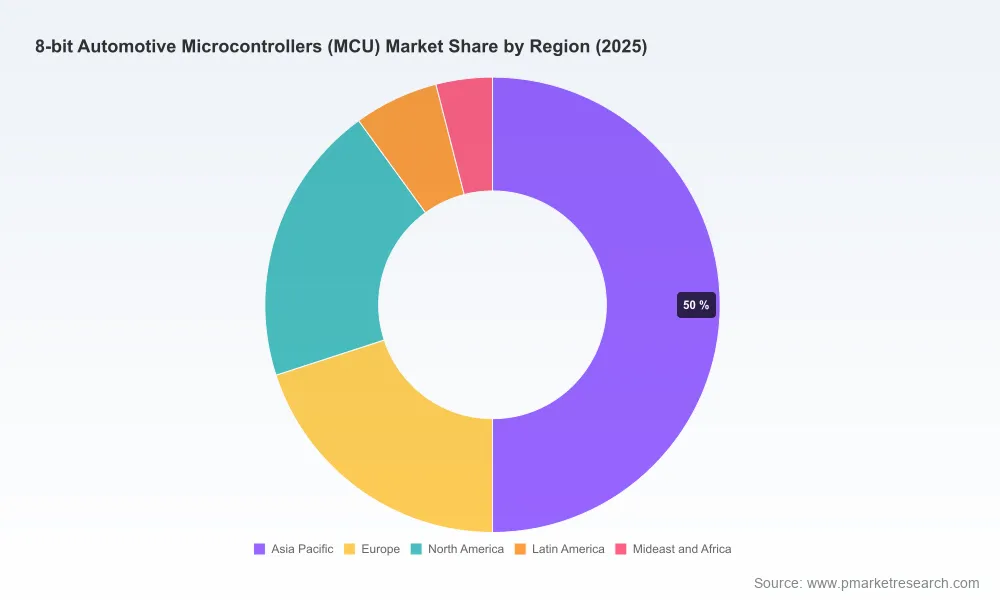
Meanwhile, geopolitical tensions continue to reshape regional sourcing strategies. The push toward localization of automotive MCU production, including 8-bit variants, is accelerating across Asia to strengthen regional OEM supply chains. This localization trend introduces both complexity and opportunity. Organizations with diversified manufacturing footprints or those capable of aligning their sourcing with regional production hubs stand to gain preferential access and reduced logistical risk. Conversely, over-reliance on single-region supply paths exposes programs to tariff fluctuations, trade friction, and localized disruption vulnerabilities.
Inside the Report: What Intelligence Awaits Decision-Makers
Our forthcoming report distills these macro and micro dynamics into an actionable intelligence framework designed specifically for strategic planning in 2026 and beyond. The analysis is structured to support cross-functional decision-making across procurement, engineering, product strategy, and competitive intelligence teams.
The report delivers a rigorous segmentation analysis that maps market allocation across device architecture types and application domains. Readers will gain clarity on how revenue distributes between flash-based and ROM/OTP-based device categories, revealing the technological preferences driving design-ins across different vehicle programs. The application-side breakdown illuminates the relative weight of body electronics, chassis and safety systems, and powertrain alongside other emerging use cases, enabling leaders to align product roadmaps with the highest-value deployment zones.
PW Consulting Information & Electronics Research Center
Beyond segmentation, the publication provides a deep competitive benchmarking suite. Each key player is evaluated not only on portfolio breadth but on strategic positioning: qualification coverage, protocol support matrices, temperature tolerance, functional safety certification depth, and ecosystem tool availability. The analysis connects these capabilities to real-world design-in likelihood, helping procurement teams identify which suppliers hold sustainable advantages in specific application verticals.
IoT Microcontroller (MCU) Market
The report also embeds a forward-looking view of market concentration trends, tracking how the top three and top five players are likely to evolve their share positions as product lifecycles mature and new design wins accumulate. Coupled with regional supply chain localization insights, this section equips executives with the context needed to evaluate make-versus-buy decisions, dual-sourcing strategies, and regional supplier partnerships.
Critically, the research integrates regulatory and compliance mapping directly into the competitive assessment. Rather than treating AEC-Q100 and ISO 26262 ASIL B requirements as isolated checkboxes, the report evaluates how suppliers stack up against these standards across their automotive-grade portfolios, highlighting gaps and strengths that directly impact sourcing risk profiles.
Strategic Imperatives for 2026 Leadership
As the 8-bit automotive MCU market enters its next growth phase, leadership teams face a clear set of priorities. The normalization of supply chains reduces immediate crisis pressure, but it also raises the bar for competitive differentiation. In a market where the top five suppliers command over 80 percent of revenue, procurement leverage must be earned through technical alignment, qualification readiness, and supply chain diversification rather than price negotiation alone.
The steady 2.5 percent compound annual growth rate signals that volume plays will yield modest returns unless paired with structural advantages. Organizations that invest in understanding the nuanced segmentation between flash-based and ROM/OTP-based architectures, and that align application roadmaps with the dominant revenue pools in body electronics and chassis and safety, will position themselves to capture disproportionate value within the overall market expansion.
Furthermore, the convergence of functional safety mandates, high-temperature reliability requirements, and regional production localization means that supplier selection in 2026 must be evaluated through a multi-dimensional risk lens. The organizations that thrive will be those that treat 8-bit MCU sourcing not as a commodity transaction, but as a strategic component of vehicle program resilience.
This executive brief has outlined the contours of the opportunity. The full market research report delivers the granular intelligence, quantitative segmentation, competitive profiling, and forward-looking scenario analysis required to translate these strategic insights into executable plans. For leaders committed to navigating the 2026 automotive semiconductor landscape with precision, the complete report provides the definitive reference point.
For detailed analysis of this topic, please visit the official page: 8-bit Automotive Microcontrollers (MCU) Market
Lacy Lee
Senior Marketing Manager
[email protected]
PW Consulting: www.pmarketresearch.com






























Sign in to leave a comment.