
Beyond the Inbox: Strategic Intelligence for the 2026 A2P SMS Landscape
The enterprise communication landscape is undergoing a silent but profound transformation. As organizations navigate an era defined by tightened regulatory frameworks, evolving consumer expectations, and the relentless pursuit of higher engagement rates, Application-to-Person (A2P) SMS has emerged as a critical infrastructure layer rather than a mere messaging utility. At PW Consulting, we recognize that leveraging A2P SMS effectively in 2026 requires more than surface-level market awareness. It demands precise, forward-looking intelligence grounded in historical performance and calibrated for the next seven years of operational reality.
Our newly released A2P SMS Market study is designed specifically for executives, product leaders, and strategic planners who need to translate macro trends into actionable roadmaps. This preview article outlines the research architecture, highlights the strategic value embedded within the analysis, and demonstrates how the report equips decision-makers with the clarity required to navigate a rapidly consolidating and highly regulated ecosystem.
Why 2026 Demands a Re calibrated View of A2P SMS
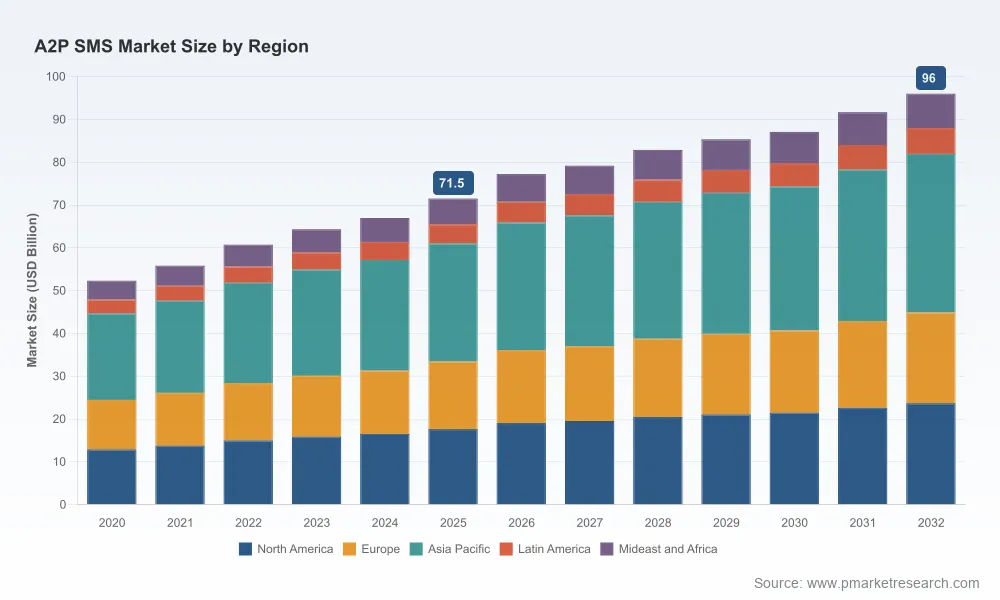
The years between 2020 and 2025 established a clear growth trajectory for enterprise messaging, with global A2P SMS revenue climbing from approximately 52.3 billion USD to 71.5 billion USD. This expansion reflects more than incremental adoption; it signals a structural shift in how businesses authenticate users, manage customer relationships, deliver time-sensitive notifications, and execute promotional campaigns. As we step into the forecast period spanning 2026 through 2032, the market is projected to continue its upward momentum, reaching an estimated 96.0 billion USD by the end of the horizon. The compound annual growth rate across this forecast window rests at a steady 4.5 percent, a figure that may appear measured but carries significant implications when mapped against enterprise budget cycles, compliance overheads, and technological integration costs.
Steady growth in a mature market rarely translates into uniform opportunity. Instead, value increasingly concentrates among organizations that can align messaging strategy with regional infrastructure realities, regulatory mandates, and application-specific performance benchmarks. The 2026 enterprise environment demands an understanding of how these forces interact, not in isolation, but as a combined operational constraint and strategic enabler.
What the Report Delivers: From Macro Signals to Operational Playbooks
PW Consulting’s A2P SMS Market research is structured to bridge the gap between high-level market intelligence and day-to-day strategic execution. Rather than offering a static snapshot, the report maps the evolution of the industry from 2020 through 2025 and extends that analytical continuity into a detailed 2026-2032 forecast. The framework integrates revenue trajectories, adoption momentum, and structural market dynamics into a cohesive narrative that supports both long-term planning and near-term investment prioritization.
The study examines the ecosystem through multiple strategic lenses. It traces how foundational application categories, including customer relationship management, authentication workflows, promotional and marketing initiatives, pushed content services, and ancillary use cases, collectively shape demand patterns and influence vendor positioning. It also evaluates regional market architectures, revealing how infrastructure maturity, carrier relationships, and localized compliance environments differentiate growth pathways across major global corridors.
Beyond demand mapping, the report dissects the competitive structure of the market. Concentration metrics highlight how dominant players command disproportionate shares of revenue and infrastructure leverage, while mid-tier and specialized providers carve out defensible positions through geographic focus, routing expertise, or omnichannel integration capabilities. This competitive mapping is paired with an operational review of how incumbents and emerging entrants are adapting their platforms, expanding carrier partnerships, and responding to regulatory shifts that redefine allowable traffic flows and pricing expectations.
To ensure the analysis remains anchored in present-day realities, the research incorporates recent platform launches, service expansions, and regulatory milestones that have reshaped routing logic, compliance obligations, and enterprise procurement criteria. By embedding these developments within a broader structural assessment, the report provides readers with a context-rich view of where the market has been, where it is heading, and which operational decisions will determine competitive advantage in the coming cycles.
Navigating a Consolidating Competitive Field
The A2P SMS ecosystem is defined by a layered competitive landscape in which global platform providers, regional specialists, and infrastructure-heavy operators coexist while competing on delivery reliability, compliance readiness, and integration flexibility. Leading platform companies have built their positions around programmable messaging capabilities, global carrier partnerships, and specialized support for high-volume transactional traffic such as OTPs and alerts. Their value proposition increasingly hinges on the ability to offer consistent delivery across jurisdictions while maintaining developer-friendly integration paths for enterprise applications.
European and globally oriented players have emphasized omnichannel architecture, blending A2P SMS with richer messaging formats and direct operator connectivity to serve enterprise clients that require unified engagement frameworks. These providers often differentiate through regional network depth, particularly in markets where direct carrier relationships and localized routing expertise create meaningful delivery advantages. Meanwhile, infrastructure-driven organizations leverage extensive global network footprints and fiber-based or carrier-integrated delivery models to support multinational enterprises seeking scale, consistency, and consolidated vendor management.
Specialized routing and compliance-focused suppliers occupy a distinct segment of the market by concentrating on traffic optimization, regulatory alignment, and high-scale transactional use cases. Their relevance grows as enterprises face stricter registration requirements, tightened termination frameworks, and heightened scrutiny around message throughput and sender reputation. In parallel, providers with strong regional footprints in Asia and emerging markets continue to strengthen their positions through carrier partnerships and high-volume solution designs tailored to local operating conditions.
Recent developments underscore how quickly the competitive environment can shift in response to infrastructure upgrades and regulatory triggers. In early 2026, a major nationwide operator launched a bulk push SMS A2P platform backed by near-complete fiberization for enterprise customers, signaling how state-level infrastructure expansion can reshape delivery expectations and competitive thresholds. At the same time, new toll-free A2P messaging services entered the U.S. market to align with January 2026 regulatory requirements, illustrating how compliance-driven innovation is becoming a standard feature of platform differentiation rather than an exceptional response.
Regulatory and Infrastructure Currents Reshaping Market Behavior
Regulatory developments are no longer peripheral considerations in A2P SMS strategy; they are core determinants of routing viability, cost structures, and market entry timing. In the UK, voluntary commitments from four large mobile operators on A2P SMS termination pricing have established a structured pricing environment covering more than 90 percent of the market through the end of 2028. This framework emerged after a formal market review concluded with accepted commitments, creating a temporary but significant stabilization in wholesale termination dynamics. For enterprises and intermediaries operating in or routing through the UK, such arrangements influence cost predictability, vendor negotiations, and long-term traffic planning.
Across the Atlantic, the U.S. market has moved toward stricter sender registration enforcement. Mandatory A2P 10DLC registration across major carriers has effectively blocked unregistered 10-digit A2P traffic, reshaping how enterprises onboard messaging use cases, manage campaign approvals, and structure vendor partnerships. This shift elevates compliance readiness from a back-office concern to a frontline operational requirement, particularly for organizations that rely on high-volume alerts, authentication flows, or customer-facing promotional messaging.
Infrastructure-side developments are equally consequential. In certain markets, near-complete fiberization and expanded enterprise-grade network readiness are strengthening the delivery foundation for high-volume A2P traffic. These improvements reduce latency risks, support more predictable routing, and enable operators and platform providers to offer more resilient service-level expectations. As infrastructure and regulation evolve together, the market’s center of gravity shifts toward participants that can demonstrate both technical robustness and regulatory fluency.
Translating Market Intelligence into 2026 Decision Quality
For enterprise leaders, the strategic value of this research lies in its ability to convert complex market signals into prioritized decisions. Executives evaluating vendor selection can use the competitive and concentration analysis to distinguish between providers offering broad global coverage and those delivering structurally stronger positioning in specific regions or application contexts. Product and engineering teams can align integration roadmaps with the application-level demand patterns identified in the study, ensuring that messaging investments support both transactional reliability and engagement objectives.
A2P SMS Market
Procurement and finance stakeholders gain a credible basis for scenario planning, particularly when assessing how regulatory timelines, termination pricing commitments, and compliance mandates may influence cost structures over the forecast window. Strategy and market entry teams can leverage the regional and infrastructure analysis to identify where demand momentum is most likely to outpace supply constraints, and where localized carrier relationships or compliance expertise may serve as decisive entry barriers or differentiators.
Equally important, the report helps organizations avoid overgeneralization. A2P SMS is often treated as a homogeneous channel, yet the underlying market is shaped by distinct application economics, regional infrastructure conditions, and regulatory regimes that reward precision over presumption. By mapping these variables together, the research enables decision-makers to design messaging strategies that are resilient under multiple operational scenarios rather than optimized for a single assumed future.
A2P SMS & cPaaS Market
How to Use This Research for Maximum Strategic Impact
PW Consulting’s A2P SMS Market study is designed to support multiple internal use cases without requiring readers to infer missing connections. The report can serve as a foundational input for annual strategy cycles, a reference framework for vendor and partner evaluations, and a briefing resource for cross-functional alignment between marketing, engineering, compliance, and finance teams. Its forecast structure supports both top-down budget planning and bottom-up use-case prioritization, while the competitive and regulatory analysis provides the context needed to interpret market shifts as they unfold.
Readers seeking a complete assessment of market sizing, segmentation dynamics, competitive positioning, and forward-looking scenario context will find the full study structured to answer those questions in detail. The complete dataset, methodological notes, and extended strategic commentary are available through the PW Consulting market research portal, where the full report can be accessed for deeper evaluation and internal distribution.
Conclusion: Positioning for Measured Growth in a Structurally Complex Market
The A2P SMS market in 2026 is not defined by explosive disruption, but by disciplined expansion, regulatory recalibration, and increasing competitive clarity. For enterprises that depend on messaging for authentication, customer engagement, notification delivery, and promotional outreach, this environment rewards informed strategy over reactive execution. PW Consulting’s market research provides the analytical depth required to see where growth is structural, where risk is regulatory, and where competitive advantage will be earned through integration quality, compliance readiness, and regional precision. The full report offers the comprehensive intelligence needed to turn those insights into confident 2026 decisions and a resilient roadmap through 2032.
For detailed analysis of this topic, please visit the official page: A2P SMS Market
Lacy Lee
Senior Marketing Manager
[email protected]
PW Consulting: www.pmarketresearch.com
























Sign in to leave a comment.