
Strategic Horizons in the Amebocyte Lysate Market: A 2026 Decision Framework
The global biologics and pharmaceutical quality assurance landscape is undergoing a structural transformation. As manufacturers scale production of biologics, cell and gene therapies, and complex injectables, the imperative for reliable, compliant, and efficient endotoxin detection has never been more critical. Against this backdrop, the Amebocyte Lysate Market has emerged as a pivotal enabler of product safety, regulatory alignment, and sustainable testing practices. Our latest market research delivers a comprehensive, forward-looking assessment designed specifically to inform enterprise strategy through 2032. This report is not merely a retrospective snapshot. It is a decision architecture for quality leadership, supply chain planning, and technology adoption in an environment defined by rapid regulatory evolution and shifting material constraints.
Market Trajectory and Structural Growth Dynamics
Over the past half decade, the Amebocyte Lysate Market has demonstrated consistent expansion, reflecting accelerating demand across pharmaceutical manufacturing, clinical diagnostics, and contract testing services. Historical revenue data from 2020 through 2025 reveals a clear upward trajectory, with total market value progressing from approximately 1,324.0 million to 2,113.0 million. This growth has been underpinned by tightening regulatory expectations, the proliferation of biologics pipelines, and the increasing integration of endotoxin testing into early-stage development workflows. Looking ahead to the forecast horizon of 2026 through 2032, the market is projected to extend its expansion curve, reaching an estimated 4,065.0 million by the terminal forecast year. This progression translates to a compound annual growth rate of 9.98 percent, signaling sustained momentum that outpaces many adjacent quality control segments.
Blood Products Market
Several structural forces are converging to support this trajectory. First, the rapid expansion of biosimilar and novel therapeutic modalities has multiplied the volume of batches requiring stringent pyrogen validation. Second, contract manufacturing and testing organizations are scaling their analytical capabilities to meet decentralized production models. Third, persistent supply chain sensitivities around traditional raw material sourcing are prompting organizations to evaluate alternative reagent architectures without compromising compliance. These dynamics collectively position the Amebocyte Lysate Market as a high-growth, high-strategic-importance segment where early positioning can yield long-term operational and competitive advantages.
Regulatory Shifts and the Recombinant Transition
Regulatory evolution is actively reshaping how endotoxin testing is specified, validated, and deployed. In a landmark move, the U.S. Pharmacopeia approved Chapter 86, which establishes a framework for bacterial endotoxin testing using recombinant reagents and became official in May 2025. This development formally acknowledges non-animal-derived alternatives within the compliance landscape, expanding the toolkit available to quality teams while preserving rigorous analytical standards. Shortly thereafter, in March 2026, the FDA issued Edition 2 of its Pyrogen and Endotoxins Testing Questions and Answers guidance, deliberately removing certain references to traditional Limulus Amebocyte Lysate testing to accommodate broader utilization of recombinant platforms. These regulatory milestones do not signal the immediate obsolescence of conventional methods. Rather, they establish an environment in which manufacturers can evaluate hybrid testing strategies, phase in recombinant workflows where appropriate, and design validation pathways that align with both current expectations and future flexibility.
The strategic implication for enterprise decision makers is clear. Organizations that proactively assess recombinant cascade reagents, evaluate method transferability, and engage with regulatory expectations early will be better positioned to mitigate transition risk, reduce dependency on constrained raw material inputs, and maintain uninterrupted testing continuity. Our report examines these regulatory developments in granular detail, mapping their operational consequences across development, manufacturing, and quality assurance functions.
Competitive Architecture and Strategic Positioning
The competitive landscape of the Amebocyte Lysate Market is characterized by a blend of established reagent specialists, integrated life sciences providers, and contract testing organizations, each pursuing distinct value propositions. Market concentration data indicates a moderately fragmented structure, with the top three participants commanding approximately 28.5 percent of revenue and the top five collectively accounting for around 42.3 percent. This distribution reflects a market in which scale, technical differentiation, and service integration all play meaningful roles in shaping customer selection.
Reagent Innovation and Platform Differentiation
Several leading firms have invested heavily in assay diversity, throughput optimization, and animal-free alternatives. FUJIFILM Wako Pure Chemical Corporation continues to emphasize its PYROSTAR ES-F endotoxin-specific LAL reagents, spanning gel clot, kinetic turbidimetric, and kinetic chromogenic formats, alongside endotoxin-free consumables that support tightly controlled testing environments. Associates of Cape Cod, Inc. has reinforced its dual-track strategy by advancing the PyroSmart NextGen recombinant cascade reagent as an animal-free alternative while maintaining its traditional chromogenic and turbidimetric LAL methods, complemented by contract testing services. Lonza Group AG offers the Kinetic-QCL chromogenic LAL assay within a broader reagent portfolio and is also positioned around its PyroGene recombinant Factor C platform, enabling customers to evaluate both conventional and recombinant pathways. Charles River Laboratories International, Inc. has focused on throughput and material efficiency through its Endosafe LAL cartridges, which are engineered to require substantially less raw material than conventional approaches, while also providing kinetic chromogenic reagents and contract endotoxin testing services.
Regional Capabilities and TAL-Based Solutions
Beyond the dominant LAL-centric suppliers, specialized providers have carved out meaningful positions by leveraging alternative amebocyte sources and regionally integrated supply models. Xiamen Bioendo Technology Co., Ltd. emphasizes TAL reagents for gel clot, kinetic chromogenic, kinetic turbidimetric, and endotoxin-specific assays, offering customers access to an established non-LAL pathway for endotoxin detection. GenScript Biotech Corporation contributes ToxinSensor chromogenic LAL endotoxin assay kits alongside endotoxin detection and removal systems, addressing both analytical and process-purification considerations. Nelson Laboratories, LLC complements the reagent ecosystem through bacterial endotoxin test and microbial testing services, reflecting the broader trend in which testing capabilities are increasingly accessed as managed services rather than solely as in-house consumables.
Technology Substitution, Sustainability, and Supply Rationalization
A defining feature of the current market cycle is the accelerated evaluation of recombinant technologies and material-sparing methodologies. These developments are being driven by a combination of regulatory openness, supply resilience concerns, and organizational sustainability commitments. Charles River Laboratories’ Endosafe cartridge technology has been engineered to utilize 95 percent less horseshoe crab raw material than traditional LAL methods, illustrating how hardware and consumable design can materially reduce dependency on limited biological inputs. In parallel, Associates of Cape Cod’s PyroSmart NextGen recombinant cascade reagent has gained approval from multiple regulatory agencies worldwide, demonstrating that animal-free alternatives are advancing beyond early adoption into broader compliance acceptance.
At the enterprise level, the transition toward recombinant and reduced-material workflows is not solely a procurement decision. It is a validation, operational, and strategic planning exercise. Amgen, for example, reduced its horseshoe crab-derived LAL usage to one-twentieth of traditional assay volumes and completed bridging studies in 2025 to support full recombinant replacement. This type of phased transition underscores the importance of method equivalence data, regulatory documentation, and internal quality system alignment. Organizations that approach this shift with structured experimentation and cross-functional coordination can reduce exposure to raw material volatility while preserving analytical integrity. Our research evaluates these transition patterns systematically, providing decision makers with a framework for balancing risk, cost, and compliance across alternative testing pathways.
Operational Integration and Service-Enabled Models
The market is also evolving in the way testing capabilities are packaged and delivered. Increasing numbers of organizations are incorporating contract endotoxin testing services into their quality workflows, particularly for specialized applications, surge capacity, or early-stage method development. Service-oriented models can reduce capital intensity, accelerate turnaround, and provide access to specialized expertise without requiring permanent infrastructure expansion. At the same time, reagent manufacturers are bundling consumables, assay kits, and method support into integrated offerings that simplify implementation and standardize workflows across sites. Understanding where to build, where to outsource, and where to partner is now a central strategic question for quality leaders.
Amebocyte Lysate Market
What the Report Delivers for 2026 Decision Making
This market research is designed to translate complex industry signals into actionable strategy. Rather than offering only aggregate trends, the analysis provides a structured decision framework across revenue dynamics, technology alternatives, regulatory readiness, competitive positioning, and implementation pathways. The report is organized to support multiple internal audiences, from procurement and quality assurance to R&D, supply chain, and executive planning.
- Macro revenue progression and forecast logic: Detailed assessment of historical expansion from 2020 through 2025 and projected growth through 2032, with attention to the drivers shaping the 9.98 percent CAGR trajectory and the implications for capacity planning and investment timing.
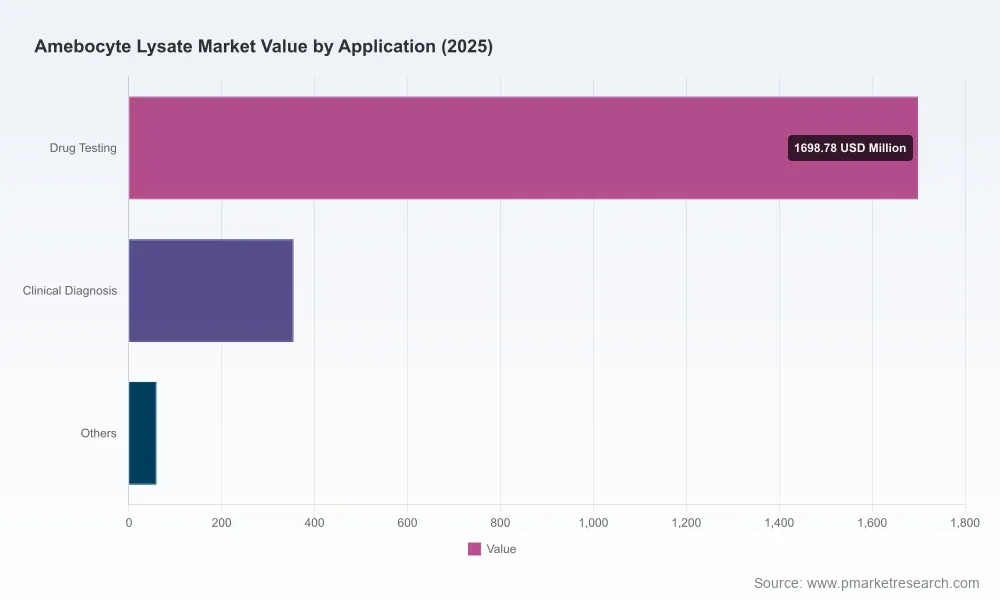
- Segment architecture and application relevance: Analysis of how demand patterns differ across major end-use contexts such as drug testing, clinical diagnosis, and other specialized applications, and what those contrasts mean for portfolio strategy, product development, and service design.
- Regional demand and geographic strategy: Examination of market distribution across North America, Europe, Asia Pacific, Latin America, and the Middle East and Africa, including regional growth characteristics, procurement implications, and localization considerations for manufacturing and testing operations.
- Reagent type and platform considerations: A comparative look at Limulus Amebocyte Lysate and Tachypleus Amebocyte Lysate pathways, including assay formats, workflow fit, and the strategic relevance of maintaining flexibility across LAL and TAL options as customer requirements evolve.
- Competitive profiling and differentiation mapping: In-depth company assessments covering reagent portfolios, recombinant platforms, cartridge and consumable innovations, service offerings, and regional capabilities, enabling benchmarking against peers and identification of partnership or procurement opportunities.
- Regulatory and transition pathway analysis: Structured evaluation of USP Chapter 86, FDA guidance updates, and recombinant acceptance trends, with practical discussion of validation implications, documentation requirements, and sequencing strategies for organizations considering alternative reagents.
- Sustainability and supply rationalization insights: Assessment of material-sparing technologies, recombinant adoption patterns, and organizational case examples that illustrate how reduced dependency on traditional raw materials can be pursued without compromising compliance or throughput.
- Strategic recommendations for 2026 planning: Actionable guidance for quality leaders and commercial teams on method selection, supplier diversification, recombinant readiness, service-model evaluation, and long-term positioning in a market that is both growing and technologically fluid.
Why This Intelligence Matters Now
The Amebocyte Lysate Market sits at the intersection of regulatory change, technology substitution, and sustained demand growth. For organizations making decisions in 2026, the central challenge is not simply whether the market is expanding, but how to align quality systems, procurement strategies, and technology roadmaps with an environment that is increasingly open to recombinant alternatives and more attentive to supply resilience. Enterprises that treat endotoxin testing as a static compliance requirement risk missing the operational and strategic leverage available through early evaluation, supplier diversification, and method flexibility. Those that approach the segment as a dynamic capability domain can improve continuity, reduce exposure to raw material constraints, and strengthen their overall quality posture.
Access the Full Strategic Assessment
Given the pace of regulatory updates, the broadening acceptance of recombinant platforms, and the ongoing recalibration of supply strategies, timely access to granular market intelligence is essential. This research report provides the depth required to evaluate where opportunities are forming, how competitive positioning is shifting, and which transition pathways are most practical for your organization. The complete analysis includes detailed segmentation breakdowns, regional and application-level demand patterns, company-level profiling, and forward-looking strategic recommendations that go beyond the high-level trends summarized here. To explore the full dataset, competitive mappings, and implementation guidance, request the complete report through the source page and equip your leadership team with the intelligence needed to navigate the next phase of market growth with confidence.
For detailed analysis of this topic, please visit the official page: Amebocyte Lysate Market
Lacy Lee
Senior Marketing Manager
[email protected]
PW Consulting: www.pmarketresearch.com



























Sign in to leave a comment.