
Strategic Trends and Commercial Opportunities in the Worldwide Renting and Leasing Test and Measurement Equipment Market
The global test and measurement (T&M) equipment rental and leasing market has evolved from a tactical procurement option into a strategic operational model. Between 2020 and 2025, the market expanded from roughly USD 5.1 billion to approximately USD 6.85 billion, reflecting sustained demand for flexible access to high-precision instrumentation. Looking ahead through 2032, the market is projected to grow at a compound annual growth rate of 5.81 percent, reaching an estimated USD 10.17 billion by the end of the forecast period. This trajectory signals more than cyclical demand recovery; it reflects a structural shift in how organizations acquire, deploy, and manage T&M assets across capital-intensive and highly regulated industries.
Understanding this market requires recognizing that rental and leasing are no longer substitutes for purchasing. They have become integrated components of engineering workflows, compliance programs, and capital allocation strategies. The steady revenue growth, combined with a moderately consolidated competitive landscape where the top three participants command roughly 32.4 percent of market share and the top five account for approximately 41.15 percent, indicates a mature ecosystem balancing scale economies with specialized service differentiation. For executives and investors, the market's resilience lies in its alignment with broader technological, regulatory, and operational pressures that favor access over ownership.
Navigating Current Market Realities and Structural Challenges
The T&M rental and leasing sector operates at the intersection of precision engineering, compliance intensity, and asset utilization economics. Several structural realities shape the current operating environment and introduce both constraints and strategic inflection points.
First, the market is highly sensitive to calibration quality, technical support, and equipment availability. Rental providers must maintain traceability, documentation, and calibration standards that meet the expectations of regulated end-user industries. This requirement introduces a persistent operational burden, as specialized human labor for calibration, maintenance, and technical support represents a primary cost driver. Unlike commoditized equipment rental, T&M rentals demand ongoing precision verification, which limits margin expansion and reinforces the value of providers with strong service infrastructure.
Second, the industry is navigating a strategic reallocation of fleet assets. Providers are increasingly deciding where to concentrate inventory based on return profiles, end-user demand cycles, and the capital intensity of certain equipment categories. A notable example is the recent divestiture of an intellirent segment by Electro Rent, which focused on medium-to-high-voltage electrical testing equipment for power generation, data center, and renewable energy applications. This move illustrates how providers are refining portfolios to align with core competencies, customer demand durability, and operational complexity. At the same time, fleet updates by major rental operators reflect continued investment in general purpose and communications test equipment, underscoring the enduring demand for widely applicable instrumentation.
Helium Leak Detector Rental Services Market
Third, the market faces a dual pressure from rapid technology innovation and the need for backward compatibility. As new measurement architectures, wireless standards, and semiconductor testing requirements emerge, rental fleets must evolve without losing utility from existing instruments. This tension has strategic implications. Providers that can balance newer capabilities with stabilized inventories of proven equipment are better positioned to serve customers with mixed-generation test needs, while those overly concentrated in legacy or narrowly specialized assets may face deployment friction.
Key Drivers Shaping Market Growth and Competitive Differentiation
Market expansion in T&M rental and leasing is being driven by a convergence of technology, regulation, demand behavior, and cost structure dynamics. These forces interact in ways that make rental and leasing increasingly attractive, but they also create uneven growth across use cases and geographies.
PW Consulting
Technology innovation and the rising cost of access to advanced instrumentation. As test and measurement requirements become more sophisticated, the upfront cost and technical risk of purchasing equipment increase. Manufacturers and research organizations increasingly rely on rental models to access the latest oscilloscopes, RF and microwave instruments, wireless test solutions, and semiconductor characterization tools without committing to long-term capital exposure. This trend is reinforced by manufacturer participation in the rental ecosystem. Companies such as Keysight Technologies, Tektronix, and VIAVI Solutions offer direct rental programs or authorized rental partner channels, enabling short- and long-term access to current-generation equipment. Their involvement elevates the credibility of rental as a legitimate access model while also expanding the range of instruments available for temporary deployment.
Regulatory and compliance requirements intensifying demand for verified equipment. Industries such as aerospace, defense, telecommunications, and power utilities depend on measurement accuracy and documented traceability. ISO 17025 accreditation for calibration laboratories is a key compliance requirement for rental providers that integrate calibration services into their offerings. In practice, this means the rental value proposition is expanding beyond access to equipment toward access to verified, compliant, and audit-ready instrumentation. Providers that can demonstrate rigorous calibration practices, maintenance records, and documentation standards gain a differentiated position in regulated segments, where downtime or non-compliance carries significant operational and financial consequences.
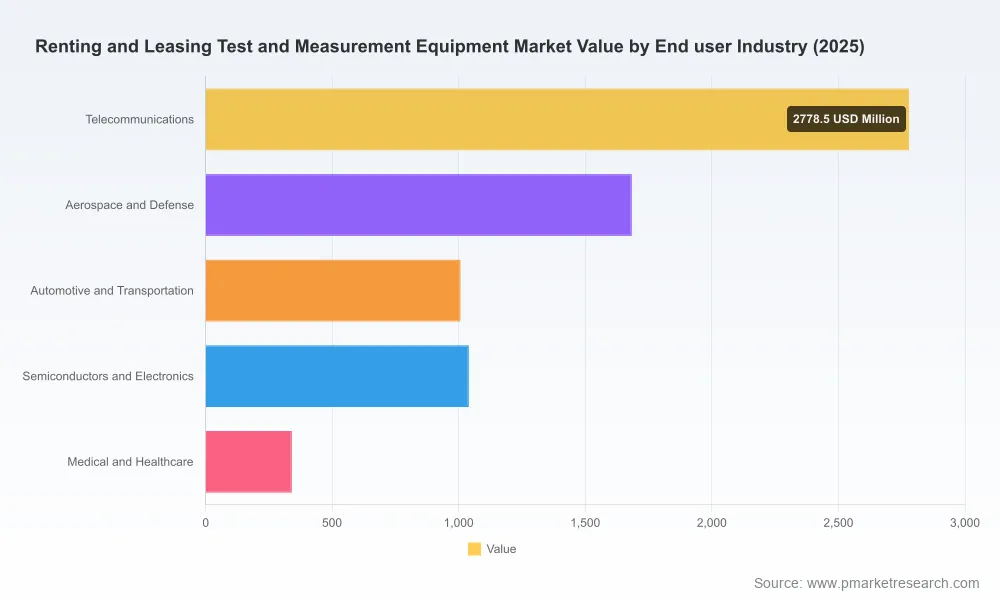
Demand-side shifts toward operational flexibility and capital efficiency. Engineering teams and procurement leaders increasingly prefer flexible deployment models that can accommodate project peaks, prototype cycles, and changing test requirements. Telecommunications operators, for example, need scalable testing capacity across network rollouts and upgrades. Aerospace and defense organizations must support program variability, range testing, and specialized EMC or environmental validation without overcommitting to dormant assets. In semiconductors and electronics, the need to validate new designs and production processes drives demand for specialized testing tools that may only be required for defined phases of development. Renting and leasing allow organizations to align equipment availability with actual need, reducing idle capacity and improving capital efficiency.
Supply chain and cost structure considerations reshaping fleet economics. Rental providers must manage inventory depreciation, maintenance costs, and the specialized labor required to keep instruments field-ready. At the same time, consolidation and partnership activity is reshaping how fleets are built and deployed. Acquisition-related expansion, such as the combination of TestEquity with ConRes Test Equipment, reflects a strategy to broaden rental, lease, sales, and calibration capabilities across a wider instrument base. Partnerships, such as the collaboration between Advanced Test Equipment Corporation and NTD Shielding to extend international EMC test equipment rental options in the UK and Europe, highlight how providers are extending reach through international alliances rather than solely through organic fleet build-out. These dynamics suggest an industry in which scale, service integration, and geographic coverage are becoming central to competitive positioning.
Worldwide Machinery Rental Market
Competitive Landscape: Positioning, Differentiation, and Market Evolution
The competitive structure of the T&M rental and leasing market reflects a blend of independent rental specialists, manufacturer-supported access programs, and organizations that combine rental with calibration, sales, and service offerings. The market's moderate concentration indicates that scale matters, but differentiation increasingly depends on fleet breadth, service quality, compliance capabilities, and usage alignment with end-user industries.
Several competitors stand out for their strategic positioning. Electro Rent Corporation operates a large global fleet spanning more than 250,000 instruments from hundreds of manufacturers, with broad exposure to electronics, communications, and industrial sectors. This scale supports a wide instrument mix and geographic reach, allowing the company to serve diverse customer requirements. TRS-RenTelco, operating as part of McGrath RentCorp, maintains a substantial rental inventory focused on general purpose and communications test equipment, with reported inventory values reflecting active fleet management and reinvestment. Its parent organization's broader asset rental footprint also provides financial and operational context for sustained rental operations.
Advanced Test Equipment Corporation (ATEC) has carved out a strong position in short- and long-term rentals for EMC, aerospace, defense, and communications applications, complemented by international partnerships that extend its service reach. Transcat Inc. integrates rental and leasing with calibration services, using acquisitions to expand its rental offerings and strengthen its North American presence. TestEquity combines rental, lease, and sales activity, with acquisition-driven expansion enhancing its general purpose and specialized T&M capabilities. Microlease Inc. also remains a recognized participant in electronic test equipment rental services, contributing to the competitive diversity of the market.
Manufacturer-based access models add another dimension to the landscape. Keysight Technologies, Tektronix, and VIAVI Solutions facilitate rental and leasing through direct programs or authorized partners, giving customers access to current-generation instrumentation within the manufacturer's ecosystem. This model can reduce procurement friction for customers seeking specific technologies, while also reinforcing manufacturer relationships in segments where access and support are as important as ownership.
The market is evolving along several strategic lines. One is consolidation and capability integration. Acquisitions and partnerships are expanding instrument coverage, geographic reach, and service integration, particularly where calibration, sales, and rental are bundled. Another is specialization. Providers with deep expertise in EMC, aerospace, defense, or communications testing are investing in partnerships and dedicated capabilities to capture higher-value demand. A third is portfolio optimization. As seen in the divestiture of certain specialized rental segments, providers are increasingly curating fleets to match demand durability, operational complexity, and capital efficiency. These trends suggest that competitive advantage will increasingly depend on how well a provider aligns fleet composition, service quality, and compliance readiness with the priorities of key end-user industries.
Forward-Looking Trends and Emerging Commercial Opportunities
The next three to five years are likely to be defined by continued demand for flexible access, deeper integration of rental with service and compliance, and strategic portfolio choices that balance innovation with fleet stability. Several trends stand out as particularly consequential for business planning.
- Access models will become more integrated with compliance and lifecycle services. Demand for rental is increasingly tied to audit readiness, calibration integrity, and documentation reliability. Providers that combine instrument access with robust calibration, traceability, and technical support will be better positioned to capture regulated-industry demand and sustain premium positioning.
- Fleet optimization will intensify around high-utilization categories and specialized use cases. General purpose and communications test equipment are expected to remain core demand anchors, while specialized instrumentation will continue to command strategic importance in segments such as aerospace, defense, and semiconductor testing. Rental providers that can balance broad coverage with targeted specialization will be better equipped to manage utilization and margin performance.
- International expansion through partnerships and selective consolidation will shape regional availability. As demonstrated by cross-border EMC rental partnerships and acquisition-driven capability expansion, providers are extending reach beyond domestic markets by combining inventory access with local compliance and support capabilities. This approach can improve utilization, reduce duplication, and accelerate entry into higher-value markets.
- Manufacturer-supported rental channels will continue to influence customer access patterns. As manufacturers expand rental and authorized partner options, customers will gain more direct pathways to current-generation equipment. This can heighten competition for independent rental providers while also creating opportunities for collaboration, especially where manufacturers benefit from expanded access without requiring customers to purchase outright.
Each trend carries opportunity and risk. The opportunity lies in aligning service models with compliance-heavy demand, building fleet breadth in high-utilization categories, and expanding into specialized applications where measurement criticality supports durable rental relationships. The risk lies in overinvesting in narrowly specialized assets with uncertain demand cycles, underestimating the labor and calibration costs that support rental quality, or entering regulated markets without the documentation and accreditation infrastructure needed to sustain credible service.
Strategic Implications for Decision Makers
The market's trajectory suggests that rental and leasing of T&M equipment will remain an important part of how organizations manage capability access, capital deployment, and compliance risk. Different stakeholders can act on this reality in distinct but complementary ways.
For manufacturers and equipment producers. Rental and authorized access programs can extend market reach, improve customer adoption of new technologies, and support demand during prototype, validation, and transition phases. Engagement in rental channels also offers a way to maintain relationships with users who may not purchase immediately but still require reliable access to current instrumentation. Manufacturers should consider how rental programs can complement sales strategies, support partner ecosystems, and reduce friction for customers managing project-based or compliance-driven testing needs.
For investors and strategic acquirers. The market's moderate concentration, service-intensive economics, and demand stability across key industries create opportunities for value creation through capability integration, fleet optimization, and geographic expansion. Acquisitions that broaden instrument coverage, strengthen calibration and service integration, or add specialized testing capabilities can improve utilization and customer stickiness. At the same time, due diligence should account for calibration labor intensity, compliance requirements, fleet depreciation, and the operational complexity of highly specialized instruments. The businesses that perform well are likely to be those that can demonstrate measurable service quality, disciplined asset management, and strong alignment with regulated or high-utilization end-user demand.
For procurement leaders and engineering organizations. Rental and leasing strategies should be evaluated not only on cost, but on availability, calibration integrity, documentation readiness, and the ability to scale with project or program needs. Using rental to access current-generation instruments, manage peak testing demand, and reduce long-term asset exposure can improve operational flexibility. Organizations should also assess providers based on their ability to maintain traceability, offer integrated calibration or support services, and accommodate the specialized requirements of their industry. A well-structured rental strategy can reduce procurement risk while preserving access to critical measurement capability.
For all of these audiences, the strategic value of the market lies in its increasing complexity and its alignment with broader operational priorities. Fleet composition, compliance readiness, service integration, and end-user alignment now matter as much as instrument availability. Organizations that make decisions with these factors in view are better positioned to benefit from the market's growth and to manage the operational trade-offs involved.
A more detailed examination of market segments, regional dynamics, competitive positioning, and forward demand scenarios can help translate these strategic themes into actionable plans for specific business contexts. The full research report provides a deeper exploration of the data, trends, and implications needed to support procurement, investment, and capability decisions across the T&M rental and leasing landscape.
For detailed analysis of this topic, please visit the official page: Worldwide Renting and Leasing Test and Measurement Equipment Market
Lacy Lee
Senior Marketing Manager
[email protected]
PW Consulting: www.pmarketresearch.com
























Sign in to leave a comment.