
Beyond Dispensing: Strategic Intelligence for the ATM Market in 2026 and Beyond
The automated teller machine has spent half a century as the physical anchor of retail banking. Yet by 2026, the ATM is no longer just a cash dispenser. It is a multi-function financial terminal, a compliance-critical node in the payments ecosystem, and a contested battleground where hardware engineering, software intelligence, and regulatory resilience collide. For executives navigating capital allocation, technology roadmaps, and competitive positioning, generalized industry commentary is no longer sufficient. What is required is a disciplined, evidence-based view of where the market is heading, which structural forces will shape profitability, and how the competitive field is rearranging itself around automation, security, and user experience.
This article previews the strategic architecture of our latest ATM Market research release. It is designed to demonstrate the depth of analysis available to subscribers while leaving the segment-level allocations, regional breakdowns, and precise forecasting tables for the full report. The objective is simple: give decision-makers enough rigorous context to validate the study’s authority, then guide them toward the complete intelligence package for planning cycles that begin in 2026.
The Market at an Inflection Point
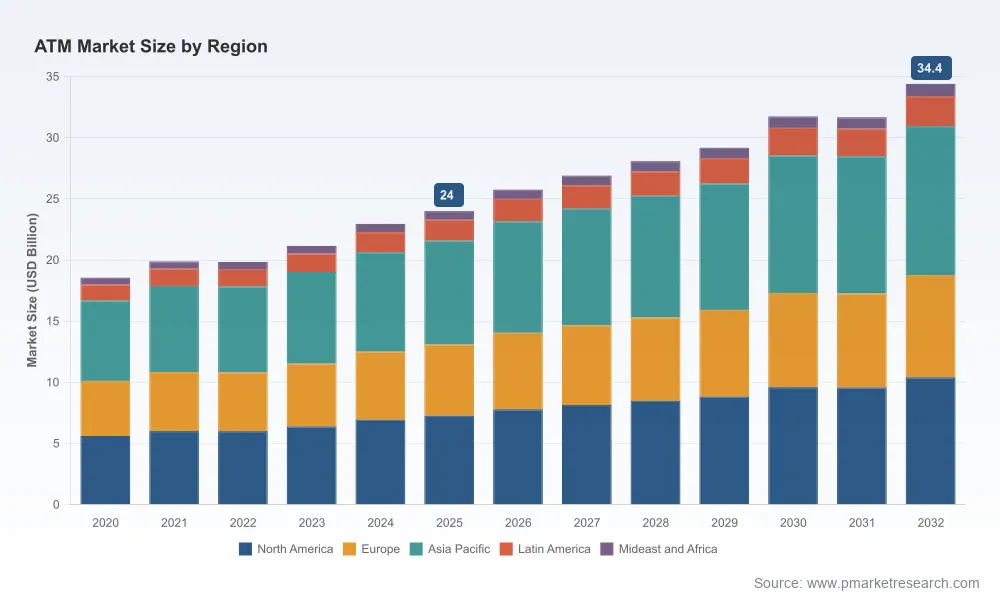
Over the historical window from 2020 through 2025, the global ATM market has traveled a path marked by pandemic-era disruption, rapid branch transformation, and the accelerating adoption of cash-recycling and multi-channel functionality. The trajectory is not one of simple linear growth. It reflects a market absorbing structural shifts in how banks deploy physical infrastructure, how non-bank networks expand surcharge-free access, and how regulatory mandates are forcing simultaneous hardware and software modernization.
Worldwide Automatic Weapons Market
Looking forward across the forecast period through 2032, the market is projected to advance at a compound annual growth rate of 4.9 percent, with the overall valuation climbing from a base of approximately 24.0 billion USD in 2025 toward an mid-30 billion USD range by the close of the decade. That headline trajectory matters, but what matters more for enterprise strategy is the composition of that growth: the shifting balance between conventional bank-operated units and alternative labeling models, the redistribution of demand across banking, retail, and transportation applications, and the way regional demand profiles are being reshaped by both digital-payment penetration and persistent cash usage in specific merchant and institutional contexts.
The full research decouples these layers systematically. Rather than presenting a single blended number, the study decomposes the market along multiple axes so that leadership teams can see where volume is concentrated, where margins are likely to compress or expand, and where substitution risk from mobile and digital channels deserves a different operational response than in cash-reliant segments.
Regulatory Pressure as a Strategic Driver, Not a Background Noise
Security Standards Reshaping the Hardware and Software Stack
One of the most consequential forces in this market is regulatory and standards-driven compliance. Beginning in January 2025, major updates to PCI DSS v4.0 and the enforcement of TR-31 and TR-34 key management mandates started requiring material upgrades across financial institution ATM fleets. These are not cosmetic software patches. They touch cryptographic key blocks, hardware security modules, encryption protocols, and the way cardholder data is protected across the transaction path. In parallel, TLS 1.2 and the transition toward TLS 1.3 support have become baseline expectations across ATM networks to mitigate man-in-the-middle risks and strengthen end-to-end transaction integrity.
By March 2025, digital signage obligations and additional PCI DSS best-practice guidance for cardholder data protection were reinforced across ATM networks, further tightening the compliance envelope. For banks and independent ATM deployers, the practical implication is clear: upgrade cycles are being pulled forward, lifecycle planning must incorporate cryptographic agility, and procurement decisions can no longer be evaluated purely on unit economics. Total cost of ownership now includes the cost of staying compliant as standards evolve.
Why This Matters for 2026 Decision-Making
Because these mandates cascade through hardware certification, software releases, and service contracts, they create both friction and opportunity. Incumbents with mature engineering pipelines can use compliance upgrades as an occasion to bundle analytics, remote monitoring, and fraud-prevention capabilities into refreshed estates. Operators with deferred maintenance backlogs face a harder equation. Our research maps these compliance-driven demand signals against procurement timelines so that organizations can anticipate where replacement cycles will concentrate, which technical capabilities will become prerequisites rather than premiums, and how service-level expectations are being redefined by security requirements.
ATM Market
Cash Recycling and the Redefinition of Branch Economics
Alongside compliance, operational economics is reshaping ATM strategy. Cash recycling systems have moved from niche efficiency tools into mainstream branch and back-office design, now accounting for a meaningful share of a bank’s operating costs while simultaneously enabling direct dispensing from authenticated deposits. The strategic logic is straightforward: reducing armored-carrier dependency, lowering vault handling, and improving cash velocity can meaningfully alter the cost structure of physical distribution. But the implementation is anything but trivial.
Recycling ATMs require different planning around note authentication, deposit verification, queue architecture, and exception handling. They also intersect with broader branch redesign initiatives, where the ATM is increasingly viewed as part of an integrated teller-and-self-service ecosystem rather than a standalone device. The research evaluates these dynamics in operational terms, examining how recycling penetration is influencing deployment strategies, what trade-offs emerge between capacity, throughput, and floor space, and where the economics of cash recycling are strongest versus where they remain marginal.
Competitive Reconfiguration: Hardware, Software, and the Rise of AI-Enabled Estates
The competitive landscape in this market is no longer defined solely by who ships the most reliable dispenser. It is increasingly defined by who can deliver a vertically coherent stack: ruggedized hardware, software that can detect faults before customers do, analytics that help institutions manage estate performance, and security tooling that keeps pace with regulatory demands. Several organizations are actively shaping this shift.
Diebold Nixdorf continues to push its DN Series for lobby and in-the-wall deployments, pairing cash-dispense and recycling options with biometric and NFC support, while anchoring the experience in Vynamic software for AI-driven fraud detection and estate management. The strategic signal here is that hardware is being packaged with software intelligence as a unified value proposition, not sold as separate line items.
NCR Atleos has built its position around the SelfServ 21, 81, and 88 families, reinforced by the Allpoint surcharge-free network and capabilities in cash and recycling. Its recent recognition with the ATM Industry Association Peter Kulik Innovation Award for an AI-assisted ATM service resolution intelligence platform underscores how quickly service resolution, remote diagnostics, and predictive support are becoming differentiators rather than back-office utilities.
Hyosung TNS, through its Americas operations and Innovue brand, has advanced recycled and retail ATMs with Secure Cash Transfer automation, biometric authentication, and the BlueVerse software suite. In early 2026, the company moved to expand modernized branch cash management solutions alongside AI-powered next-generation ATMs, reflecting a broader push to link device capability with end-to-end cash logistics.
At the same time, regional and specialist players are shaping portions of the market with focused engineering. GRG Banking offers instruments such as the H34V and i21-804 with cash sorting, video teller, and bill-pay integration, pointing toward hybrid teller-and-ATM experiences. Hitachi Channel Solutions emphasizes anti-skimming and serial-number counterfeit detection in its SR7500VS and UR-D/S cash-recycling lines, while OKI Electric Industry has pushed high-throughput handling in products like the ATM-Recycler G8 and BRM-RG8 modules with substantial note capacity and transaction throughput. On the software side, KAL ATM Software GmbH provides hypervisor-based ATM software with AI-driven fault detection and estate analytics, illustrating how deeply software is beginning to mediate hardware performance and service economics.
The market structure underpinning these competitive moves is concentrated but not closed. With the top three firms holding roughly 55 percent of market share and the top five approaching 68 percent, scale advantages in service networks, certification pipelines, and software development are real. Yet concentration also creates room for specialist entrants and regional incumbents to compete where compliance readiness, cash-handling optimization, or vertical application fit deliver disproportionate value. The research breaks this landscape down by supplier positioning, product architecture, and strategic emphasis, providing a more useful map than a simple ranking.
Industry Momentum: The “Super ATM” Narrative Gains Substance
Recent industry activity suggests that the “Super ATM” concept is moving from marketing language into operational reality. At the ATMIA US Conference in February 2026, more than 100 exhibitors showcased expanded ATM capabilities spanning deposits, recycling, and AI-driven solutions. That breadth of participation signals that the ecosystem is aligning around a broader device role: deposit-taking, identity-assisted transactions, service expansion, and smarter backend orchestration.
This momentum matters because it changes the decision calculus for 2026. An organization planning a fleet refresh is no longer choosing only between a dispenser and a recycler. It is choosing among devices with different deposit workflows, different levels of authentication sophistication, different software integration potential, and different readiness for compliance mandates that are already in force. The conference activity, taken together with product announcements and industry awards, indicates that vendors are racing to make AI-assisted service resolution, fraud detection, and estate analytics standard components of the offering rather than isolated innovations.
Why 2026 Decision-Making Needs More Than Aggregate Figures
For boards, procurement leaders, technology officers, and strategy teams, the central challenge is not whether the ATM market is growing. It is whether their internal assumptions about deployment models, compliance costs, service economics, and competitive vulnerability are aligned with how the market is actually evolving. Aggregate forecasts can guide high-level budgeting, but they do not answer the questions that determine execution:
- Which deployment archetypes are gaining share, and where do conventional bank-operated models retain structural advantages?
- How should institutions sequence hardware replacements against PCI DSS and cryptographic mandates already in effect?
- Where do recycling economics improve total cost of ownership, and where do operational complexity and exception handling erode the business case?
- Which suppliers are competing on raw hardware durability versus integrated software, analytics, and service resolution, and what does that imply for long-term support relationships?
- How are banking, retail, and transportation applications diverging in their requirements, and what does that mean for form factor, functionality, and service-level expectations?
These questions cannot be answered responsibly with top-line numbers alone. They require segment-level decomposition, scenario-based interpretation, and competitive context that ties product capabilities to market dynamics. That is the analytical core of the full report.
What the Full Report Delivers
This research is built to support practical decision-making rather than abstract observation. It integrates historical performance from 2020 through 2025 with a forward forecast extending to 2032, then layers that quantitative backbone with qualitative analysis of the forces shaping demand. The study is structured to help teams move from awareness to action.
- Macro trajectory and structural growth analysis, including how the market has evolved and where the forward CAGR places it across the forecast horizon
- Segmentation by region, type, and application, presented to show where volume and relevance are concentrated without reducing the market to a single blended narrative
- Competitive profiling of leading manufacturers and software providers, with attention to product families, differentiating capabilities, and strategic orientation
- Operational and regulatory context, including compliance mandates affecting hardware and software upgrades, cryptographic key management requirements, encryption standards, and digital signage expectations
- Cash-recycling economics and branch-integration implications, with an emphasis on cost structure, deposit-to-dispense workflows, and operational trade-offs
- Recent industry developments, such as major conference showcases, product launches, and innovation awards that signal where vendor focus is converging
In short, the report treats the ATM not as a legacy device but as a compliance-sensitive, software-defined, cash-handling platform whose economics depend on how well institutions align hardware, security, and service strategy.
Reading the Preview, Then Going Deeper
The purpose of this article is to establish the framework. It shows that the market is being reshaped by regulatory mandates already in force, by the growing importance of cash recycling and deposit functionality, by AI-enabled service and fraud capabilities moving from optional features to core expectations, and by a competitive field in which hardware, software, and service resolution are increasingly bundled into a single value proposition. It also shows that the headline growth path, while important, is only the beginning of the story for organizations that must make procurement, compliance, and estate-planning decisions in 2026.
To move from framework to execution, decision-makers need the segment-level detail that cannot be responsibly summarized in a preview: the regional distribution behind the aggregate, the split between conventional bank ATMs, white-label, and brown-label models, the application mix across banking, retail, and transportation, and the concentration pattern that shapes supplier leverage and substitution dynamics. Those elements are developed in full within the complete study, along with the forecasting detail and competitive analysis needed to support budget cycles, technology roadmaps, and risk assessments.
For organizations preparing for 2026 and beyond, the market is offering both opportunity and exposure. The opportunity lies in aligning fleet strategy with compliance, recycling economics, and smarter service architectures. The exposure lies in treating the ATM as a static utility rather than a dynamic platform. Our research is designed to help leaders make that distinction with confidence. The full report provides the depth, segmentation, and competitive intelligence required to turn market momentum into a defensible strategic plan.
For detailed analysis of this topic, please visit the official page: ATM Market
Lacy Lee
Senior Marketing Manager
[email protected]
PW Consulting: www.pmarketresearch.com


























Sign in to leave a comment.