
Navigating the Next Wave of Growth: Why 2026 Is a Pivot Point for the Baby Clothing Market
The global baby clothing market has entered a phase of disciplined expansion. As the industry steps into 2026, the convergence of rising material costs, tighter compliance frameworks, and shifting parental preferences is reshaping how brands design, source, and distribute infant and toddler apparel. Our latest comprehensive research on this sector is designed not merely to map these shifts, but to translate them into actionable strategic roadmaps. This article outlines the architectural thinking behind the study, demonstrates the analytical rigor applied, and previews the operational intelligence you will gain—all while preserving the granular data points in the full report so that your competitive decisions remain sharp and exclusive.
The Macro Trajectory: A Contraction-Resilient Sector Building Toward a Billion-Dollar Horizon
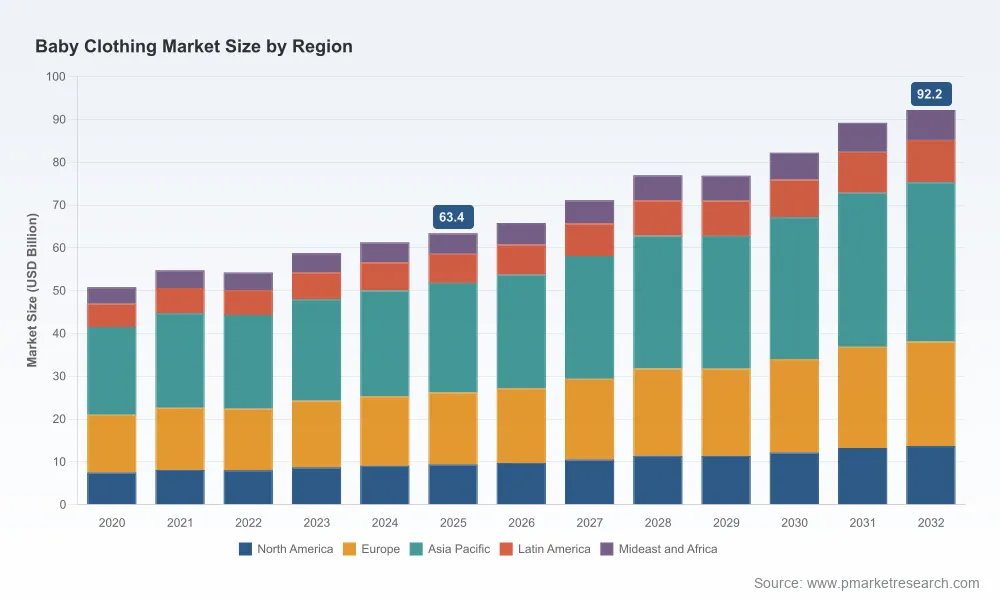
The industry narrative is no longer about simple volume growth. Between 2020 and 2023, the market navigated pandemic-driven demand spikes, supply chain turbulence, and subsequent normalization cycles. Yet despite those disruptions, the sector has demonstrated remarkable resilience, with revenue reaching well over sixty billion USD by 2025. The forecast interval through 2032 projects a steady compounded annual growth rate of 5.5 percent, steering the overall market toward approximately 92.2 billion USD by the close of the decade. This trajectory signals a market that is strengthening rather than fragmenting. Growth is increasingly decoupled from pure population expansion and is instead driven by premiumization, functional textile innovation, and the conversion of everyday essentials into differentiated consumer experiences.
For executives planning capital allocation and product roadmaps for 2026, these figures carry more meaning than headline numbers. The consistency of the expansion curve reflects a consumer base that treats children's apparel as a recurring investment rather than a seasonal expense. At the same time, the scale of the forecast reveals how much room exists for brands that can master compliance, sustainability signaling, and private-label agility without eroding margin structure. The research behind this article dissects the forces stabilizing the curve and isolates where competitive advantage is likely to concentrate in the coming quarters.
Strategic Scope: What the Full Study Delivers for 2026 Planning
This research is engineered for cross-functional decision-making. Rather than offering a static inventory of market attributes, the study is structured around practical inputs that procurement, product development, brand strategy, and compliance teams can deploy immediately. The analysis moves beyond high-level sizing to interrogate the operational bottlenecks and consumer behavior patterns that determine winning execution in 2026 and beyond.
- A detailed breakdown of demand architecture across product categories, use-case contexts, and purchasing motivations, with exact quantitative splits reserved for the downloaded intelligence baseline.
- An evaluation of sourcing models, including private-label agility, low-MOQ production pathways, and regional compliance alignment, to help brands calibrate their manufacturing partnerships against current lead-time expectations.
- A forward-looking inventory of regulatory and certification shifts, examining how updated children's product documentation, electronic filing systems, and organic textile standards reshape time-to-market and risk exposure.
- A consumer-preference mapping that captures how safety concerns regarding chemical treatments, material transparency, and fabric feel influence product development priorities and packaging claims.
- A competitive positioning matrix that contextualizes brand differentiation strategies, from premium capsule collections to wholesale volume plays, without disclosing the proprietary scoring weights used in the full assessment.
If your organization needs to decide where to place development bets, how to phase compliance readiness, or which sourcing routes will preserve flexibility under tighter cost discipline, the study is built to compress the distance between market intelligence and operational action.
The Competitive Arena: Private Label, Compliance Agility, and the Rise of Specialized Manufacturing
The supplier and manufacturer landscape is undergoing a quiet but consequential restructuring. Companies that once competed primarily on volume are now differentiating through compliance readiness, fiber specialization, customization thresholds, and regional positioning. Several core players illustrate how the market is adapting to the new rules of engagement.
Specialization and Private-Label Readiness
Leading manufacturers are aligning their production capabilities with brand-neutral design models and material credibility. Several firms have concentrated on private-label knit apparel that emphasizes natural fibers and infant-appropriate comfort profiles. Others have built dual-hub structures and low-MOQ flexibility to accommodate brands seeking smaller test runs, faster iteration, and European-level compliance standards without large inventory commitments. Meanwhile, a separate cohort has focused on USA-based production using organic cotton, bamboo blends, and recycled polyester pathways to serve wholesale and custom programs that require domestic sourcing narratives. Additional manufacturers emphasize soft-touch construction, secure garment design, and strict regulation-aligned manufacturing for private-label partners. Beyond these specialized producers, broader apparel suppliers continue to provide bulk, customizable kids' and infant options, while another group concentrates on smocked baby and children's garments with an explicit emphasis on ethical and sustainable production. On the elevated end of the spectrum, designer-oriented houses are extending capsule collections into baby and children's lines to capture consumers who view infant apparel as part of a family fashion ecosystem.
Recent Moves That Signal Strategic Direction
The calendar of 2026 has already produced visible signals about where value is consolidating. A notable designer collaboration recently debuted a playful baby and kids capsule at a major luxury department-store flagship, underscoring how premium and lifestyle narratives are migrating downward into the youngest demographic. On the trade-show circuit, elevated international baby and children's fashion exhibitions and regional showroom events have become more than sourcing venues; they are increasingly functioning as validation platforms for new fabric technologies, sustainability claims, and design directions. At the standards level, the release of the latest certification annual report confirmed a measurable expansion in certified facilities, reinforcing the infrastructure behind organic and sustainably produced baby textiles. Together, these events suggest that the market is rewarding both commercial creativity and verifiable supply-chain integrity.
Regulatory and Consumer Trends Redefining Execution in 2026
Market performance will increasingly depend on how quickly and cleanly brands absorb regulatory changes and safety expectations. Several developments now dictate operational readiness.
Starting in mid-2026, importers of children's products, including apparel, are required to electronically file Children's Product Certificates through the customs ACE system. This transition transforms documentation from a back-office procedural task into a front-line compliance checkpoint. Combined with broader age-labeling verification requirements, the shift raises the stakes for supply-chain traceability, certificate coordination, and customs readiness. Brands that treat these obligations as peripheral will face delays and friction, while those that integrate them into sourcing selection and onboarding workflows will gain speed and reliability.
Baby Carriers Market
Sustainability standards are also gaining operational weight. The expansion of organic textile certification facilities reflects growing system capacity to support sustainable baby clothing production. This matters because certification availability directly influences sourcing confidence, label credibility, and the ability to make verifiable claims in marketing and product storytelling. At the same time, consumer studies continue to highlight a preference for PFAS-free and organic baby clothing, with parents actively seeking to avoid exposure to toxic chemicals in infant apparel. The result is a market environment where safety, material transparency, and confidence in chemical-free construction are no longer niche concerns; they are becoming baseline expectations that directly affect product acceptance and brand trust.
Baby Clothing Market
Taken together, regulatory filing requirements and consumer safety priorities are pushing manufacturers and brands to align documentation, material selection, and communication strategies in a more synchronized manner. The research translates these dynamics into a practical framework for assessing compliance readiness, sourcing risk, and claim substantiation before commitments are made.
Why This Study Matters for 2026 Decision-Makers
The market is large enough to support diverse participation, but selective enough to punish unprepared entrants. The industry growth outlook is real, yet it is being filtered through stricter compliance, more informed parents, and manufacturing partners who increasingly compete on agility and credibility rather than price alone. In that context, strategy must be built on verified intelligence rather than extrapolation.
This report was created to answer the questions that 2026 planning teams cannot resolve through broad industry commentary. Where is demand structurally expanding, and what use cases are driving the majority of volume? Which product categories carry the strongest commercial pull, and what distinguishes the suppliers positioned to win in each segment? How should brands interpret certification growth, electronic compliance filing, and chemical-safety expectations when evaluating sourcing partners or product timelines? What competitive moves are already shaping premium, wholesale, and private-label channels? These questions are addressed with cross-referenced data, company-level context, and event-driven signals rather than isolated observations.
The publication intentionally preserves the most decision-critical segment proportions, revenue assignments, and proprietary assessment metrics within the full report. The logic is straightforward: leadership teams benefit most when the market architecture is explained with depth, but the precise numbers that drive budget models and competitive positioning remain available where they belong—inside the sourcing intelligence. This approach ensures the study sustains analytical credibility while guiding readers toward the complete picture before commitments are finalized.
From Insight to Execution
2026 is a year in which operational resilience will be as important as category creativity. The market's expansion path indicates that demand remains robust, but the payoff for brands will depend on how effectively they interpret compliance transitions, align sourcing with material and safety expectations, and place product development bets where growth is structurally concentrated. The full study unpacks those layers with company contexts, emerging event signals, and detailed segmentation architecture so you can connect macro momentum to actionable plans. The strategic conversation begins here, but the execution-ready intelligence is reserved for the complete report. For organizations that need to move ahead with clarity on where demand lives, which partners fit current sourcing models, and how to prepare for the regulatory and consumer environment shaping this market, the full analysis delivers the detail required to act with confidence.
For detailed analysis of this topic, please visit the official page: Baby Clothing Market
Lacy Lee
Senior Marketing Manager
[email protected]
PW Consulting: www.pmarketresearch.com


























Sign in to leave a comment.