
Precision at the Edge of Discovery: Why the Chromatography Syringes Market Demands Strategic Foresight in 2026
Executive Overview: A Market Built on Silent Precision
Chromatography syringes occupy a deceptively narrow niche in the broader laboratory instrumentation ecosystem, yet they serve as the critical interface between sample preparation and analytical certainty. Every injection that feeds a gas chromatograph, a high-pressure liquid system, or a thin-layer workflow depends on plunger smoothness, barrel clarity, needle geometry, and chemical resistance. When those variables drift, reproducibility erodes, batches fail, and compliance teams face preventable scrutiny. The market has evolved from a commoditized accessory category into a strategically guarded segment where material science, automation integration, and regulatory traceability converge. For executives operating across pharmaceuticals, environmental testing, food safety, and academic research, understanding the trajectory of this segment is no longer optional. It is a procurement discipline, a risk management imperative, and a window into how analytical laboratories will scale throughput without sacrificing data integrity.
Our latest market intelligence study maps this landscape across a sixteen-year analytical window, anchoring historical behavior from 2020 through 2025 and projecting forward through 2032. The research is designed to convert fragmented purchasing patterns, supplier announcements, and regulatory shifts into a coherent decision framework. Rather than delivering a static snapshot, the report treats the market as a living system shaped by laboratory automation, compliance tightening, and the slow but deliberate consolidation of specialized manufacturing capabilities. The following assessment previews the strategic architecture of the study and explains why 2026 represents a decisive inflection point for teams that must align capital allocation, supplier strategy, and product development with measurable market momentum.
Macro Trajectory: Reading the Growth Curve Without Losing Sight of the Drivers
The market has demonstrated sustained, measured expansion across the historical period, moving from a base just above sixty-five million USD to a level exceeding eighty-two million USD by 2025. The forward outlook maintains that disciplined pace, with the trajectory extending past one hundred million USD before the end of the forecast horizon and settling into a mature, high-value tier by 2032. A compound annual growth rate of 5.6 percent frames this progression, signaling a market that is neither explosively speculative nor stagnant. Instead, it reflects steady replacement cycles, incremental automation adoption, and the compounding effect of chromatography serving as a backbone technique across regulated and research-intensive industries.
This growth profile carries a specific strategic implication: the market rewards precision in forecasting more than it rewards aggressive speculation. Buyers do not replace syringes on impulse; they do so in response to instrument lifecycles, validation schedules, throughput targets, and compliance mandates. Suppliers, in turn, compete on consistency, material performance, and integration compatibility rather than on dramatic price disruption. The result is a landscape where historical continuity matters as much as forward projection. Our analysis preserves that continuity, allowing decision-makers to see not only where the market is heading, but how past purchasing rhythms, instrument refresh cycles, and consumable replenishment behaviors shape the reliability of the forecast itself.
Segment Architecture: Where Value Concentrates and Where Complexity Hides
The market’s internal structure reveals a clear hierarchy of value creation. Automated injection formats command a dominant share of revenue, reflecting the broader laboratory shift toward higher throughput, reduced operator variability, and tighter integration with chromatographic platforms. Manual syringes remain materially significant, particularly in workflows that demand flexibility, specialized sample handling, or lower-cost operational profiles. The coexistence of these two categories is not a temporary transition; it is a structural feature of a market that serves both highly automated analytical environments and laboratories that still rely on skilled manual technique for specific applications.
Application demand is distributed across gas chromatography, high-pressure liquid chromatography, and thin-layer chromatography, with each pathway placing distinct requirements on syringe design. Gas chromatography workflows emphasize gas-tight integrity, carryover minimization, and compatibility with volatile analytes. High-pressure liquid chromatography imposes demands around precision dosing, chemical resistance, and compatibility with complex solvent systems. Thin-layer chromatography applications, while smaller in aggregate scale, sustain a consistent demand profile in educational, quality-control, and specialized research settings where simplicity and reproducibility remain paramount. The report examines these application pathways not as isolated silos but as overlapping demand streams that influence supplier product roadmaps and procurement bundling strategies.
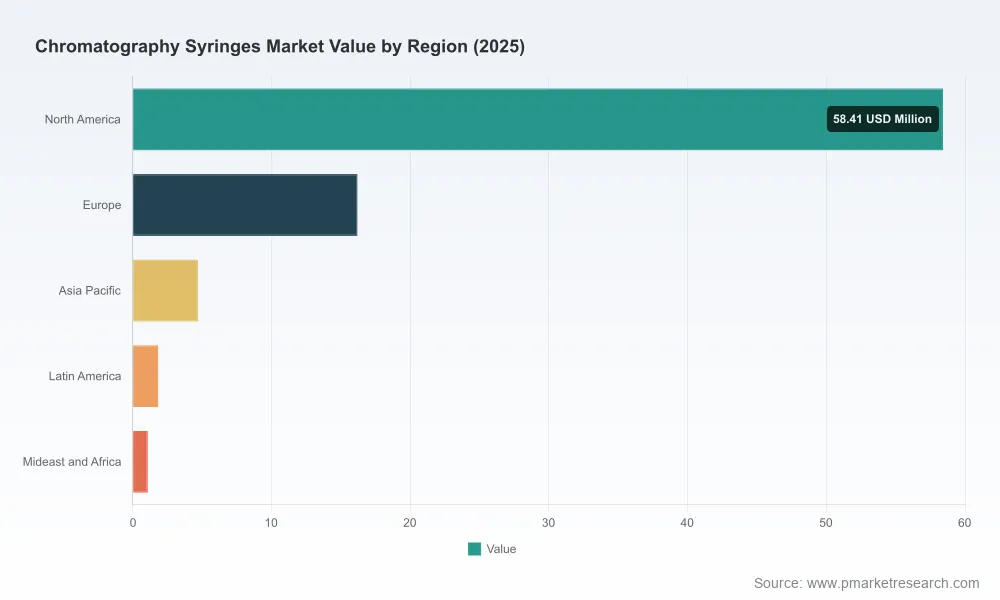
Regional dynamics further complicate the picture. Demand is not evenly distributed, and the strongest concentration of activity reflects mature analytical infrastructure, dense pharmaceutical and biotechnology footprints, and established compliance ecosystems. Other regions contribute smaller but increasingly strategic shares, often shaped by instrument installation bases, localized quality standards, and the gradual modernization of laboratory consumables procurement. The study maps these geographic patterns without reducing them to superficial rankings, instead using them to explain where supplier presence matters most, where procurement leverage is likely to shift, and which markets are positioned for faster consumable adoption as analytical capacity expands.
Chromatography Columns Market
Competitive Landscape: Convergence, Capability, and Calculated Consolidation
The competitive field is defined by a mix of instrument-adjacent manufacturers, specialized consumables specialists, and companies that have deliberately extended their reach through acquisition or collaboration. Hamilton Company continues to anchor its position through precision engineering across manual, autosampler, and thin-layer formats, with particular emphasis on plunger technology that addresses chemical resistance and carryover reduction. Agilent Technologies leverages its broader chromatography ecosystem to position autosampler syringes and needles as integral components of high-throughput, automated analysis, where specimen handling consistency is inseparable from platform performance. Thermo Fisher Scientific contributes gas-tight and fixed-needle options reinforced by traceability features that appeal directly to pharmaceutical and clinical laboratories seeking reproducible injections and auditable workflows.
Shimadzu Corporation and Restek Corporation extend the competitive palette through durable, instrument-compatible consumables and cross-brand compatibility, respectively, while SGE Analytical Science maintains a strong identity around high-precision syringes and needles for injection-critical applications. VICI AG International and Gilson, Inc. add further depth by serving automated platform integration and sample injection workflows, and PerkinElmer sustains a focused presence in micro and analytical syringe formats suited to specialized gas chromatography and related analytical tasks.
Recent industry activity underscores a market that is consolidating capability rather than merely competing on volume. A notable acquisition expanded a major player’s portfolio into specialized chromatography syringe products, signaling strategic intent to secure consumables adjacencies that strengthen end-to-end laboratory offerings. Shortly thereafter, a strategic partnership was announced to co-develop integrated syringe systems for automated chromatography platforms, illustrating how suppliers are aligning to reduce integration friction and improve performance consistency across complex workflows. These moves matter because they reshape purchasing options, alter the balance between proprietary and compatible consumables, and influence how laboratories evaluate total cost of ownership against performance assurance.
Regulatory and Operational Dynamics: The Invisible Architecture of Demand
Regulatory expectations and operational realities exert a quiet but decisive influence on market behavior. Environmental and material standards continue to encourage the use of eco-friendly components in syringe design, nudging manufacturers toward material choices that satisfy both performance and sustainability expectations. At the same time, stringent pharmaceutical requirements reinforce demand for high-precision, certified syringes in settings where injection integrity is directly tied to data reliability and regulatory compliance. Standardization frameworks further shape procurement by defining test methods for barrels, stoppers, and plastic components, giving laboratories and suppliers a shared technical language for qualification and quality assurance.
Operational incentives also drive category behavior. Single-use formats have gained prominence in high-throughput environments because they eliminate cleaning and sterilization cycles between runs, reducing turnaround time and cross-contamination risk. This preference is not simply a convenience trend; it reflects a structural calculation about labor efficiency, contamination control, and workflow continuity. For procurement leaders, that means syringe purchasing is increasingly intertwined with laboratory throughput planning, contamination management policy, and validation strategy. The study integrates these dynamics into a practical framework so that buyers can anticipate how compliance, sterilization logic, and automation goals will interact to shape demand over the forecast period.
What the Study Delivers: A Practical Architecture for Decision-Makers
The report is structured to move from market definition to actionable intelligence without forcing readers to reconstruct the logic themselves. It begins with a clear articulation of scope, base-year context, and forecast boundaries, then progresses into detailed segmentation analysis that clarifies how type, application, and regional demand patterns interact. The narrative is paired with quantitative modeling that preserves historical traceability while projecting forward under scenarios that reflect realistic procurement behavior and instrument adoption rhythms.
Chromatography Syringes Market
Competitive profiling extends beyond descriptive summaries. Each core company is examined through the lens of product architecture, integration strategy, and recent market moves, allowing readers to understand not only who is active in the space, but how they are positioning themselves for durable advantage. The analysis also tracks the implications of acquisitions and partnerships, translating corporate activity into practical outcomes for laboratories evaluating supplier stability, consumable compatibility, and portfolio breadth.
Operational and regulatory considerations are woven into the segmentation and competitive discussion rather than treated as side notes. This approach reflects the reality that purchasing decisions in this category are rarely made on technical specifications alone. They are shaped by compliance posture, sterilization policy, automation roadmaps, and the need to maintain reproducible results across shifting analytical workloads. By embedding these factors into the analytical framework, the study helps teams align sourcing strategy with broader laboratory objectives instead of treating syringes as an isolated line item.
The forecast component is designed for planning utility. It provides a disciplined projection of market scale across the forecast window while preserving the analytical logic that connects historical behavior to future expectations. Decision-makers can use this structure to evaluate budget timing, supplier diversification, inventory strategy, and the likely impact of automation or regulatory shifts on consumable demand. Because the research intentionally preserves proprietary depth for the full report, the preview emphasizes architecture and interpretive logic rather than exposing every numerical breakpoint. That design is deliberate: the study is built to reward direct engagement with the complete dataset, where scenario sensitivity, segment interplay, and supplier-specific implications can be examined with the precision that executive planning requires.
Strategic Implications for 2026 and Beyond
For organizations making decisions in 2026, the central lesson is that this market should be managed as a precision consumable environment with compounding strategic value. Procurement teams benefit from understanding where automation intensifies demand, where manual formats retain defensible relevance, and how regulatory expectations reshape qualification requirements. Supplier strategy becomes more important as integrated syringe systems and portfolio expansions alter the balance between proprietary and compatible options. Product and service leaders, in turn, need to anticipate how traceability, material compatibility, and sterilization logic will influence end-user preference over the next several years.
The broader takeaway is that chromatography syringes are no longer a passive accessory category. They are a performance-critical link in analytical workflows that increasingly demand reproducibility, automation readiness, and compliance assurance. A market expanding at a steady mid-single-digit pace may appear mature from a distance, but its internal dynamics reward careful segmentation, disciplined forecasting, and supplier evaluation tied to real laboratory outcomes. Organizations that treat the category with that level of strategic attention will be better positioned to manage cost, protect data quality, and align consumable procurement with the broader trajectory of analytical operations.
This assessment serves as a strategic prelude to the full market study. The complete research unpacks the underlying segment interplay, supplier positioning details, regional demand logic, and forecast sensitivities that executive teams need to make confident decisions. For decision-makers seeking a usable intelligence baseline rather than a superficial summary, the full report provides the depth required to convert market structure into procurement advantage, supplier strategy, and forward-looking planning clarity.
For detailed analysis of this topic, please visit the official page: Chromatography Syringes Market
Lacy Lee
Senior Marketing Manager
[email protected]
PW Consulting: www.pmarketresearch.com


























Sign in to leave a comment.