
Strategic Intelligence in the C-Reactive Protein Test Market: Navigating the 2026 Landscape
The global diagnostics landscape is undergoing a subtle but decisive shift. Inflammation biomarkers, particularly C-Reactive Protein (CRP), have moved from routine clinical adjuncts to central positioning in cardiovascular risk stratification, infectious disease triage, and precision monitoring. For executives, investors, and commercial leaders operating in the in vitro diagnostics space, understanding where this market is heading is no longer optional. It is a prerequisite for capacity planning, partnership strategy, reimbursement positioning, and product portfolio architecture.
This article serves as a strategic primer to PW Consulting's latest market research on the C-Reactive Protein Test market. It is designed to demonstrate the analytical rigor, commercial relevance, and decision-ready framing that define the full study. At the same time, consistent with a professional teaser methodology, it intentionally refrains from disclosing granular segment breakdowns, regional revenue splits, or device-level market shares. Those details reside in the complete report, where they are presented with the transparency, methodological documentation, and scenario scaffolding that serious strategic planning demands.
Why CRP Diagnostics Matter More in 2026
CRP testing has matured into a multi-layered market. What was once dominated by standard qualitative or semi-quantitative assays has evolved into a segmented ecosystem spanning high-sensitivity formulations, point-of-care platforms, and integrated cartridge-based workflows. The clinical rationale is compelling: CRP and its high-sensitivity variants continue to anchor decisions in cardiology, rheumatology, post-surgical monitoring, and acute care settings where turnaround time and analytical reliability directly influence patient pathways.
From a commercial standpoint, the market's trajectory signals durable demand rather than cyclical fluctuation. Built on a base year of 2025 and grounded in historical tracking from 2020 through 2025, the market research evaluates a forecast window extending to 2032. The overall market has been scaling steadily across the historical period, reaching a baseline of approximately 1,000 million USD in 2025. The forward outlook reflects continued expansion, with the forecast period projecting growth to roughly 1,099 million USD in 2026 and further escalation toward the 2032 horizon. These macro indicators are not merely historical artifacts; they provide the scaffolding for capacity forecasting, manufacturing planning, and long-cycle capital allocation.
Equally important is the compound annual growth rate embedded in the analysis. The study models a CAGR of approximately 6.98 percent across the forecast period, offering a disciplined benchmark against which internal growth assumptions, pipeline timelines, and investment hurdles can be tested. For senior teams, this is the kind of external reference point that helps distinguish realistic expansion plans from aggressive wish lists.
What the Research Delivers: A Practical Toolkit for Decision-Makers
A strong market study should do more than report numbers. It should translate complexity into operational clarity. The CRP market report is structured to support concrete decisions across multiple functional areas, including commercial strategy, market access, supply chain design, and competitive positioning. The full document integrates demand-side analysis, supply-side dynamics, product architecture comparisons, and macroeconomic touchpoints that influence purchasing behavior in healthcare systems.
Among the practical components included in the research are detailed assessments of product categories that reflect the current division of activity across high-sensitivity, standard, and ultra-sensitive CRP testing. Rather than treating these categories as abstract labels, the study examines how they map to real-world use cases, laboratory throughput requirements, and emerging point-of-care expectations. This framing is particularly valuable for organizations deciding whether to expand into adjacent sensitivity tiers, reposition existing reagents, or focus on workflow-integrated solutions.
The report also examines application contexts where CRP testing generates the most persistent demand. Clinical diagnostics remains the dominant setting, but the analysis extends to research and development activities and other application areas where CRP measurement supports upstream innovation and specialized monitoring programs. For companies evaluating partnerships with research institutions, contract laboratories, or specialty clinics, this broader application view helps identify where adoption momentum may be forming before it becomes visible in headline revenue figures.
In addition, the study incorporates firmographic dynamics by company size, differentiating the market behavior of large enterprises from small and medium enterprises. This distinction matters because scale shapes purchasing leverage, regulatory navigation, platform standardization, and speed of product iteration. By understanding how these two cohorts participate in the market, strategists can better calibrate go-to-market models, channel partnerships, and acquisition targets.
Competitive Landscape: incumbents, Platform Logic, and Recent Market Signals
No diagnostic market can be understood without a clear view of the companies competing within it. The CRP test space features a mix of global in vitro diagnostics leaders, specialized instrumentation providers, and firms with strong regional footprints. The full report profiles several core participants, each representing a distinct commercial approach to CRP measurement.
ProciseDx Inc. represents the point-of-care momentum now reshaping part of the market. With an FDA-cleared instrument and CRP test assay introduced in 2022, the company emphasizes rapid quantitative CRP measurement in serum within approximately five minutes using a fluorescence immunoassay architecture. This model illustrates a broader commercial theme: the premium that workflow speed and decentralized testing can command when clinical teams face time-sensitive decisions.
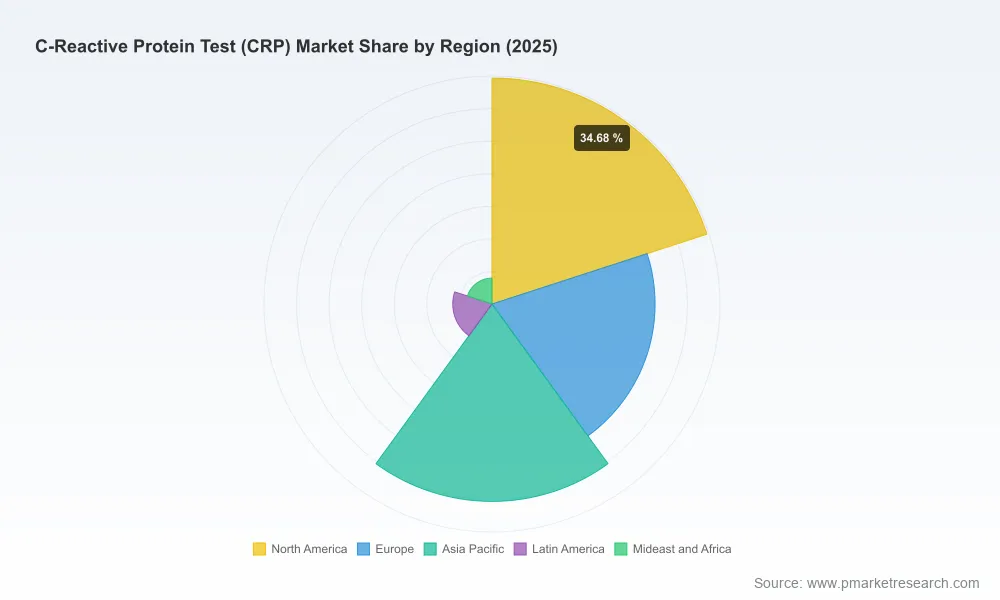
C-Reactive Protein Test (CRP) Market
Abbott Laboratories continues to reinforce its position through the Afinion CRP assay, a cartridge-based solution designed for quantitative measurement in blood, serum, or plasma with turnaround times in the three-to-four-minute range. Abbott's approach highlights the enduring appeal of streamlined, cartridge-driven point-of-care testing where laboratory burden, sample handling, and result latency are critical considerations.
Roche Diagnostics remains a central force through offerings such as CRPHS and Tina-quant C-Reactive Protein IV reagents and cartridges, delivered on cobas c and Integra systems. The company's products are used across inflammatory disorders, infection assessment, and coronary risk evaluation. Roche's presence reflects the scale advantage of integrated analyzer ecosystems and the institutional trust associated with standardized high-volume workflows.
Siemens Healthineers contributes a cardiovascular-focused angle through Dimension RCRP Flex reagent cartridges and CardioPhase hsCRP assays. With analytical ranges suitable for high-sensitivity measurement, these solutions address cardiovascular risk stratification and demonstrate how CRP testing is embedded within broader cardiac and laboratory diagnostics strategies.
Beckman Coulter, Inc. maintains a strong footprint through CRP reagents developed for quantitative determination in serum on AU/DxC and DxC chemistry analyzers. The company's recent product catalog update in October 2025, which revised instructions for use and clarified ready-to-use formulation and storage stability details, underscores an important commercial reality: in mature diagnostic categories, incremental product documentation, usability, and stability improvements can be just as strategically meaningful as major new launches.
Sekisui Diagnostics operates from a Japan-based foundation with immunoturbidimetric CRP and high-sensitivity reagent kits, reflecting the importance of methodological diversity and regional manufacturing strength. QuidelOrtho Corporation, meanwhile, continues its involvement through VITROS Chemistry Products CRP slides for quantitative measurement in serum and plasma, with ongoing maintenance and distribution activity. Notably, the market has also seen regulatory and quality-system events that shape commercial confidence, including QuidelOrtho's Class 2 recall activity in late 2024 and its subsequent resolution in early 2025.
Taken together, these profiles reveal a market where competitive advantage is rarely about a single attribute. It is the interplay of assay performance, analyzer compatibility, turnaround time, documentation quality, service reliability, and regional access that determines sustained positioning. The full report unpacks these layers with greater precision than a high-level overview can provide, including the market concentration context that signals how consolidated the leading positions have become.
Regulatory, Reimbursement, and Supply Dynamics as Strategic Variables
One of the recurring weaknesses in diagnostic market analysis is treating regulation and reimbursement as background noise. In reality, they are core drivers of purchasing behavior, product design priorities, and commercial timelines. The CRP research integrates these dynamics to help organizations anticipate operational friction before it becomes a margin problem.
On the regulatory side, the market operates within an environment shaped by evolving expectations for CRP, hsCRP, and cardiac CRP assays. FDA review criteria guidance has historically played a role in how assays are evaluated, and the report situates these expectations against the current commercial product landscape. For developers and suppliers, this matters because regulatory framing influences both product clearance strategy and the confidence of downstream buyers.
Reimbursement developments are equally important. Recent updates to the HCPCS code system from the Centers for Medicare & Medicaid Services have included changes effective for dates of service on or after January 1, 2026, along with broader code additions, deletions, descriptor revisions, and payment adjustments. A subsequent July 2026 alpha-numeric HCPCS file further refreshed the official code system. These administrative updates can affect billing workflow, coding accuracy, and the financial predictability of diagnostic testing programs. For commercial leaders, the takeaway is straightforward: reimbursement infrastructure is not static, and diagnostic strategies must be resilient enough to absorb periodic revisions without losing operational momentum.
Supply-side considerations also receive attention in the research. Reagents and cartridges for CRP assays are commonly provided in multi-test kit sizes, such as 250-test, 600-test, and 1,000-test configurations. This packaging logic influences inventory planning, reorder frequency, analyzer utilization, and cost-per-test economics. For large laboratory networks, small hospitals, and point-of-care programs alike, kit sizing and formulation stability can be decisive in determining whether a product fits smoothly into daily operations or introduces hidden administrative burden.
Using the Research for Enterprise Decisions in 2026 and Beyond
Strategic research earns its keep when it changes how teams think and act. The CRP market study is built to support a range of enterprise decisions in 2026, including:
- Portfolio prioritization across standard, high-sensitivity, and ultra-sensitive CRP offerings
- Point-of-care versus centralized laboratory segmentation strategies
- Partnership and distribution decisions in regions with distinct purchasing structures
- Capacity and reagent planning aligned with forecasted demand through 2032
- Regulatory and reimbursement readiness in the context of evolving HCPCS and FDA expectations
- Competitive positioning relative to established analyzer ecosystems and emerging rapid-testing entrants
Because the full report maintains disciplined boundaries around proprietary segmentation detail, it is especially useful for organizations that need credible external validation without exposing sensitive internal benchmarking data too early. Decision-makers can use the macro trajectory, growth rate, product structure, application distribution, firmographic patterns, and competitive context as an alignment tool for internal forecasts, board discussions, and cross-functional planning.
Why the Full Report Is Worth Accessing
This article has outlined the strategic logic behind the market research and highlighted the kinds of insights it contains. What it has not done, by design, is enumerate regional revenue splits, application percentages, product-tier market shares, or company-level figures. Those details are essential for precise planning, but they are also the core commercial value of the study. Releasing them here would undercut the very reason a comprehensive report exists: to provide decision-makers with verified, structured, and actionable intelligence that can be trusted in high-stakes planning environments.
Troponin Market
The complete report goes further by placing the market within a forecast structure that supports scenario thinking, competitive benchmarking, and operational translation. It does not merely describe where the CRP test market has been; it helps organizations prepare for where it is going. For executives navigating product launches, market entry, procurement strategy, or investment allocation, that difference matters.
In 2026, the most effective diagnostic strategies will belong to organizations that can connect clinical utility, operational workflow, reimbursement reality, and competitive pressure into a single coherent plan. PW Consulting's CRP market research is designed to help build exactly that plan, with enough depth to inform action and enough structure to support confident decisions across the forecast horizon.
For detailed analysis of this topic, please visit the official page: C-Reactive Protein Test (CRP) Market
Lacy Lee
Senior Marketing Manager
[email protected]
PW Consulting: www.pmarketresearch.com





























Sign in to leave a comment.