
Global Dissolving Pulp Market Outlook 2026: Strategic Intelligence for Executive Decision-Making
The dissolving pulp sector stands at a critical inflection point as the industry transitions from the historical baseline of 2020 through 2025 into a forecast period extending to 2032. For executives, procurement leaders, and strategic planners operating within cellulose derivatives, textile supply chains, pharmaceutical formulations, and specialty materials, the market presents a complex matrix of steady growth trajectories, concentrated supplier dynamics, raw material volatility, and shifting trade policy environments. This executive briefing outlines the strategic architecture of our latest Dissolving Pulp Market research initiative and explains why institutional stakeholders must treat this analysis as an operational necessity rather than a passive reference document.
Our research framework is built around a comprehensive historical dataset spanning 2020 to 2025, establishing a verified foundation of market performance, followed by a forward-looking projection window covering 2026 through 2032. The base year for this analysis is 2025, with all valuations expressed in USD millions. According to our consolidated data architecture, the global market reached approximately 6.63 billion in 2025, reflecting a measured but consistent expansion trajectory. The forecast horizon indicates that the sector will continue its upward march, progressing toward a valuation of 6.71 billion in 2026, advancing to 7.11 billion by 2027, and reaching 7.46 billion in 2028. The trajectory continues through 2029 at 7.53 billion, crosses the 7.74 billion threshold in 2030, and approaches 7.94 billion by 2031 before settling at roughly 8.18 billion in 2032. This layered progression translates into a compound annual growth rate of 3.05 percent across the full forecast window, a figure that demands careful contextualization rather than superficial extraction.
Why 3.05 Percent CAGR Demands Strategic Interpretation, Not Surface Reading
A headline CAGR provides only the outermost layer of market intelligence. The real strategic value lies in understanding the velocity shifts embedded within that rate, the structural drivers pushing demand forward, and the frictional forces that can compress or accelerate growth in specific segments. Our research deliberately maps the 3.05 percent aggregate rate against underlying demand signals from regenerated fiber supply chains, cellulose derivative manufacturing, pharmaceutical excipient production, food-grade applications, and specialty chemical formulations. Rather than isolating regional or application-level percentages, the analysis constructs an integrated view of how volume migration, capacity reallocation, and feedstock dynamics reshape the aggregate curve over time.
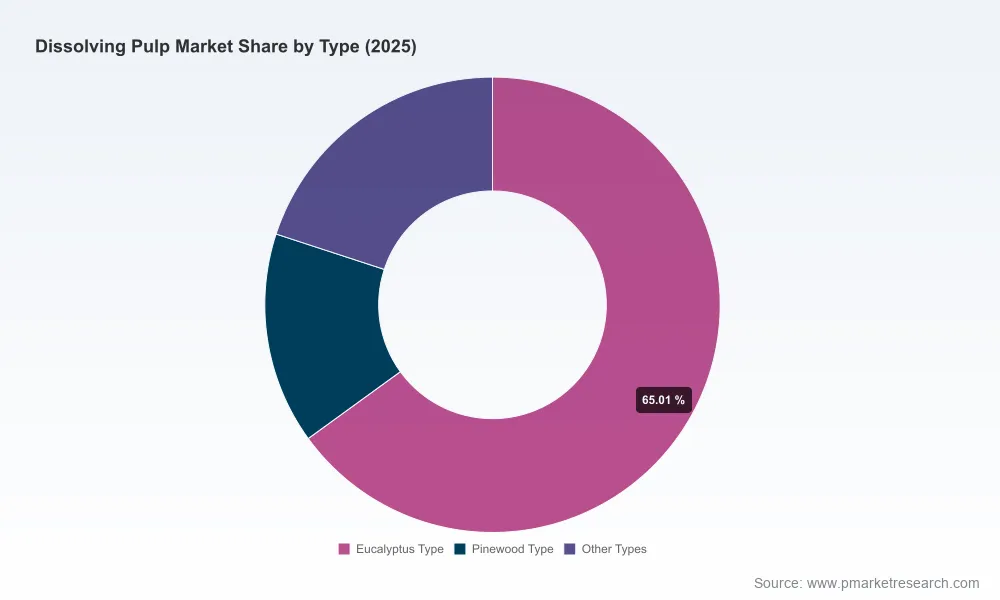
Production-side realities play an equally decisive role in shaping this trajectory. The eucalyptus-based dissolving pulp segment demonstrates substantial market weight, backed by extensive plantation infrastructure and dedicated mill capacity across multiple geographies. Pinewood-derived grades occupy a distinct positioning within the type segmentation, while other fiber categories contribute additional volume diversity. On the application spectrum, viscose-linked demand constitutes the dominant utilization pathway, with cellulose acetate and cellulose ether applications reinforcing secondary but strategically vital demand pillars. These structural relationships are examined in granular detail within the full report, where consumption intensity, capacity balance, and feedstock economics are cross-referenced against regional supply footprints and mill-level operational profiles.
Competitive Architecture: Concentration, Capacity Reallocation, and Strategic Posturing
Market concentration remains a defining characteristic of the dissolving pulp landscape. The top three players collectively command a combined market share of 51.2 percent, while the top five firms extend their collective footprint to 62.5 percent. This concentration profile signals that strategic interactions among leading producers carry outsized influence over pricing behavior, capacity deployment decisions, and regional supply security. Understanding how these firms calibrate investment cycles, optimize fiber sourcing, and respond to regulatory and logistics headwinds is essential for any organization seeking to navigate procurement cycles or evaluate partnership opportunities.
Bracell, headquartered in Brazil, operates as a global leader in dissolving pulp through its integrated mills in Bahia and Lençóis Paulista. The company produces both rayon-grade and specialty-grade dissolving pulp derived from eucalyptus plantations, supplying downstream markets that span rayon, lyocell, cellophane, medications, food formulations, and cosmetics. The strategic significance of Bracell's operational footprint becomes even clearer when examining its recent capacity reallocation move. In November 2025, the company announced that it would dedicate one full production line exclusively to dissolving pulp production beginning in 2026, removing an additional 600,000 tonnes of bleached eucalyptus kraft output from its standard schedule. This decision reflects a deliberate reorientation toward higher-value dissolving pulp streams and will meaningfully alter regional supply balances as the 2026 calendar unfolds.
Sappi Limited, based in South Africa, maintains a prominent position in dissolving wood pulp production under its Verve brand. The company's mills emphasize high-purity cellulose tailored for rayon and specialty applications, serving textile, pharmaceutical, and foodstuff end-use channels. Sappi's operational philosophy centers on maintaining consistent grade purity while scaling capacity to align with downstream demand volatility, making its mill-level execution a key reference point for analysts tracking pulp quality differentiation and supply reliability.
Rayonier Advanced Materials Inc., headquartered in the United States, specializes in high-purity dissolving pulp designed for cellulose derivatives, acetate production, and pharmaceutical applications. The company operates multiple mills with a strong emphasis on quality assurance and sustainability credentials, positioning itself as a preferred supplier for end-use markets where purity thresholds and regulatory compliance are non-negotiable. RYAM's strategic focus on derivative-grade pulp illustrates how product differentiation can serve as a buffer against commodity-cycle pressures and reinforce long-term customer retention in technically demanding segments.
Lenzing AG, operating from Austria, supplies dissolving wood pulp through its Biocel softwood and LDCel hardwood product lines. Production is supported by company-owned mills in Austria, the Czech Republic, and Brazil through its LD Celulose joint venture. Lenzing's supply chain architecture is closely aligned with regenerated fiber markets and integrates FSC-certified sourcing, reinforcing its positioning within sustainability-conscious procurement frameworks. The firm's multi-geography mill network provides geographic diversification that mitigates localized supply disruptions while maintaining traceable fiber origins for downstream textile applications.
The Aditya Birla Group, through its Grasim Industries and Birla Cellulose banner, represents an integrated production model spanning Indian facilities alongside North American assets such as AV Cell's Atholville and AV Nackawic mills in Canada. This vertically coordinated structure allows the group to supply dissolving-grade pulp directly into viscose staple fibre production pathways, reducing intermediary friction and enhancing feedstock control across the value chain. The integrated approach underscores how corporate structure and geographic diversification intersect to shape competitive positioning in a market where fiber continuity and cost management carry equal weight.
Neucel Specialty Cellulose Ltd., based in Canada, focuses on high alpha-cellulose dissolving pulp with content exceeding 90 percent, sourced from hemlock fiber. Its product slate supports rayon staple, pharmaceutical formulations, film production, and HPMC applications, with ongoing process improvements aimed at tightening quality consistency and expanding application flexibility. Neucel's technical emphasis on alpha-cellulose content illustrates a broader industry trend in which purity specifications increasingly function as competitive differentiators rather than baseline expectations.
Dissolving Pulp Market
Regulatory Friction, Feedstock Volatility, and the Redistribution of Supply Risk
The strategic calculus for dissolving pulp procurement and capacity planning cannot be divorced from the evolving regulatory and input-cost environment. In September 2025, the U.S. Department of Commerce initiated a countervailing duty investigation into high-purity dissolving pulp originating from Brazil. This development introduces a direct trade-policy variable into supply chain scenario planning, particularly for buyers and producers with cross-border exposure to Brazilian eucalyptus-based pulp. The investigation's trajectory will influence tariff exposure, sourcing flexibility, and regional pricing dynamics, making it a central component of our report's market dynamics analysis.
Feedstock conditions further complicate the operational landscape. Global eucalyptus wood chip prices rose 18 percent in 2023, driven by drought conditions in Brazil and escalating transportation costs. Although this input shock was recorded in 2023, its structural implications continue to inform procurement strategies, mill-level cost modeling, and hedging approaches across the dissolving pulp value chain. The persistence of elevated transport costs and the recurring risk of climatic disruption in key plantation regions mean that raw material pricing cannot be treated as a transient variable. Instead, it requires continuous monitoring, scenario-based budgeting, and supplier diversification where feasible.
These regulatory and raw-material pressures intersect with the competitive landscape in ways that reward proactive analysis. Capacity shifts such as Bracell's production line reallocation, combined with mill-level quality differentiation from players like Sappi, RYAM, Lenzing, the Aditya Birla Group, and Neucel, create a market environment where supply responsiveness, purity consistency, and trade-policy adaptability determine commercial advantage. Organizations that rely on static supplier assumptions or single-source procurement models face elevated exposure, while those that incorporate multi-scenario supply planning into their decision frameworks can better absorb shocks and capture opportunities as capacity and demand realign.
What the Full Research Delivers: Operational Content Built for Execution
The Dissolving Pulp Market report is structured to convert macro-level intelligence into operational clarity. Rather than presenting detached statistics, the research maps market size evolution against capacity deployment decisions, segment interaction patterns, and competitive behavior across the forecast horizon. The analysis integrates type-based and application-based demand structures with regional supply footprints, allowing readers to trace how fiber economics, mill utilization, and downstream consumption intensity interact across the 2026 to 2032 window.
Worldwide Unbleached Wood Pulp Market
Key operational components embedded in the research include:
- A detailed historical reconstruction from 2020 through 2025 that establishes verified baseline performance and isolates the growth inflection points leading into the 2026 forecast start.
- A forward-looking projection architecture that tracks how aggregate valuations progress through 2032, with scenario sensitivity built around demand migration, capacity adjustments, and input-cost variability.
- An integrated segmentation review that examines how eucalyptus, pinewood, and other pulp types interact with viscose, cellulose acetate, and cellulose ether application channels, without isolating fragmented percentage breakdowns that obscure cross-segment dependencies.
- A competitive landscape evaluation that maps market concentration, mill ownership structures, product-grade differentiation, sustainability positioning, and recent capacity decisions among major producers.
- A market dynamics module that analyzes regulatory developments, feedstock pricing behavior, logistics cost pressures, and trade-policy variables as active forces rather than background context.
- Strategic interpretation designed for procurement planning, capacity investment assessment, supplier evaluation, and risk mitigation across textile, pharmaceutical, specialty chemical, and food-related cellulose value chains.
The report deliberately avoids reducing the market to static snapshots. Instead, it presents a living analytical structure in which market size, CAGR context, competitive behavior, and input volatility are continuously cross-referenced. This approach ensures that decision-makers can evaluate not only where the market has been, but how structural shifts are likely to unfold as capacity reallocations take effect, regulatory investigations mature, and downstream demand patterns evolve under differing macroeconomic and sustainability pressures.
Strategic Value for 2026 Decision-Making
The 2026 decision environment requires a research asset that bridges historical verification, forward-looking projection, and competitive interpretation within a single coordinated framework. Organizations entering this year must evaluate whether existing supplier relationships can withstand trade-policy uncertainty, whether capacity reallocations by major producers will tighten or loosen regional supply balances, and whether demand expansion from regenerated fibers and specialty derivatives can sustain the forecast growth path amid raw material cost pressures. Each of these questions depends on a granular understanding of how market size progression, concentration dynamics, and segment economics interact over time.
Our Dissolving Pulp Market research is designed to answer those questions with precision and operational relevance. By anchoring the analysis in a verified 2020 to 2025 historical base, projecting through 2032 with a 3.05 percent CAGR framework, and contextualizing competitive moves such as Bracell's 2026 production-line reallocation alongside regulatory actions like the U.S. countervailing duty investigation, the report delivers an integrated intelligence platform for executive planning. The full document expands on the structural layers summarized here, providing the detailed segmentation mapping, competitive profiling, and scenario interpretation necessary for confident strategic action.
Accessing the complete research enables organizations to move beyond surface-level market awareness and into decision-grade analysis. The full report unpacks the interdependencies between supply concentration, fiber-grade differentiation, raw material exposure, and demand-channel dynamics that shape the market's trajectory across the forecast horizon. For leaders responsible for procurement strategy, capacity investment, product-mix planning, and supply-chain resilience, this intelligence provides the foundational clarity required to act with confidence in a market where small shifts in capacity, regulation, or feedstock economics can have outsized commercial consequences.
For detailed analysis of this topic, please visit the official page: Dissolving Pulp Market
Lacy Lee
Senior Marketing Manager
[email protected]
PW Consulting: www.pmarketresearch.com
























Sign in to leave a comment.