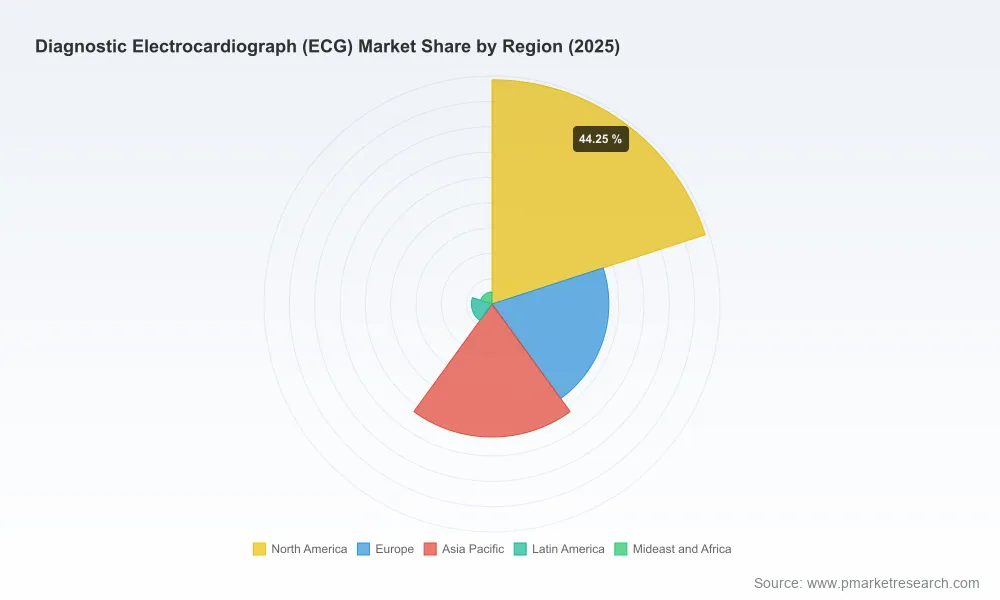

Strategic Intelligence in Cardiology Diagnostics: Navigating the Diagnostic Electrocardograph Market Through 2032
The global diagnostic electrocardiograph (ECG) market stands at a pivotal inflection point. Driven by an aging population, the escalating prevalence of cardiovascular diseases, and rapid advancements in artificial intelligence-enabled cardiac interpretation, the sector is poised for sustained expansion. Our latest market intelligence estimates that the overall market size reached approximately $8.5 billion in 2025, with projected revenue climbing to over $14 billion by 2032. This trajectory reflects a compound annual growth rate of 7.5%, underscoring a robust demand environment that rewards organizations capable of aligning product strategies, clinical workflows, and reimbursement pathways with evolving care delivery models.
For executives, procurement leaders, and clinical strategy teams, standalone growth figures tell only a fraction of the story. The real value lies in understanding how macro-level momentum translates into actionable positioning across product architectures, connectivity paradigms, end-user purchasing behaviors, and the intensifying competitive ecosystem. This report was designed to bridge that gap, offering diagnostic ECG stakeholders a comprehensive, data-driven roadmap for 2026 decision-making and beyond.
Market Trajectory and Structural Catalysts
Over the historical period of 2020 through 2025, the diagnostic ECG market demonstrated consistent upward momentum, advancing from roughly $6.5 billion to $8.5 billion. The forecast window extending through 2032 projects continuous growth, with annual revenue milestones marking steady expansion across each subsequent year. This acceleration is not merely cyclical. It is anchored in structural shifts reshaping how cardiac diagnostics are ordered, performed, and integrated into broader care pathways.
Key Growth Drivers Shaping the 2026–2032 Landscape
Several converging forces are propelling this market forward. A growing incidence of coronary artery disease, arrhythmias, and heart failure is expanding the addressable patient population, while healthcare systems increasingly prioritize early detection and outpatient monitoring to alleviate inpatient burdens. Technological maturation is equally critical. The transition from standalone hardware toward connected, software-driven diagnostic platforms is redefining clinician workflows, enabling faster interpretation, longitudinal data aggregation, and seamless integration with enterprise cardiology information systems.
Regulatory and reimbursement evolution is providing additional tailwinds. Recent guidance establishing Class II special controls for diagnostic ECG electrodes emphasizes material safety and performance standards, giving manufacturers clearer compliance frameworks while reinforcing quality expectations. Simultaneously, reimbursement mechanisms are adapting to support extended diagnostic episodes. For example, the introduction of CMS CPT code 93264 in January 2025 created reimbursement pathways for 30-day remote ECG monitoring episodes, aligning payment structures with the clinical shift toward longer-duration ambulatory assessment.
Artificial intelligence is also moving from research curiosity to cleared clinical utility. The 510(k) clearance of AI-based ECG analysis tools, such as machine-learning interpretation platforms for 12-lead recordings, signals a new phase of software-enabled diagnostics. These developments reduce interpretive bottlenecks, support risk stratification, and create differentiation opportunities for device manufacturers that can embed validated algorithms into commercial offerings. In parallel, European market access expectations continue to tighten under medical device coordination guidance, requiring robust clinical evidence for ECG diagnostic devices seeking conformity marking under the prevailing regulatory framework.
Decoding the Report: What Strategic Buyers Will Gain
PW Consulting’s Diagnostic Electrocardograph Market report is structured to convert complex market signals into executable strategy. Rather than offering superficial aggregates, the analysis dissects demand patterns, technology migration trends, and purchasing drivers across the full diagnostic ECG value chain. Below is a preview of the operational intelligence embedded within the study.
Comprehensive Market Sizing and Forward Demand Modeling
The report delivers a granular historical reconstruction and multi-year forecast built on consistent revenue metrics across the 2020–2032 horizon. Analysis captures how total market expansion decomposes across product categories, device architectures, connectivity preferences, and end-user segments. This layered sizing approach helps organizations benchmark internal performance, validate TAM assumptions, and identify high-velocity demand pockets that warrant prioritized commercial focus.
- Historical revenue reconstruction and forecast cascade across the full analysis window
- Decomposition of market scale across diagnostic system types, cardiac monitoring modalities, and mobility-focused device categories
- Breakdown of demand by lead configurations and connectivity environments, reflecting how clinical workflows and IT integration needs shape purchasing behavior
- End-user demand profiles spanning acute, ambulatory, primary, and home-based care settings to map where procurement decisions are being made
Technology and Workflow Intelligence
Electrocardiography is increasingly influenced by workflow consolidation, connectivity requirements, and clinician-facing usability. The report evaluates how different device architectures align with real-world clinical environments. From portable point-of-care systems to wearable and implantable monitoring approaches, the study maps adoption drivers, limitation factors, and integration expectations that determine whether a technology option translates into sustained commercial traction.
Regulatory, Reimbursement, and Compliance Dynamics
Navigating cardiology diagnostics requires fluency in both technical performance and policy environments. The report synthesizes current regulatory guidance, reimbursement changes, and evidence expectations that directly affect product development timelines, market entry sequencing, and pricing strategies. By connecting policy shifts to commercial implications, the analysis helps teams anticipate compliance friction and align product roadmaps with the shapes of market access.
Competitive Intelligence: The Companies Reshaping the ECG Landscape
The diagnostic ECG market is defined by a blend of established multinational manufacturers, specialized cardiac device innovators, and emerging technology entrants. With a moderately concentrated competitive structure, the top players collectively command meaningful share, yet differentiation remains highly achievable through workflow integration, AI-enabled interpretation, and form-factor innovation.
Several organizations anchor the competitive landscape. Nihon Kohden Corporation continues to develop and manufacture a full range of diagnostic electrocardiographs, including resting, portable 12-lead systems and related physiological measurement equipment. Schiller AG manufactures diagnostic ECG systems, notably its CARDIOVIT AT series for clinical resting ECG recording and analysis. Philips provides diagnostic ECG machines, cardiographs, ambulatory monitoring systems, and ECG management platforms designed for hospital and point-of-care use. GE HealthCare offers MAC series resting ECG machines with touchscreen interfaces and an integrated MUSE ECG management system. Siemens Healthineers supplies diagnostic ECG systems and cardiology solutions with syngo Dynamics for enterprise ECG management.
Beyond the traditional diagnostic equipment leaders, newer entrants are expanding the boundaries of cardiac assessment. AliveCor develops portable Kardia 12L ECG systems with a single-cable design and AI-enabled medical-grade cardiac determinations. HeartBeam produces a cable-free, credit-card-sized 3D ECG system that synthesizes 12-lead ECGs for arrhythmia assessment. Welch Allyn manufactures ELI series resting ECG machines designed for clinical diagnostic cardiology suites. Bionet produces CardioCare and Cardio7 interpretive 12-channel touchscreen ECG machines. Spacelabs Healthcare offers CardioExpress SL18A and other resting ECG systems for diagnostic cardiology. Mindray manufactures BeneHeart R series ECG machines with advanced diagnostics and connectivity.
This mix of scale players and specialized innovators is generating meaningful competitive pressure. Larger manufacturers continue to strengthen enterprise integration, interoperability, and global service networks, while nimble entrants are leveraging compact form factors, single-cable convenience, and software-defined interpretation to capture procurement attention in targeted care settings. The report examines how these positioning strategies intersect with purchasing cycles, clinical preference formation, and channel influence.
Recent Strategic Developments
Recent corporate activity underscores how fast the market is moving at the product and regulatory level. In January 2026, AliveCor received FDA clearance for next-generation KAI 12L AI technology, adding five new cardiac determinations to the Kardia 12L ECG system and expanding the total number of cleared determinations. In December 2025, HeartBeam secured FDA 510(k) clearance for 12-lead ECG synthesis software enabling arrhythmia assessment with its cable-free system. In April 2025, Nihon Kohden received CE marking for a portable 12-lead ECG device, enabling expanded European market access. In March 2026, Spacelabs Healthcare launched the new CardioExpress 4012 and 5012 resting ECG machines designed to simplify cardiac care and improve workflow efficiency.
These milestones are not isolated product news items. They reflect broader patterns: AI interpretation is becoming a competitive battleground, cable-free and compact 12-lead synthesis is gaining regulatory credibility, European market access is being strengthened through conformity milestones, and workflow simplification is increasingly central to new product launches. Understanding these patterns is essential for firms evaluating partnership opportunities, competitive response timing, and feature prioritization.
Market Structure, Concentration, and Execution Risk
Competitive intensity is compounded by a market structure that rewards scale in distribution, regulatory execution, and clinical evidence generation. The report includes market concentration analysis to illuminate where competitive density is highest and how share distribution may shape pricing negotiations, channel strategy, and differentiation requirements.
A moderately concentrated environment creates both opportunity and challenge. Organizations with broad installed bases and integrated ECG management platforms may enjoy workflow stickiness and cross-selling advantages. At the same time, buyers are increasingly attentive to consumable compatibility, software upgradeability, total cost of ownership, and interoperability with electronic health records and cardiology IT ecosystems. The report connects concentration patterns with practical commercial implications, helping teams assess where they can win on value rather than price alone.
Why This Research Is Essential for 2026 Decision-Making
The diagnostic ECG market is leaving behind an era of incremental hardware upgrades. The current trajectory favors firms that can couple diagnostic accuracy with smarter connectivity, clearer reimbursement alignment, and clinically credible software capabilities. In this environment, strategic decisions made in 2026 will influence product portfolio strength, regional expansion timing, partnership structures, and competitive positioning well into the late 2020s.
The report is built to support those decisions with rigorous structure and commercial relevance. It provides executives with a consolidated view of how demand is evolving, which device categories and connectivity models are gaining traction, how competitive activity is reshaping expectations, and where regulatory and reimbursement developments are likely to alter market accessibility. Rather than presenting raw figures without context, the analysis ties each dimension of the market to strategic implications that procurement, R&D, commercial, and market access teams can act upon.
For organizations considering product launches, channel expansion, competitive benchmarking, or investment prioritization, the full study delivers the depth required for confident decision-making. The complete segmentation breakdowns, regional demand profiles, end-user purchasing behavior, and competitor intelligence are detailed in the full report, where our analysts translate market complexity into actionable commercial guidance.
Worldwide 12 Channel Electrocardiograph Market
How to Use This Intelligence in Practice
Organizations can apply the report across multiple functional priorities:
- Portfolio and product strategy teams can map demand shifts across diagnostic system types, lead configurations, and connectivity models to inform feature roadmaps and launch sequencing
- Commercial and sales leadership can align channel focus with end-user demand patterns and workflow preferences across hospital, ambulatory, primary care, home care, and cardiac center settings
- Regulatory and market access teams can integrate FDA, CMS, and EU guidance developments into compliance planning, evidence generation, and reimbursement strategy
- Corporate development and partnership teams can assess where AI-enabled interpretation, portable form factors, and synthesized 12-lead capabilities are creating new competitive entry points
- Executive stakeholders can use the forecast architecture and competitive context to validate long-range planning assumptions and resource allocation priorities
Conclusion
The diagnostic electrocardiograph market is entering a phase where clinical value, technological integration, and regulatory alignment determine competitive advantage. With market scale expanding steadily from 2025 through 2032 and innovation accelerating across AI-enabled interpretation, compact cardiac monitoring, and workflow-oriented device design, organizations that act on timely, structured intelligence will be better positioned to capture growth and manage disruption.
This report is designed to provide that intelligence in a format built for executive use. For the full segmentation detail, regional demand profiles, end-user breakdowns, and deep competitor analysis that support 2026 strategy development, please access the complete Diagnostic Electrocardograph Market report from PW Consulting.
Diagnostic Electrocardiograph (ECG) Market
For detailed analysis of this topic, please visit the official page: Diagnostic Electrocardiograph (ECG) Market
Lacy Lee
Senior Marketing Manager
[email protected]
PW Consulting: www.pmarketresearch.com























Sign in to leave a comment.