
Navigating the Next Cycle in Furniture Performance Fabrics: Strategic Intelligence for 2026 and Beyond
The global furniture performance fabric market is entering a decisive inflection point. After navigating a contractionary environment between 2022 and 2025, the sector is demonstrating structural resilience, with market revenue projected to recover to approximately USD 5.02 billion in 2026 and accelerate steadily through the end of the decade. Our latest comprehensive research synthesizes six years of historical trajectory alongside a forward-looking forecast horizon extending to 2032, delivering scenario-ready intelligence for product development, procurement, capacity planning, and competitive positioning.
Furniture Performance Fabric Market
For executive teams operating across residential upholstery, contract furnishing, and outdoor applications, this study is not a static snapshot. It is a decision architecture designed to translate macro shifts into actionable pathways. The analysis is structured to help stakeholders anticipate demand reallocation, evaluate material substitution dynamics, and align investment timing with evolving regulatory baselines and consumer expectation curves.
Market Trajectory: Contraction, Reset, and Recovery
Historical data from 2020 through 2025 reveals a market that absorbed significant macroeconomic pressure before stabilizing. Revenue declined steadily through the mid-2020s, reflecting supply chain recalibration, pricing sensitivity in end markets, and transitional shifts in raw material economics. However, the trajectory reverses in 2026, with the market crossing back above the USD 5 billion threshold and compounding at a projected CAGR of 6.7 percent through 2032.
This growth profile matters because it signals more than volume expansion. It indicates that performance criteria are becoming non-negotiable across purchase decisions. Durability, cleanability, moisture management, and UV stability are increasingly embedded in specification requirements rather than treated as premium add-ons. The recovery is therefore fundamentally tied to value migration toward fabrics engineered for sustained service life, lower total cost of ownership, and compliance with tightening performance benchmarks.
The forecast pathway suggests that by the close of the decade, market revenue will reach a materially higher plateau than pre-contraction levels. For leadership teams, this creates a narrow but critical window to align product portfolios, channel strategies, and sourcing commitments before the next phase of competitive intensity consolidates around established performance standards.
Segmentation Architecture and Structural Demand Flows
The report dissects the market across material families, application verticals, and regional demand centers, mapping where growth is structurally anchored and where positioning risk is accumulating. Rather than treating segmentation as a static allocation exercise, the analysis emphasizes the interplay between material economics, specification behavior, and end-use durability requirements.
In material composition, the landscape is shaped by the relative performance-to-cost ratios of dominant fiber families. Investigation into substitution patterns, throughput economics, and specification migration reveals where manufacturers are gaining traction through technical differentiation and where incumbents face margin compression if they rely solely on legacy positioning. The study details how solution-dyed architectures, high-tenacity constructions, and moisture-resistant treatments are reshaping acceptable performance thresholds across contract and residential channels.
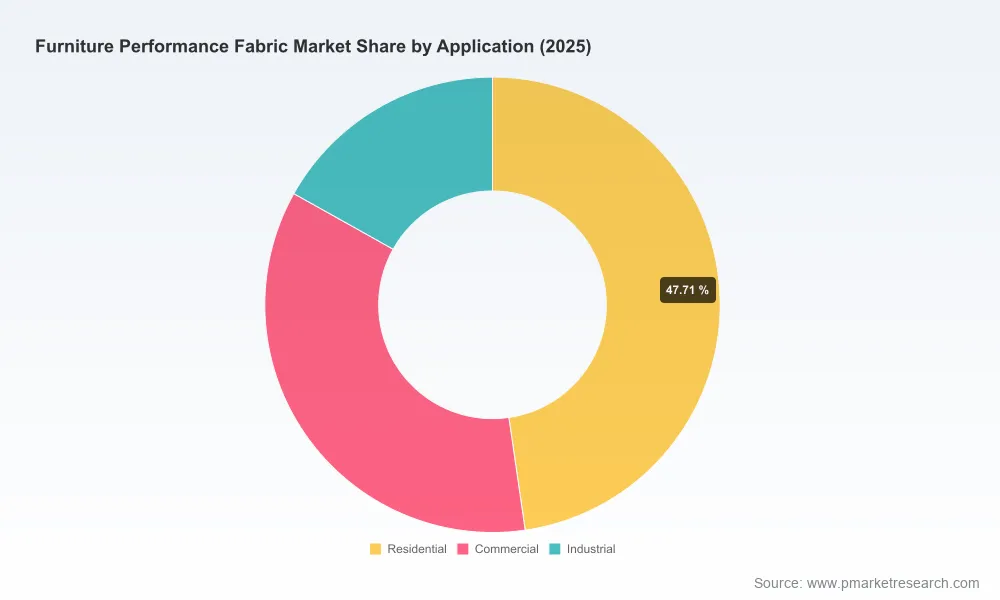
Application-side analysis separates demand behavior across residential, commercial, and industrial utilization contexts. Each vertical operates with distinct adoption cycles, testing expectations, and replacement cadences. Residential demand is influenced by lifestyle-driven preferences, ease of care, and aesthetic longevity. Commercial and contract applications are governed by specification documentation, abrasion thresholds, and lifecycle value arguments. Industrial contexts introduce additional considerations around chemical exposure, frequent reprocessing, and environmental stress. The report maps how these divergent requirements translate into volume concentration, pricing tolerance, and competitive entry barriers.
Regional analysis further contextualizes where demand scaling is most pronounced and where supply footprints must adapt. The study evaluates logistics exposure, localized production advantages, import dependency dynamics, and specification localization trends. Importantly, it identifies where regional momentum is likely to outpace broader market averages and where latent demand remains under-specified due to awareness gaps or procurement inertia.
To preserve the precision of the underlying allocations and avoid overgeneralization, the full segmentation breakdown, conversion assumptions, and scenario sensitivities are presented in the complete report. The executive summary here is designed to establish directional confidence while directing operational teams to the detailed tables for planning-grade inputs.
Competitive Positioning and Strategic Group Dynamics
The competitive field is characterized by a concentrated core of specialized manufacturers alongside a widening perimeter of regional and brand-integrated fabric suppliers. The study evaluates how leading organizations are competing not merely on aesthetics, but on engineered performance, manufacturing reliability, and specification ecosystem integration.
Sunbrella, anchored as the flagship brand of Glen Raven, Inc., remains a defining reference point for solution-dyed acrylic performance fabrics across indoor and outdoor furniture upholstery. Its scale of specification influence and brand recognition across contract and residential channels positions it as a benchmark for weather resistance, colorfastness, and application breadth. Recent operational expansion at the specialty yarn plant in Burlington, North Carolina, adding a third shift and moving the facility toward 24-hour operations five days a week, signals a deliberate push to strengthen domestic production capacity for performance fabrics. This move has direct implications for lead-time reliability, supply assurance, and responsiveness to North American specification cycles.
Specialty Textiles Incorporated (STI) operates a differentiated position through its Revolution performance fabric line, emphasizing stain resistance, durability, and contract-grade upholstery suitability. Its distribution model and focus on performance clarity for residential and contract furniture create a competitive lane centered on specification trust and application versatility rather than broad decorative assortment alone.
Crypton continues to compete on functional performance identity, with fabrics engineered for stain, moisture, and odor resistance in furniture upholstery. Its concentration on high-performance attributes and domestic manufacturing footprint supports positioning in environments where cleanability and lifecycle resilience are prioritized in procurement criteria.
Maxwell Fabrics contributes a design-forward performance proposition, offering modern-classic collections intended for contemporary residential and contract applications. Its strategic relevance lies in bridging aesthetic coherence with performance expectations, an increasingly important balance as specification teams seek fabrics that perform under stress without sacrificing visual intent.
Nuvella, associated with Ashley Furniture’s upholstery ecosystem, represents a proprietary next-generation washable fabric line engineered for stain, moisture, and wear resistance. Its integrated position within a large furniture brand environment illustrates a growing competitive vector: vertically aligned performance fabric development that ties material performance directly to end-product assurance, warranty confidence, and dealer-facing value messaging.
Concentration dynamics further inform competitive strategy. The market exhibits meaningful consolidation at the top, with the top three players accounting for over half of total market share and the top five approaching two-thirds. This level of concentration suggests that scale, specification relationships, material innovation cadence, and distribution reliability are compounding advantages. For mid-tier and emerging suppliers, the strategic challenge is not simply entering the market but establishing defensible performance claims, repeatable supply consistency, and channel partnerships that can withstand comparison against dominant incumbents.
Performance Fabric for Outdoor Market
Competitive analysis in the study extends beyond corporate profiles to examine asymmetry in R&D orientation, vertical integration choices, geographic manufacturing exposure, and specification capture tactics. The report maps where brand-led fabric programs are gaining traction, where independent performance specialists are defending margin through technical differentiation, and where consolidation risk is likely to intensify as procurement teams favor suppliers with validated consistency and documentation depth.
Regulation, Standards, and the Reshaping of Performance Baselines
Regulatory and standards activity has become a material driver of demand evolution, particularly where specifications once treated as voluntary are now influencing mandatory procurement expectations. Multiple recent developments show how performance benchmarking is being formalized across indoor and outdoor furniture applications.
In February 2026, BIFMA released the updated Furniture Surfaces Guideline, G8.1-2026, revising performance testing protocols for upholstery fabrics with an emphasis on durability and cleanability requirements in furniture applications. This update directly affects how performance claims are validated and how specification teams compare fabric options across residential and contract contexts. Then, in July 2025, BIFMA issued the Outdoor Furniture Whitepaper, OF-2025, establishing performance standards applicable to fabrics used in outdoor furniture upholstery, with explicit focus on weather and abrasion resistance. Together, these instruments reduce ambiguity around acceptable performance levels and raise the floor for competitive participation in specification-driven environments.
In parallel, the broader seating standards landscape has continued to tighten. Updated benchmarks for public and lounge seating have reinforced higher abrasion resistance expectations for upholstered fabrics in commercial and contract furniture. Where these requirements are adopted by designers, facility operators, and institutional buyers, they create a structural pull toward fabrics with stronger test outcomes and clearer compliance documentation.
These standards do not merely regulate; they educate the market. As benchmarking becomes more visible, manufacturers with robust testing narratives and transparent performance data gain a persuasive advantage. Conversely, suppliers relying on generalized claims without traceable testing alignment face increasing friction in specification meetings and procurement reviews. The research assesses how these regulatory shifts redistribute competitive leverage and influence specification decision-making timelines.
Raw Material Economics and Cost Structure Implications
Material input economics remain central to margin architecture, especially as performance fabrics increasingly depend on engineered fibers, solution-dye processes, and specialized finishing. Recent cost movements underscore the importance of procurement timing, supplier diversification, and formulation strategy.
During the third quarter of 2025, the US Polyester Filament Yarn Price Index increased by approximately 5.9 percent quarter-over-quarter, driven by restocking demand and feedstock volatility. This movement illustrates how quickly input conditions can shift when demand signals re-emerge alongside supply-side uncertainty. For fabric producers, such fluctuations affect not only direct material cost but also pricing negotiation leverage, inventory strategy, and the timing of product introductions aimed at cost-sensitive segments.
Broader PET market dynamics add further complexity. In 2025, the average global spot price of washed clear PET flake ranged from roughly 0.82 to 0.95 dollars per kilogram, compared with about 0.65 to 0.75 dollars per kilogram for virgin PET chips. The rPET premium for high-tenacity filament yarn reached an additional 15 to 30 percent over virgin equivalents. These differentials matter because sustainability positioning and circular material narratives are increasingly tied to procurement decisions, yet the economic trade-offs remain material. The study examines how these pricing relationships influence fiber selection, recycled content adoption, and the balance between performance assurance and cost control.
Rather than treating raw material volatility as a transient concern, the report incorporates it into a broader cost-structure framework. It evaluates where producers can absorb input pressure through process efficiency, where they must pass cost changes through to downstream pricing, and where blended material strategies can preserve performance objectives while managing exposure to single-commodity swings. The detailed sensitivity analysis, including scenario ranges and margin impact pathways, is provided in the full study to support procurement and finance planning.
What the Report Delivers: Operational Intelligence for Decision Teams
This market research is built for translation from insight to execution. The report is organized to support cross-functional use, giving product, sales, sourcing, and strategy teams a shared reference framework. The following elements are addressed in depth:
- Historical reconstruction of market revenue from 2020 through 2025, establishing the baseline for recovery analysis and scenario anchoring.
- Forward forecast through 2032, with a defined CAGR trajectory and revenue pathway that supports capacity planning, market entry evaluation, and portfolio timing.
- Material-type analysis covering the dominant performance fabric families, with attention to performance positioning, specification adoption, and substitution behavior.
- Application-side evaluation across residential, commercial, and industrial contexts, distinguishing demand drivers, replacement cycles, and pricing tolerance.
- Regional demand mapping that identifies where scale is accumulating and where supply localization, logistics, and specification adaptation will shape competitiveness.
- Competitive profiling of leading companies, including positioning logic, operational moves, and implications for market share dynamics.
- Standards and regulatory assessment, focusing on how updated testing guidelines and outdoor performance specifications are reshaping procurement expectations.
- Raw material cost context, integrating recent filament yarn price movements and PET/rPET pricing differentials into margin and sourcing implications.
- Market concentration analysis, clarifying the strategic significance of top-player share structures and the barriers facing challengers.
Each section is designed to connect market data with operational consequence. The intent is to help teams answer not only what is happening, but what it means for specification strategy, product roadmap priorities, supplier selection, and investment sequencing.
Strategic Imperatives for 2026 Decision-Making
As the market re-enters a growth phase, the strategic question is no longer whether performance fabrics matter, but how precisely companies will align their offerings with the performance, compliance, and cost expectations now taking hold. Several priorities emerge from the current landscape.
First, specification credibility is becoming a decisive differentiator. With updated testing guidelines and whitepapers raising the visibility of performance requirements, suppliers that can demonstrate traceable test results, consistent lot-to-lot performance, and clear application guidance will have an advantage in both contract and residential channels. Marketing claims alone are increasingly insufficient where procurement teams compare documentation depth.
Second, capacity and supply assurance are gaining strategic weight. Operational expansion decisions, such as extended production shifts and domestic capacity reinforcement, are not purely tactical. They influence lead-time reliability, specification confidence, and resilience against import-dependent volatility. Companies evaluating sourcing relationships should assess not just unit pricing but production continuity, responsiveness, and geographic risk exposure.
Third, material economics must be managed as a strategic variable rather than a passive cost. With filament yarn price movements and PET/rPET differentials affecting formulation economics, fabric producers and furniture manufacturers need to understand where recycled content, fiber blending, and process efficiency can be used to preserve performance without overexposing margins to commodity swings.
Fourth, competitive positioning will increasingly depend on alignment between fabric performance and end-product value propositions. Whether through brand-integrated fabric programs or independent performance lines, suppliers that connect cleanability, wear resistance, and weather stability to durable furniture value will be better positioned to influence purchasing decisions at the point of specification.
Conclusion: Why the Full Report Should Inform the Next Planning Cycle
The furniture performance fabric market is transitioning from a period of contraction and recalibration into a structurally expanding environment shaped by performance standards, material innovation, and concentrated competitive pressure. The macro trajectory is clear enough to warrant strategic attention, but the operational detail, segmentation granularity, specification dynamics, and cost-structure sensitivities require deeper examination than a high-level summary can provide.
This research study is designed to fill that gap. It offers a rigorous historical and forecast foundation, a structured view of segmentation and competitive dynamics, and an applied assessment of standards and raw material forces that will shape decision-making through 2032. For leadership teams planning product development, sourcing strategy, market expansion, or competitive positioning in 2026, the complete report provides the level of detail necessary to move from directional confidence to execution-ready judgment.
The full dataset, segmentation allocations, scenario sensitivities, and company-level strategic implications are available in the complete market research release. For teams that need to calibrate investment timing, evaluate supplier relationships, or refine performance-led product strategy, the detailed intelligence within the report is the critical next step.
For detailed analysis of this topic, please visit the official page: Furniture Performance Fabric Market
Lacy Lee
Senior Marketing Manager
[email protected]
PW Consulting: www.pmarketresearch.com























Sign in to leave a comment.