
Navigating the AI GPU Supercycle: Strategic Intelligence for Enterprise Leaders in 2026
The global artificial intelligence infrastructure market has entered a phase of unprecedented expansion, fundamentally reshaping capital allocation, supply chain strategy, and competitive positioning across the enterprise landscape. Our latest Worldwide AI GPU Market research offers a definitive analytical framework for decision-makers navigating this volatility. Spanning historical performance from 2020 through a comprehensive forecast window extending to 2032, this study maps the architectural, regulatory, and competitive shifts that will dictate returns on technology investment throughout the decade.
For executives and strategy teams operating in 2026, the imperative is no longer to recognize that demand is surging. The imperative is to understand where compute capacity is concentrating, which architectural paradigms will dominate specific workload classes, and how geopolitical trade mechanisms will reroute hardware flows. This report is engineered to convert macroeconomic momentum into actionable procurement roadmaps, partnership assessments, and risk-mitigation strategies. The following overview outlines the analytical depth contained within the full publication while highlighting the structural forces that will define market outcomes over the next several years.
The Trajectory of a Decade: Scaling Infrastructure, Shifting Capex Postures
The AI GPU sector has transitioned from an emerging technology niche to a foundational infrastructure pillar at remarkable velocity. Market valuation has expanded from approximately 3.8 billion dollars in 2020 to a base-year valuation of 128.0 billion dollars in 2025, representing a compound annual growth rate of 30.14 percent across the historical window. The forward outlook maintained in our model extends this trajectory through 2032, charting a continued expansion toward an 803.21 billion dollar endpoint. Such growth is not merely linear acceleration; it reflects a structural reorientation in how organizations deploy computational resources, moving from experimental pilot programs to production-grade, mission-critical AI workloads that demand sustained, high-throughput accelerator capacity.
Worldwide AI SoC Market
For corporate strategists, these headline figures carry enforceable operational implications. The magnitude of forecasted expansion signals that hardware procurement cycles will remain under persistent strain, requiring multi-year capacity commitments, diversified supplier relationships, and disciplined total-cost-of-ownership modeling. It also indicates that the window for organic capacity planning before encountering supply bottlenecks is narrowing. Organizations that delay architectural standardization or postpone cloud versus on-premises workload placement decisions will face escalating premium pricing and constrained access to next-generation accelerator generations.
Architectural Realignment and the Memory Bandwidth Inflection Point
A defining theme of the current market cycle is the shifting bottleneck equation within accelerator design. Raw compute throughput alone no longer guarantees competitive performance; rather, data movement and memory bandwidth have emerged as the primary constraints on real-world AI GPU effectiveness. High Bandwidth Memory has become the critical enabling technology for modern accelerators, with supply dynamics reflecting a highly concentrated ecosystem. SK Hynix currently holds approximately 62 percent of the HBM supply market, a position that directly influences the manufacturing cadence and delivery timelines of accelerators from leading silicon developers.
This memory-centric performance reality is propelling the industry toward HBM4 adoption in next-generation architectures, including forthcoming AMD and NVIDIA accelerator families. The transition carries meaningful design, thermal, and integration consequences. It also creates a parallel supply chain dependency that procurement teams must monitor closely. Our report dissects how memory technology roadmaps intersect with discrete GPU and integrated SoC segments, clarifying which workload categories will benefit most from specialized acceleration versus unified silicon platforms. The discrete GPU architecture remains the dominant revenue category, while integrated solutions continue to capture targeted deployments where power efficiency, form factor, and cost discipline outweigh maximum throughput requirements.
Competitive Architecture Wars: Hyperscalers, Silicon Incumbents, and the Rise of Custom Silicon
The competitive landscape is defined by extraordinary concentration and rapid architectural differentiation. The market exhibits a pronounced consolidation pattern, with the leading trio of suppliers accounting for a dominant share of total revenue and the top five firms capturing an even larger majority of industry output. This structure places extraordinary strategic weight on a small number of silicon roadmaps, partnership decisions, and contract manufacturing relationships.
NVIDIA continues to anchor the market with its successive accelerator architectures, advancing from Hopper through Blackwell variants and preparing its next-generation Rubin family for data center training and inference workloads. The firm's strategic position is reinforced by an expanding ecosystem of design and manufacturing collaborations, including a recent initiative with major EDA and engineering software providers to embed AI agents into chip design, verification, and production workflows. This ecosystem expansion illustrates how incumbents are moving beyond silicon supply into workflow-level integration, gradually raising switching costs for enterprise buyers.
AMD presents the most formidable alternative trajectory, leveraging its Instinct accelerator series as a cost-competitive option for high-performance training and inference. Its roadmap has gained additional momentum through a strategic expansion of its HBM4 supply agreement with Samsung, ensuring memory capacity for its next-generation Instinct platforms and EPYC processors within the Helios rack-scale architecture. AMD's planned introductions later in 2026 reinforce a narrative of intensifying architectural competition and supply diversification, which benefits enterprises seeking pricing leverage and redundancy.
Worldwide AI Server PCB Market
Intel is repositioning around inference-optimized and energy-efficient accelerator propositions, with its Gaudi 3 product and upcoming data center GPU programs targeting workloads where power consumption and silicon cost efficiency are paramount. The Crescent Island design, unveiled for AI inference applications, highlights an approach centered on large memory capacity and power-optimized configurations, an angle likely to resonate with enterprises managing operational expenditure constraints at scale.
Simultaneously, hyperscale cloud operators are accelerating their custom silicon agendas. Alphabet continues to advance its Tensor Processing Unit lineage, including seventh-generation Ironwood units for internal and cloud-based workloads. AWS extends its Trainium and Inferentia family to reduce dependency on third-party accelerators across its infrastructure. Microsoft is advancing its Maia accelerator program for Azure, further evidencing the strategic push by cloud majors to internalize critical compute supply. Broadcom has carved out a distinct role by designing bespoke AI accelerators and networking solutions for hyperscalers, generating growing revenue from customized silicon programs. Cerebras Systems remains a specialized contender, pursuing wafer-scale architectures that cater to specific large-model training paradigms.
This multi-venue competition is not merely a product rivalry. It is a restructuring of supply availability, pricing dynamics, and architectural optionality for the broader enterprise market. Decision-makers must evaluate whether to align with vendor-specific software ecosystems, pursue heterogeneous accelerator portfolios, or negotiate long-term capacity guarantees across multiple silicon providers.
Geopolitical Friction and the Rewiring of Hardware Flows
The global AI GPU market cannot be analyzed in isolation from the regulatory architecture governing advanced semiconductor trade. In January 2026, the U.S. Department of Commerce Bureau of Industry and Security revised its license review policy for advanced AI semiconductors destined for China. The shift moved the default posture from a presumption of denial toward a case-by-case review framework, subject to conditions including a 25 percent tariff, a volume cap equivalent to 50 percent of U.S. sales, third-party testing requirements, and enhanced customer due diligence obligations. This mechanism affects prominent accelerator models and equivalent-class offerings, altering how manufacturers structure regional supply allocation and how enterprises plan multi-region deployment architectures.
These controls reflect an ongoing policy trajectory that seeks to limit the transfer of high-performance AI computing capacity with potential military or strategic applications, while preserving limited commercial access under strict compliance conditions. For multinational enterprises, the practical consequence is an increasingly fragmented procurement landscape where region-specific inventory strategies, localized cloud capacity planning, and trade-compliance workflows become integral to infrastructure budgeting. Our report analyzes the intersection of these regulatory developments with regional demand concentration, illustrating why North America continues to command the largest share of market activity, while Asia Pacific and Europe maintain substantial and growing demand profiles shaped by distinct industry mixes and policy environments.
Where Compute Flows: End-User Demand and Strategic Allocation
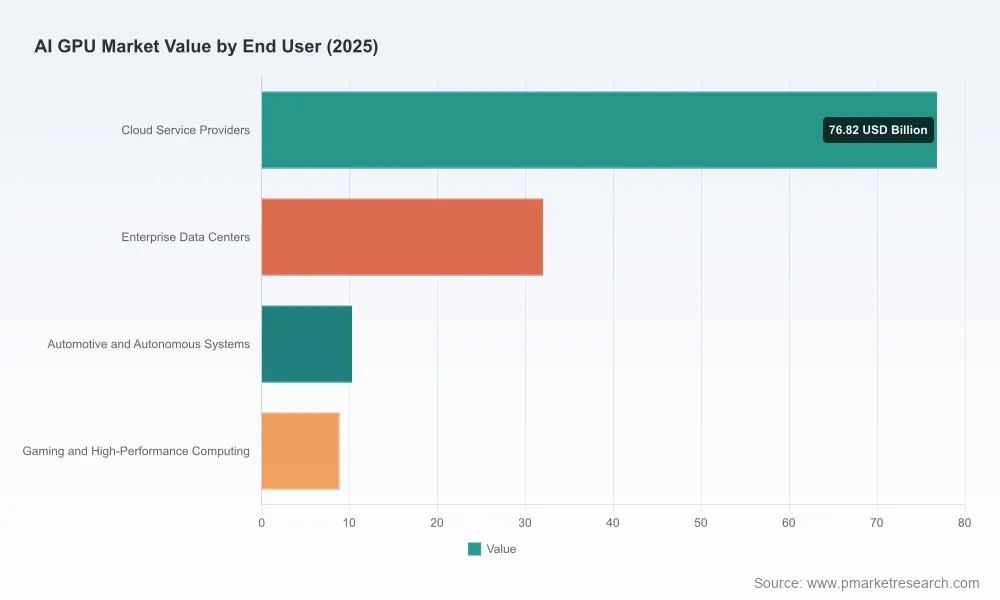
Demand is not uniformly distributed across application domains or organizational types. Cloud service providers represent the largest end-user category, reflecting the sustained build-out of AI infrastructure to support model training, inference serving, and platform-as-a-service offerings. Enterprise data centers constitute the next major demand pillar, as corporations internalize AI workloads for proprietary analytics, operational automation, and customer-facing intelligence systems. Beyond these primary categories, automotive and autonomous systems applications and gaming and high-performance computing segments each contribute distinct demand signatures, shaped by latency requirements, throughput profiles, and deployment environments.
This segmentation matters because each end-user class imposes different procurement parameters. Cloud providers prioritize volume commitments, manufacturer roadmaps, and long-term supply assurance. Enterprise data centers weigh integration complexity, power and cooling constraints, software ecosystem maturity, and vendor support. Automotive and HPC deployments add specialized reliability, thermal, and certification considerations. Our research evaluates these demand distinctions without collapsing them into generic growth narratives, providing leaders with the context needed to align infrastructure investments with workload maturity and operational risk tolerance.
What the Full Report Delivers: Frameworks, Forecasts, and Operational Playbooks
This Worldwide AI GPU Market study is structured to support direct application in strategy sessions, procurement reviews, and capital-planning cycles. Beyond macro trend documentation, the report delivers a detailed segmentation analysis across regions, architecture types, and end-user categories. It examines supply chain dependencies, including memory technology constraints and advanced packaging implications, and maps how those dependencies influence delivery timelines and cost structures. The competitive assessment extends beyond product catalogs into ecosystem lock-in dynamics, partnership networks, and the strategic implications of custom silicon development among hyperscale operators.
PW Consulting
We also incorporate forward-looking regulatory scenario analysis, enabling readers to model the potential impact of export-control adjustments, tariff structures, and compliance requirements on regional capacity availability and pricing. The forecast methodology traces how historical acceleration translates into differentiated growth velocities across segments, giving executives a credible basis for scenario planning rather than single-point projections. For organizations evaluating build-versus-buy decisions, cloud commitment structures, or multi-supplier strategy, the report offers a structured basis for comparing alternative architectural paths and risk exposures.
Turning Market Velocity into Strategic Advantage
The global AI GPU market is expanding at a pace that rewards organizations capable of translating momentum into disciplined, evidence-based planning. The transition from compute scarcity to architectural choice, from single-vendor reliance to diversified silicon strategy, and from centralized procurement to region-aware supply design requires analytical rigor that general market narratives cannot provide. Our research is designed to fill that gap by delivering granular segmentation context, competitive roadmap intelligence, and regulatory scenario frameworks that can be embedded directly into 2026 decision processes.
For leaders seeking to align infrastructure investment with workload requirements, assess supplier concentration risk, and anticipate how memory technology, export policy, and custom silicon development will reshape procurement options, this report provides the strategic foundation. The macro trajectory is clear, but the operational implications depend on the specific segmentation choices, architectural commitments, and compliance postures an enterprise adopts. Accessing the complete analysis enables decision-makers to move beyond surface-level market awareness and into the level of detail required to secure capacity, manage cost exposure, and position for the next phase of the AI infrastructure cycle.
For detailed analysis of this topic, please visit the official page: Worldwide AI GPU Market
Lacy Lee
Senior Marketing Manager
[email protected]
PW Consulting: www.pmarketresearch.com
























Sign in to leave a comment.