
Strategic Imperatives in the Global Antifreeze Recycler Market: Navigating Growth, Compliance, and Competitive Dynamics Through 2032
The worldwide antifreeze recycler market stands at a critical inflection point as industrial operators, fleet managers, and environmental compliance teams recalibrate their fluid management strategies for the coming decade. Between 2020 and 2025, the sector expanded from approximately 362.4 million USD to 487.36 million USD, reflecting sustained demand for closed-loop coolant recovery, regulatory-driven waste minimization, and the economic appeal of reclaimed engine coolants. Looking ahead, our comprehensive market research projects the industry to reach an estimated 738.63 million USD by 2032, underpinned by a compound annual growth rate of 6.12 percent across the 2026 to 2032 forecast horizon. For executives evaluating capital allocation, vendor partnerships, or in-house recycling infrastructure, these trajectory signals translate into tangible strategic questions: which operational models will capture the highest margin pools, how will regulatory frameworks reshape procurement behavior, and where should firms position themselves to outpace consolidation among established recyclers and equipment manufacturers. This article outlines the analytical architecture of our newly released Worldwide Antifreeze Recycler Market study and explains why decision-makers in 2026 should treat its findings as a foundational input to capital planning, supplier evaluation, and market-entry assessments.
Why 2026 Demands a Refined Market View
The 2026 operating environment introduces competing forces that make legacy market assumptions insufficient. On the supply side, feedstock dynamics continue to influence total cost of ownership for both virgin and reclaimed coolants. Ethylene glycol, the primary feedstock for conventional antifreeze formulations, exhibited price volatility throughout 2025, with regional benchmark levels such as USA CIF readings registering around 634 USD per metric ton in early 2026. Simultaneously, propylene glycol pricing in North America touched 1.57 USD per kilogram in March 2026, a 6.8 percent upward movement from December 2025, reflecting tighter supply conditions linked to scheduled maintenance shutdowns and demand pull from antifreeze manufacturing. These input-cost signals do not simply pressure margins; they reshape the economic case for on-site recovery versus third-party reclamation, alter payback calculations for recycling equipment, and influence the blend strategies that service providers offer to end users. For procurement leaders, the implication is clear: evaluating antifreeze recycling options now requires a forward-looking lens that integrates raw material trajectory, recovery efficiency, and compliance risk rather than relying on historical price spreads alone.
On the demand side, the market is being steered by a combination of operational efficiency targets and regulatory tailwinds. Federal procurement guidance encourages the use of reclaimed engine coolant for vehicle maintenance, positioning recycled antifreeze as a preferred option within broader waste minimization and environmental objectives. At the generator level, used antifreeze is generally presumed non-hazardous when managed separately and kept distinct from contaminating streams, although facilities must still perform hazardous waste determinations if contamination is suspected. Several jurisdictions further streamline the process by classifying antifreeze under universal waste frameworks or offering expedited recycling rules, which reduces manifest burdens and permitting friction for legitimate reclamation activities. Together, these dynamics lower the administrative barrier to recovery programs while reinforcing the compliance value proposition of certified recycled products. The result is a market in which economic and regulatory incentives increasingly align, but the precise allocation of growth across customer segments, equipment formats, and geographies requires disciplined segmentation analysis to separate structural expansion from short-term substitution effects.
Report Architecture: What Decision-Makers Will Find Inside
Our study is structured to support both strategic planning and tactical evaluation. Rather than presenting a single aggregated figure, the analysis disaggregates market activity across type, application, and regional dimensions, then cross-references these slices against pricing behavior, regulatory schedules, and competitive intensity. This design allows executives to test hypotheses about where investment should flow, which customer groups generate the most reliable recovery volumes, and how equipment preferences differ between mobile service operations and fixed-site industrial facilities.
Worldwide Antifreeze Recycler Market
The report contains the following practitioner-oriented components:
- Macro trajectory analysis covering historical performance from 2020 through 2025 and a ten-year forecast extending to 2032, with explicit attention to the forces likely to accelerate or moderate growth in each phase of the cycle.
- A structured segmentation framework that examines portable versus stationary antifreeze recyclers and maps application-level demand patterns across automotive repair shops, transportation fleets, industrial manufacturing, and construction and mining operations.
- Regional assessment of market activity that highlights where recovery infrastructure, service density, and compliance-driven procurement are most pronounced, enabling readers to calibrate geographic priorities without oversimplifying local regulatory nuance.
- Competitive profiling of leading participants, including operational footprint, technological differentiation, certification alignments, and recent product or service enhancements that signal where the market is heading.
- Input-cost and raw-material context that ties ethylene glycol and propylene glycol price behavior to downstream recycling economics, helping finance and procurement teams model sensitivity around feedstock volatility.
- Regulatory and standards mapping that connects federal procurement guidance, RCRA presumptions, universal waste pathways, and technical specifications such as ASTM benchmarks to practical procurement and compliance decisions.
- Strategic readouts that translate the quantitative base into actionable implications for capacity planning, vendor selection, service-model design, and market-entry timing.
By organizing the intelligence this way, the study gives leaders a way to test internal assumptions against an external, evidence-based baseline. Readers can identify which segments exhibit the strongest structural demand, where equipment providers are concentrating innovation, and how regulatory clarity is removing barriers that previously slowed the adoption of closed-loop coolant recovery.
Segmentation Dynamics: Types, Applications, and Regional Weighting
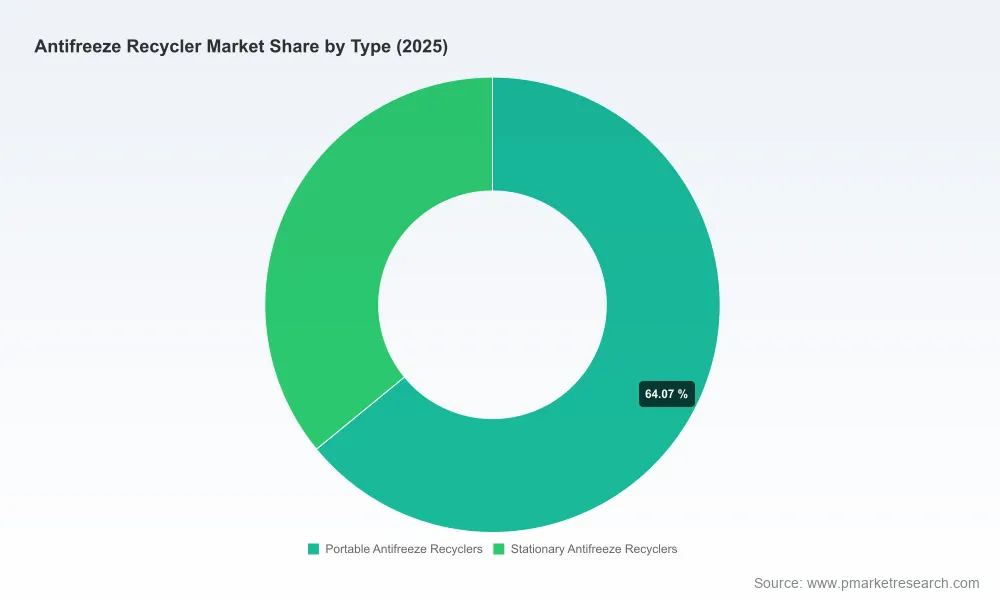
The market’s structure reveals where value creation is most concentrated and where execution risk varies. In terms of equipment type, portable antifreeze recyclers command a significant share of activity, reflecting the needs of mobile service providers, dealership networks, and field-based fleet maintenance operations that prioritize rapid turnaround, flexibility, and reduced downtime. Stationary systems, meanwhile, serve higher-volume, fixed-site environments where continuous processing, integration with existing fluid-handling infrastructure, and long run-time efficiency are paramount. The balance between these two formats is not static; it shifts according to the intensity of on-site processing, the scale of coolant consumption, and the extent to which organizations prefer capital ownership versus outsourced reclamation services.
Application-level demand patterns further clarify where recovery volumes and recurring service relationships are strongest. Automotive repair shops represent the largest single application pool, driven by steady vehicle throughput, the need to maintain OEM-compatible coolant quality, and the operational convenience of recovering and reusing fluid on site or through certified service partners. Transportation fleets follow as a major demand center, with centralized maintenance operations seeking to control coolant spend, reduce disposal exposure, and standardize fluid specifications across large vehicle populations. Industrial manufacturing, construction, and mining contribute additional demand, often with different priorities such as compatibility with metalworking fluid management, tramp oil removal, and robust equipment performance under heavy-duty conditions. The interplay among these applications matters because each segment carries distinct buying criteria, volume profiles, and compliance expectations, meaning that growth in one pool does not automatically translate into proportional gains for every supplier or equipment format.
Regionally, the market displays uneven distribution that reflects differences in industrial density, service infrastructure maturity, regulatory cadence, and fleet composition. North America remains a substantial activity center, supported by well-established service networks, federal procurement encouragement, and a broad base of generators seeking compliant coolant recovery. Europe follows as another significant region, where environmental directives and industrial coolant management practices shape demand for both equipment and reclamation services. Asia Pacific represents a growing area of interest as industrial activity, transportation expansion, and localized fluid-management capabilities continue to develop. Latin America and the Middle East & Africa, while currently smaller in absolute activity, offer targeted opportunities where fleet operators and industrial facilities look to improve coolant lifecycle management and reduce waste-handling exposure. The study examines these regional patterns without reducing them to oversimplified scorecards, instead emphasizing how local regulatory environments, feedstock availability, and service economics interact to shape realistic growth pathways.
Competitive Landscape: Ten Profiles and the Consolidation Signal
Competitive dynamics in this market are defined by a mix of fluid reclamation specialists, equipment manufacturers, and integrated service providers. The study profiles ten companies whose strategies illustrate the principal ways firms are competing for share: through proprietary purification and distillation technologies, standardized compliance-aligned products, turnkey recycling operations, and specialized fluid-handling components that enable downstream recovery systems.
GlyEco, Inc. operates across multiple U.S. facilities with a focus on processing waste glycol into high-quality recycled automotive antifreeze and specialty blends. Its distillation and blending capabilities, including a large re-distillation plant meeting recognized coolant specifications, are supported by collection relationships spanning thousands of generators. The company’s emphasis on meeting ASTM and OEM specifications for bulk recycled products highlights a broader industry shift toward quality assurance as a differentiator, particularly for customers who must demonstrate that reclaimed coolant performs reliably in mixed-fleet or warranty-sensitive environments.
KFM, LLC takes a different route with its Coolant Purification System™, a portable ion-exchange and resin-bed recycler built around high recovery rates and substantial flow capacity. Its alignment with defense and commercial standards, along with turnkey ancillary equipment offerings, illustrates how portable systems can serve government, automotive, and commercial users that require both performance verification and operational simplicity. Eriez Manufacturing Co. complements this equipment-focused perspective with coolant recycling systems that emphasize filtration, coalescing, and centrifugation to remove tramp oil and solids while minimizing production interruption. Its recent enhancement of an antifreeze recycler model to improve efficiency and turnaround speed underscores the ongoing product-evolution cycle that equipment providers are pursuing to maintain relevance in a market where downtime and processing speed directly affect customer economics.
Antifreeze & Coolants Market
On the service side, Heritage-Crystal Clean and Clean Harbors, through its environmental and Safety-Kleen operations, provide closed-loop collection, recovery, and reclamation capabilities with regional recovery centers and broad automotive fluid service portfolios. These providers illustrate the value of integrated logistics and compliance management, where the ability to handle used antifreeze alongside oil, filters, and related wastes creates operational efficiencies and reduces the administrative burden for generators. The remaining profiles, including PRAB, Finish Thompson, Diversified Manufacturing, ETL Fluid Experts, and Master Fluid Solutions, contribute additional depth across fluid filtration, pump and handling equipment, on-site purification systems, and metalworking-fluid-adjacent reclamation expertise. Taken together, these companies reveal a landscape in which competitive advantage increasingly depends on combining technical reliability, standards conformance, and service reach rather than competing on price alone.
Market concentration data further contextualizes this landscape. The combined share of the top three firms stands at approximately 34.5 percent, while the top five reach about 48.25 percent. This level of concentration suggests a market that is neither fully fragmented nor tightly consolidated, leaving meaningful room for specialized players to differentiate while also signaling that scale, compliance credibility, and technological capability will matter more as operators compare vendors and service partners. For 2026 decision-makers, the strategic implication is that vendor evaluation should extend beyond unit economics to include recovery consistency, certification coverage, geographic service density, and the ability to support both portable and stationary requirements as operations evolve.
Regulatory Context and the Compliance-Economics Intersection
Regulatory clarity continues to function as a market accelerant by reducing uncertainty around the handling, transport, and reuse of used antifreeze. Federal procurement preferences for reclaimed engine coolant reinforce the legitimacy of recycled products in institutional and fleet settings, while RCRA-related presumptions that used antifreeze is non-hazardous when properly managed simplify waste determination for many generators. Where states designate antifreeze under universal waste rules or offer streamlined recycling pathways, the administrative load associated with manifests and permitting can be reduced, making recovery programs more practical for a broader set of operators. These frameworks do not eliminate due diligence—facilities still need to verify contamination status and ensure that downstream processors meet applicable specifications—but they do lower friction for organizations that want to pursue compliant reuse without building in-house reprocessing capability from scratch.
For procurement and sustainability teams, this regulatory backdrop interacts directly with economics. When virgin feedstock costs are elevated or volatile, the case for recovery strengthens, but only if the recycled product can meet performance requirements and the recovery process does not introduce hidden compliance or handling risks. The study therefore examines how procurement guidance, waste classification assumptions, and technical specifications intersect with the cost structure of recycling equipment and reclamation services. This integrated view helps leaders decide whether to invest in on-site processing, contract with certified reclaimers, or pursue a hybrid model that balances control, cost, and compliance risk.
What to Expect in the 2026 to 2032 Window
As the market moves through the forecast period, several strategic themes are likely to shape competitive outcomes. Feedstock price behavior will continue to influence the relative attractiveness of reclaimed coolant versus virgin formulations, with procurement teams increasingly modeling sensitivity around ethylene glycol and propylene glycol trends when evaluating total cost of ownership. Equipment providers will keep refining portable and stationary systems for faster turnaround, higher recovery efficiency, and easier integration with existing fluid-handling workflows, while service providers expand regional recovery capacity and strengthen certification alignment to capture demand from fleets and industrial users seeking consistent quality. Regulatory frameworks are expected to maintain their supportive role for reclaimed products, particularly where federal procurement guidance and state-level universal waste pathways reduce compliance friction. At the same time, consolidation pressure may intensify among firms that can combine technology, service reach, and compliance assurance at scale, while specialized players may find opportunity by targeting application-specific needs or regional service gaps.
The study’s ten-year forecast base, extending from 2026 through 2032, provides a structured way to test these themes against quantified trajectory signals. By linking historical performance, segmentation behavior, raw-material context, and competitive positioning, the analysis offers executives a basis for scenario planning rather than a single deterministic outlook. That distinction matters in a market where operational decisions—purchasing equipment, selecting a reclamation partner, expanding recovery coverage, or standardizing coolant specifications—can lock in costs and capabilities for years.
How to Use This Research for 2026 Decision-Making
Leaders evaluating antifreeze recycling strategies in 2026 can use the full report to stress-test assumptions across multiple dimensions. Procurement teams can compare the economic logic of on-site recovery against outsourced reclamation under varying feedstock price scenarios. Operations leaders can assess whether portable or stationary solutions better fit their maintenance footprint, downtime tolerance, and coolant volume profile. Sustainability and compliance functions can align coolant recovery programs with procurement guidance, waste classification assumptions, and regional regulatory pathways to reduce exposure while improving lifecycle performance. Commercial teams entering or expanding in this space can use the segmentation and competitive profiles to identify underserved application pockets, evaluate partnership opportunities, and calibrate go-to-market timing against the growth trajectory projected through 2032.
Because the complete dataset, segmentation detail, regional analysis, and company-level assessments are necessary to translate these strategic themes into precise plans, we recommend accessing the full Worldwide Antifreeze Recycler Market study for comprehensive figures, scenario breakdowns, and practitioner-ready appendices. The research is designed to serve as a decision-grade reference for executives who need more than a headline number: it provides the segmentation logic, competitive context, and regulatory-economic interplay required to act with confidence in a market that is expanding steadily, consolidating selectively, and increasingly shaped by the intersection of compliance incentives and feedstock economics.
For detailed analysis of this topic, please visit the official page: Worldwide Antifreeze Recycler Market
Lacy Lee
Senior Marketing Manager
[email protected]
PW Consulting: www.pmarketresearch.com



























Sign in to leave a comment.