
Global Down-The-Hole Hammer Market Strategic Outlook 2026
Navigating Capital Expenditure in a Maturing Rock Drilling Landscape
As the global construction and mining sectors transition from post-pandemic recovery phases into a period of stabilized capital expenditure, equipment procurement strategies are undergoing a significant recalibration. For stakeholders involved in rock drilling operations, the Down-The-Hole (DTH) hammer market represents a critical nexus of technological advancement and operational efficiency. Our latest comprehensive analysis, the Worldwide DTH Hammer Market Report, provides a granular look at the forces shaping demand, supply chains, and competitive positioning through 2032.
This research is not merely a collection of historical statistics; it is a strategic tool designed to inform procurement, investment, and product development decisions in the immediate fiscal year and beyond. By understanding the trajectory of the DTH hammer industry, enterprises can better anticipate supply constraints, evaluate vendor reliability, and align their operational capabilities with incoming macro-economic shifts.
Market Trajectory and Historical Context
The DTH hammer market has demonstrated resilience over the past half-decade, navigating fluctuations in raw material costs and varying demand cycles across key industries. Our analysis covers historical performance from 2020 through 2025, establishing a baseline of stability before projecting forward momentum. The data indicates that the global market revenue reached approximately USD 822.0 Million in the base year of 2025. This figure encapsulates the aggregated value of various hammer types and applications across all major geographical zones.
Looking toward the forecast period spanning 2026 to 2032, the market is expected to follow a steady growth trajectory. While short-term fluctuations may occur due to logistical adjustments or regional demand shifts, the long-term compound annual growth rate suggests a consistent upward trend. By the end of the forecast window in 2032, the market valuation is projected to approach a significant milestone, driven by sustained activity in mining extraction and infrastructure development.
Strategic planners should note that the transition from 2025 to 2026 reflects nuanced adjustments in global supply chains. The data suggests a market that is consolidating around high-efficiency technologies rather than experiencing volatile expansion. This stability offers a conducive environment for long-term contracting and capital investment in drilling fleets.
Key Drivers and Operational Dynamics
Several macroeconomic and industry-specific factors are converging to influence the DTH hammer landscape. One primary driver is the sustained high price of metals observed in recent periods, which has supported elevated activity levels in global mining markets. This commodity supercycle encourages exploration and extraction activities, directly benefiting demand for DTH drilling equipment capable of handling hard rock formations efficiently.
DTH Drill Market
Conversely, operational costs are facing upward pressure. Fluctuations in the prices of tungsten carbide and high-grade steel have led to incremental increases in manufacturing expenses for mining drill bits and related DTH tools. Industry data indicates that manufacturing expenses for these components have seen annual increases in the range of 5-7% recently, while tungsten carbide unit prices saw notable hikes in 2024 due to supply constraints. These cost pressures are forcing manufacturers and end-users alike to prioritize durability and total cost of ownership over initial purchase price.
Furthermore, environmental and regulatory considerations are playing an increasingly vital role. DTH hammers are designed specifically for hard rock formations and enable drilling in populated areas with reduced risk to existing structures compared to other methods. This characteristic is becoming a decisive factor in urban construction and infrastructure projects where vibration control and structural safety are paramount.
Competitive Landscape and Strategic Positioning
The market exhibits a moderately concentrated structure, with the top three players holding a significant portion of the market share and the top five companies commanding over half of the total revenue. This concentration suggests that while there is room for specialized players, economies of scale and technological proprietary advantages held by large multinational corporations are critical barriers to entry and key drivers of market leadership.
Leading entities such as Sandvik and Epiroc continue to define the technological ceiling of the industry. Sandvik recently introduced the Leopard DI610i high-performance down-the-hole surface drill rig for open-pit mines, signaling a push toward automation and high-performance surface operations. Similarly, Epiroc has maintained strong demand for tools and attachments, with aftermarket solutions remaining robust, indicating a healthy lifecycle revenue stream beyond initial equipment sales.
These industry leaders are not only competing on hardware durability but also on integration and smart technology. For instance, Epiroc showcased the Smart Roc T40 rig with DTH hammer and new integrated OilQuick bracket at CONEXPO-CON/AGG 2026, highlighting the industry's shift toward connected equipment and quick-change systems that reduce downtime.
In parallel, regional specialists and cost-focused manufacturers are carving out significant niches. Companies like Guizhou Sinodrills Equipment and Minrill are expanding their footprint by supplying cost-effective and reliable DTH hammers optimized for hard rock with high penetration rates. The presence of diverse players from regions including Sweden, the United States, China, and India ensures that buyers have varying options regarding price-performance trade-offs.
Other notable participants include Atlas Copco, which delivers high-performance hammers for demanding environments, and Numa, which designs large-diameter DTH hammers for specific hole size requirements ranging from 3.5 to 48 inches. The variety in product specifications across these key companies underscores the importance of matching hammer specifications to specific geological and operational constraints.
Segmentation Insights and Application Trends
While the overall market size provides a macro view, the true strategic value lies in understanding how demand is distributed across different types and applications. The market is divided primarily between high-pressure and low-to-medium pressure DTH hammers. High-pressure variants continue to represent a substantial portion of the revenue, reflecting the industry's preference for deeper and harder rock penetration capabilities in major mining and quarrying operations.
In terms of application, the Mining sector remains the dominant driver of demand. The need for efficient extraction methods in open-pit and underground mines ensures that DTH hammers are integral to the mining supply chain. However, other sectors are showing complementary growth patterns. Water well drilling continues to be a significant application area, driven by agricultural needs and urban water infrastructure projects. Construction applications also contribute heavily, particularly in foundation drilling and blast-hole preparation where precision and noise reduction are critical.
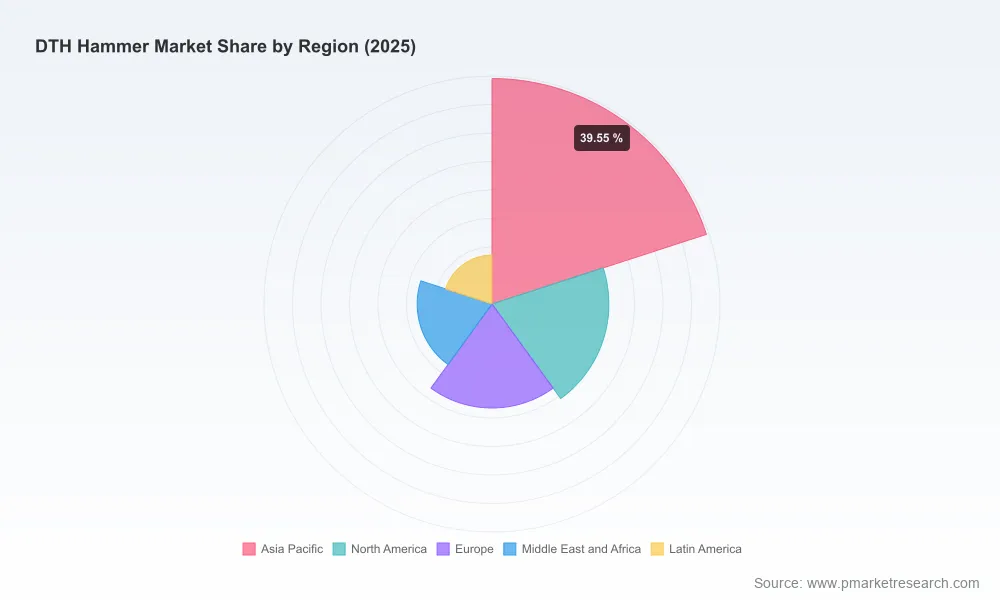
Geographically, the demand distribution reflects industrial density and development priorities. Asia Pacific remains a central hub of activity, followed by established markets in North America and Europe. Emerging regions in the Middle East, Africa, and Latin America also contribute to the global volume, often driven by infrastructure development and resource exploration initiatives. Understanding these regional weightings allows companies to tailor their distribution networks and service support accordingly.
Operational Challenges and Supply Chain Considerations
Enterprises must remain vigilant regarding supply chain volatility. The reliance on specific raw materials like tungsten carbide creates exposure to geopolitical and mining supply constraints. As noted in recent industry data, price increases in these key materials have already impacted manufacturing expenses. Procurement teams should consider hedging strategies or long-term supplier agreements to mitigate the risk of sudden cost spikes in 2026 and beyond.
Hydraulic Hammer Market
Additionally, the trend toward modularity and efficiency is reshaping product lines. Recent corporate reports indicate moves to streamline hammer families to improve efficiency, such as modular offerings that allow for easier maintenance and part replacement. This shift suggests that future procurement decisions should weigh the ease of maintenance and availability of spare parts as heavily as the initial performance metrics of the hammer itself.
Strategic Value of the Research Report
In an environment where margin pressure and operational efficiency are paramount, access to detailed, verified market intelligence is a competitive advantage. The Worldwide DTH Hammer Market Report goes beyond high-level summaries to provide actionable data that supports specific business use cases.
- Investment Analysis: Determine where capital should be allocated within drilling fleets based on projected demand growth in specific applications and regions.
- Vendor Evaluation: Assess the competitive positioning of key manufacturers to identify reliable partners for long-term supply contracts.
- Risk Mitigation: Anticipate raw material cost trends and regulatory shifts that could impact production costs or operational compliance.
- Market Entry Strategy: Identify underserved segments or geographical areas where competitive density is lower and growth potential is higher.
The report includes detailed profiles of major companies, recent development timelines including product launches and corporate reports, and a thorough analysis of market concentration metrics. This depth allows stakeholders to benchmark their own performance against industry leaders and identify gaps in their current strategy.
Conclusion and Next Steps
The DTH hammer market in 2026 presents a landscape defined by steady growth, technological refinement, and cost optimization. For industry participants, the ability to navigate raw material fluctuations while leveraging high-efficiency equipment will define success in the coming years. The data indicates a market that is maturing but still offering opportunities for strategic expansion.
PW Consulting
To fully utilize the insights contained in this analysis, we invite you to access the complete Worldwide DTH Hammer Market report. The full document contains detailed segmentation data, specific revenue projections for each sub-segment, and comprehensive country-level analysis that are essential for finalizing your 2026 strategic plan.
Secure your copy today to ensure your organization is equipped with the intelligence needed to make informed decisions in a dynamic global market.
For detailed analysis of this topic, please visit the official page: Worldwide DTH Hammer Market
Lacy Lee
Senior Marketing Manager
[email protected]
PW Consulting: www.pmarketresearch.com



























Sign in to leave a comment.