
Unlocking Growth in the Global Flexible Plastic Snack Packaging Market: Strategic Intelligence for 2026 and Beyond
The global snack food industry is undergoing a structural transformation. Consumers demand convenience, shelf life, and premium presentation, while regulators and brands simultaneously push for circularity, reduced carbon footprints, and transparent supply chains. In this complex environment, flexible plastic packaging remains the dominant vehicle for delivering salty, dry, and confectionery snacks to retail and e-commerce channels. Yet the strategic playbook has changed. Companies that rely on legacy film architectures or static supply chain assumptions are increasingly exposed to margin compression, compliance risk, and competitive displacement.
Our latest Worldwide Flexible Plastic Snack Food Packaging Market study provides decision-makers with a rigorously modeled view of where the market has been, where it is heading, and how value is being redistributed among material types, applications, and geographies. The research spans historical performance from 2020 through 2025 and projects forward through 2032, giving executives a ten-year lens to stress-test capital allocation, procurement strategy, and innovation roadmaps.
Why This Study Matters for 2026 Decision-Making
2026 is not a routine planning year. It is a pivot point in which multiple forces converge: regional resin cost volatility, accelerating extended producer responsibility frameworks, and a technology race toward mono-material recyclable structures that can maintain high-barrier performance. The study was designed to convert these pressures into actionable intelligence. Rather than presenting static snapshots, the analysis maps the interplay between volume growth, material substitution, regional demand patterns, and competitive positioning. It does so with a level of granularity that supports scenario planning for R&D, procurement, sales, and sustainability teams alike.
For executives evaluating market entry, capacity expansion, or packaging format transitions, the study offers a calibrated baseline. It quantifies the trajectory of total market revenue and translates it into forward indicators that help frame investment timing, risk exposure, and strategic prioritization. The objective is to equip leadership with a shared factual foundation so that cross-functional teams can debate trade-offs on the basis of modeled evidence rather than anecdote.
The Macro Trajectory: Growth With Shifting Composition
Over the historical period from 2020 to 2025, the flexible plastic snack packaging sector demonstrated resilience and expansion despite raw material fluctuations and supply chain disruptions. That momentum carries into the forecast window, with the market advancing from a 2025 revenue base to an estimated 2026 level, and continuing to rise through the end of the decade. The compound annual growth rate across the forecast horizon is 5.82%, a pace that reflects durable underlying demand for snack formats combined with the structural advantages of lightweight, high-functionality flexible films.
What makes this growth strategically meaningful is not the headline number alone, but the shifting composition beneath it. Revenue expansion is not uniform across materials, applications, or regions. Some segments rise faster because they align with sustainability initiatives, barrier performance requirements, or regional consumption trends. Others face structural headwinds as regulations and consumer expectations reshape preferred formats. The study unpacks these divergences so that users can distinguish between broad market tailwinds and segment-specific opportunity.
By 2032, the combined revenue trajectory reflects a market that has grown both in scale and in complexity. The forward estimates highlight a market in which value creation increasingly depends on format optimization, mono-material redesign, and the ability to serve premium and emerging snack categories without compromising freshness, machinability, or total cost of ownership. The report translates this trajectory into decision-ready insights rather than abstract projections.
Material, Application, and Regional Dynamics Without Losing Sight of Strategy
One of the study’s central contributions is its segmentation architecture, which enables teams to see where value concentrates and where it is migrating. The report examines the major material families that underpin flexible snack packaging, including polyethylene, polypropylene, polyethylene terephthalate, and polyamide-based structures. Each category is evaluated in terms of barrier capability, recyclability pathways, cost sensitivity, and fit with specific snack formats. Because the strategic question for 2026 is not simply which material is largest today but which material will retain commercial advantage under evolving regulatory and sustainability constraints, the analysis links material performance to compliance dynamics and buyer preferences.
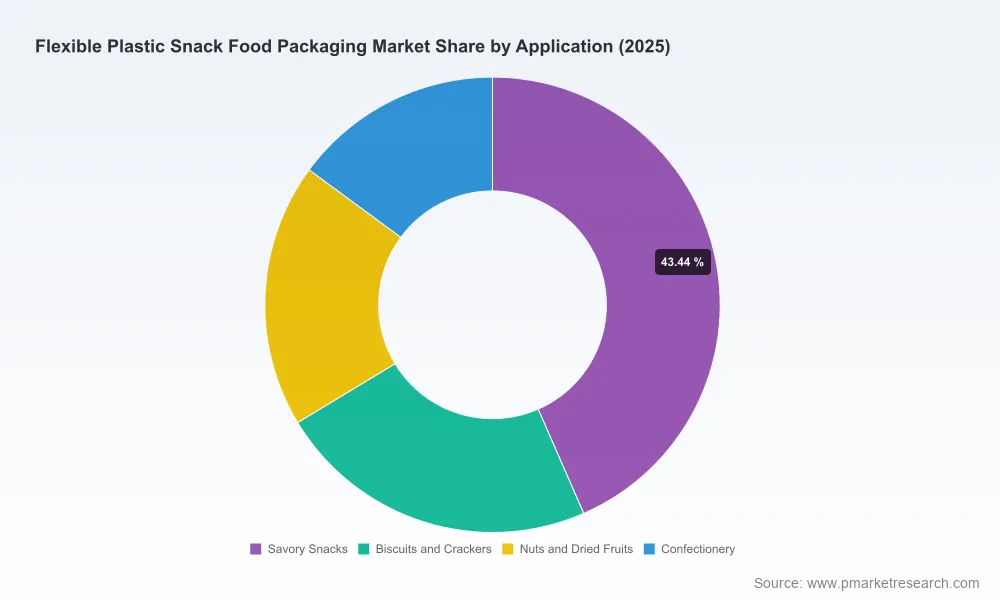
On the application side, the report dissects demand across core snack categories such as savory snacks, biscuits and crackers, nuts and dried fruits, and confectionery. These categories differ markedly in their barrier requirements, oxygen and moisture sensitivity, print expectations, and retail presentation needs. The study maps how packaging formats evolve across these applications and where innovation is most urgently required. This enables snack manufacturers and converters to prioritize development efforts in line with category-level performance requirements and growth potential, rather than treating all flexible packaging as interchangeable.
Regionally, the research captures demand geography without reducing it to a simple ranking. The study evaluates the relative scale and direction of demand across major regions, including Asia Pacific, North America, Europe, Latin America, and the Middle East and Africa. Rather than presenting the analysis as a static allocation, it frames regional dynamics in terms of consumption growth, packaging infrastructure maturity, regulatory posture, and the pace of format modernization. This regional perspective is especially valuable for companies deciding where to localize production, where to pursue partnership-based distribution, and where compliance costs may alter margin structures.
Crucially, the study deliberately withholds the precise region-by-region and application-by-application percentage breakdowns in this public summary. The reason is strategic: the highest-value decisions depend on seeing how segmentation data interacts with material trends, regulatory pressure, and competitive capacity. That integrated view is provided in full within the complete research product, where the segmentation tables, scenario overlays, and regional interpretations are presented together so that leadership can evaluate trade-offs with precision.
Competitive Landscape and the 2025–2026 Innovation Race
The market is contested by a broad set of global and regional players, each pursuing distinct value propositions in barrier performance, sustainability, print quality, and service responsiveness. The study profiles leading participants, including Amcor PLC, Sonoco Products Company, Sealed Air Corporation, Huhtamaki, Mondi Group, ProAmpac, Berry Global, Coveris, Constantia Flexibles, Uflex Limited, Bryce Corporation, C-P Flexible Packaging, PPC Flex, and Polymerall Flexible Packaging. These companies are not treated as a flat list; the analysis examines how each positions its flexible film and pouch offerings for snack applications, where mono-material recyclable structures are becoming central to commercial messaging, and which players are expanding high-barrier platforms to protect shelf life while supporting recyclability goals.
Several recent moves illustrate the direction of travel. In early 2026, UFlex Limited introduced a mono-material PET film with a copolymer sealant layer designed to strengthen seals and support snack pouches and lidding applications. That launch reflects a wider industry push toward mono-material architectures that simplify recycling while preserving functional performance. Similarly, Amcor’s expansion of its high-barrier mono-material polyethylene platform underscores the competitive emphasis on recyclable structures tailored for dry foods and snacks. Sealed Air’s recycle-ready mono-material VFFS pack, launched in late 2025, further signals how major suppliers are aligning product development with downstream recyclability and processing compatibility.
Beyond product launches, the competitive field is shaped by industry recognition and commercial execution. Recent Flexible Packaging Achievement Awards highlighted multiple gold-level innovations for snack, bakery, and confectionery packaging, indicating that technical creativity in barrier design, print quality, and format efficiency is being actively rewarded. At the same time, converters and film producers are moving to support emerging snack brands with scalable flexible formats, showing that the market is not only about incumbents but also about enabling new entrants to grow production rapidly without sacrificing packaging integrity or visual appeal.
The study uses these developments to assess competitive intensity, differentiation potential, and the pace at which sustainability claims are becoming table stakes rather than differentiators. It also considers how concentration dynamics influence pricing power, capacity access, and the ability to influence downstream buyer specifications. That competitive perspective is essential for firms evaluating partnership opportunities, supplier consolidation risk, and the strategic value of proprietary film structures or converting capabilities.
Regulatory and Raw Material Pressures as Strategic Variables
No strategic assessment of this market is complete without integrating regulatory and input cost dynamics. In the United States, extended producer responsibility frameworks for packaging are expanding across multiple states, including California, Colorado, Maine, Maryland, Minnesota, Oregon, and Washington. Fee structures are increasingly modulated by recyclability and recycled content, which means packaging decisions now have direct compliance cost implications. Oregon’s program is already in full effect, with 2026 fee schedules ranging from near zero for certain paper formats to over 1.30 dollars per pound for specific plastic formats. This creates a clear economic incentive to shift toward mono-material flexible designs that can reduce producer fees while maintaining required performance.
At the same time, raw material pricing remains a live variable. Polypropylene resin prices in early 2026 have shown notable regional differences, with Northeast Asian, European, and Indian markets sitting at distinct price levels. Polyethylene spot and contract pricing in North America has been shaped by feedstock conditions and demand from packaging applications. These variations matter because flexible snack packaging is sensitive to resin cost, film conversion efficiency, and the economics of format changes. The study treats raw material dynamics not as background noise but as a strategic input that interacts with sourcing strategy, formulation choices, and total cost models.
The interplay between regulation and material cost is particularly important. As state-level mandates and recycled content expectations intensify, the cost of maintaining conventional multi-layer structures may rise relative to mono-material alternatives that offer better end-of-life pathways. The report examines how this dynamic influences supplier offerings, buyer negotiations, and format adoption timelines so that companies can anticipate shifts rather than react to them after margins have already been affected.
Worldwide Flexible Plastic Snack Food Packaging Market
What the Report Delivers for Cross-Functional Teams
- A ten-year view that connects historical performance with forecast structure, enabling executive planning teams to align target-setting with modeled market behavior.
- Segmentation analysis across materials, applications, and regions that clarifies where growth is concentrated and how value is redistributed as sustainability and barrier requirements evolve.
- Competitive assessments of major global and regional participants, including how their flexible film and pouch strategies position them for snack-specific demand and recyclable structure adoption.
- Evaluation of recent product launches, platform expansions, and industry awards to gauge the pace and direction of innovation.
- Integration of regulatory developments and raw material pricing trends into strategic context, helping teams quantify compliance exposure and input-cost sensitivity.
- Decision-oriented framing that supports R&D prioritization, procurement negotiations, commercial positioning, and sustainability roadmap design.
Using This Intelligence for 2026 and Beyond
The most valuable question this study helps answer is not simply how large the flexible plastic snack packaging market will become, but how a company can act on that knowledge. For procurement leaders, the analysis supports material sourcing decisions by mapping resin dynamics and regional cost structures against demand trends. For R&D and innovation teams, it highlights where mono-material, high-barrier, and recyclable structures are most commercially relevant. For commercial and sales organizations, it clarifies which snack applications and regions offer the strongest growth alignment with packaging capabilities. For sustainability and regulatory teams, it frames the financial stakes of EPR adoption and recycled content expectations in a market where compliance costs are increasingly design-dependent.
Plastic Food Containers Market
The report has been built to support that breadth of use. It combines modeled market estimates with qualitative assessments of competitive behavior, material performance, and regulatory direction. The goal is to create a single reference point that can anchor strategy conversations across functions and reduce the risk of decisions made in silos. In a market where growth is real but uneven, and where compliance and sustainability pressures are reshaping the economics of packaging format choices, that shared intelligence is a competitive asset.
Conclusion: Access the Full Market Intelligence
The Worldwide Flexible Plastic Snack Food Packaging Market will continue to expand through 2032, but the strategic winners will be those who understand the composition of that growth rather than its size alone. Material choices, application-fit requirements, regional regulatory exposure, and competitive capacity trends will determine which companies capture margin, which face rising compliance costs, and which can translate sustainability ambition into commercial advantage. Our study provides the depth required to navigate those decisions with confidence, while preserving the integrated segmentation detail and scenario context needed for executive action.
For a complete reading of the segmentation estimates, regional interpretations, competitive profiles, and forward-looking scenario analysis, please access the full report through our official market research portal. The public summary showcases the framework and strategic direction; the full product delivers the precise quantitative intelligence and cross-segment context that decision-makers need to plan with precision.
For detailed analysis of this topic, please visit the official page: Worldwide Flexible Plastic Snack Food Packaging Market
Lacy Lee
Senior Marketing Manager
[email protected]
PW Consulting: www.pmarketresearch.com





























Sign in to leave a comment.