
Navigating the New Orbit: Strategic Imperatives in the 2026 Global GNSS Market
The global positioning landscape is undergoing a structural transformation. What was once a utility infrastructure for navigation has evolved into a critical enabler of autonomy, safety, and operational efficiency across virtually every industrial sector. For executives and strategy leaders, the 2026 fiscal year represents a pivotal juncture. The convergence of advanced receiver technology, regulatory shifts, and expanding use cases demands a reevaluation of how organizations invest in and leverage Global Navigation Satellite System (GNSS) capabilities. This insight serves as an introduction to the latest PW Consulting GNSS Market Report, a comprehensive study designed to equip decision-makers with the intelligence required to navigate this high-growth environment.
Market Trajectory and Economic Scale
The macroeconomic indicators for the GNSS sector signal sustained and robust expansion. Analyzing historical performance from 2020 through 2025 provides a baseline of resilience, while forecasts extending to 2032 outline a trajectory of accelerated value creation. The total market revenue has demonstrated consistent year-over-year growth, surpassing key thresholds as adoption deepens across both enterprise and consumer segments.
Our analysis indicates that the market size is projected to reach significant milestones over the forecast period. Starting from a established 2025 base, the industry is moving toward a valuation that reflects the increasing dependency on precise positioning data. The compound annual growth rate for the forecast period stands at 9.48 percent, underscoring a healthy demand curve driven by technological maturation and new application deployment. This growth is not merely linear; it represents a compounding effect of infrastructure investment, hardware innovation, and service integration. Investors and corporate strategists must recognize that this trajectory implies a shift from niche positioning solutions to mainstream operational necessities.
Segmentation Dynamics and Application Drivers
Understanding where value is generated requires a nuanced look at market segmentation. The report dissects the industry by region, technology type, and application vertical. While broad geographic distributions show established markets maintaining strong hold, emerging regions are displaying rapid uptake in specific technology categories. The analysis highlights that different territory clusters exhibit distinct maturity levels and investment priorities, necessitating tailored go-to-market strategies rather than a one-size-fits-all approach.
On the technology front, the ecosystem is divided between major global constellations, regional systems, and augmentation services. The interplay between these segments determines signal availability, accuracy, and reliability. Global constellations continue to form the backbone of the industry, yet regional constellations and satellite-based augmentations are becoming increasingly critical for enhancing precision in challenging environments. This layered architecture allows for redundancy and improved performance, which is essential for high-stakes applications.
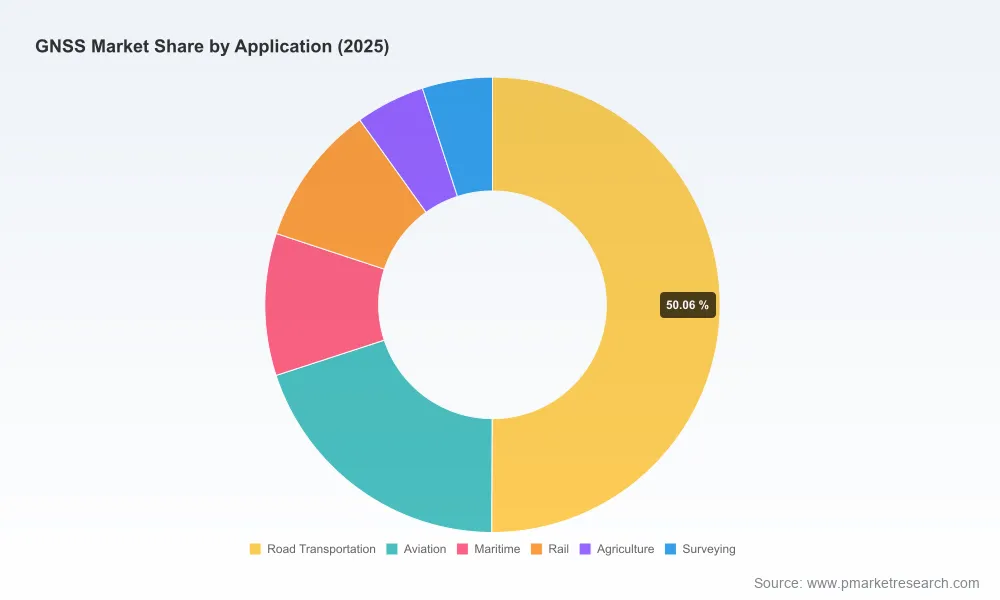
Application-wise, the demand is heavily skewed toward transportation and mobility. Road transportation remains a dominant revenue generator, fueled by the proliferation of connected vehicles and advanced driver assistance systems. Aviation continues to be a stable and high-value sector, where safety-critical positioning demands rigorous standards. Maritime and rail sectors also contribute substantial value, driven by logistics optimization and automated train control systems. Meanwhile, traditional sectors such as agriculture, surveying, and construction are seeing renewed investment as precision tools become more accessible and integrated with broader IoT frameworks. The report details how these application verticals interact with specific technology types to create unique value chains.
Competitive Landscape and Corporate Strategy
The GNSS market is characterized by a mix of specialized high-precision providers and broader connectivity players. Market concentration metrics suggest a competitive environment where no single entity dominates the entire value chain, allowing for diverse strategic plays. Our report profiles key industry leaders who are shaping the technological and commercial boundaries of the sector.
Companies such as u-blox and Quectel are heavily focused on the mass-market and industrial integration space. u-blox, based in Thalwil, Switzerland, emphasizes high-precision chips and modules for automotive and robotics, while Quectel, headquartered in Shanghai, China, leverages its position in IoT solutions to embed GNSS capabilities into broader machine control and automotive ecosystems. These players are critical for scaling deployment across high-volume applications.
In the high-reliability and enterprise sector, firms like NovAtel and Septentrio hold significant sway. NovAtel, located in Calgary, Canada, specializes in OEM receivers and correction services for defense and aerospace, where fail-safe positioning is non-negotiable. Septentrio, from Leuven, Belgium, has built a reputation for resilient multi-frequency modules suitable for UAVs and robots in challenging environments. Topcon Positioning Systems and Trimble remain dominant forces in surveying, construction, and agriculture. Topcon, based in Tokyo, Japan, continues to innovate in receiver hardware and correction services for precision agriculture, while Trimble, in Westminster, Colorado, USA, integrates GNSS systems into comprehensive solutions for automated vehicles and infrastructure development.
GNSS Market
Recent Corporate Developments and M&A Activity
The competitive landscape is dynamic, with recent mergers and acquisitions signaling consolidation and capability expansion. A notable development occurred in March 2025 when Hexagon announced the acquisition of Septentrio NV. This move was strategically aimed at expanding Resilient Assured Positioning solutions, integrating specialized GNSS technology into broader mission-critical navigation and autonomy applications. Such consolidation highlights the industry trend toward bundling positioning hardware with higher-level assurance and software services.
Product launches continue to drive differentiation. In May 2025, Septentrio extended its mosaic-G5 family with ultra-compact GNSS modules targeted at high-volume applications, demonstrating a push toward miniaturization without sacrificing performance. More recently, in February 2026, Hexagon NovAtel launched new firmware designed to enhance GNSS reliability in challenging environments. This update captures more signals, increasing availability by 20 percent, a critical improvement for operations where signal obstruction is a constant risk. Similarly, Topcon unveiled new innovations including a modular GNSS receiver at Agrishow 2026, specifically tailored for Latin American precision agriculture, illustrating how regional needs drive product customization.
Regulatory and Technical Dynamics
External factors are exerting increasing influence on market development. Regulatory bodies are updating guidance to address modern threats to positioning integrity. In March 2026, the FAA updated guidance on GPS/GNSS interference, jamming, and spoofing based on industry recommendations. This update incorporates changes recommended by a government and industry rulemaking committee, reflecting heightened awareness of vulnerability in critical infrastructure. For enterprises, compliance with these evolving standards is not just a legal requirement but a operational necessity to ensure continuity.
Spectrum regulation and resilience testing are also shaping product roadmaps. Results from Jammertest 2025 confirmed GNSS receiver resilience against GPS jamming and spoofing for Septentrio solutions, providing empirical data that supports the adoption of hardened receivers in sensitive sectors. Furthermore, broader market analyses suggest long-term optimism. EUSPA market analysis indicates that GNSS revenues are projected to reach €580 billion by 2034, driven by mass-market applications and consumer solutions. This long-term outlook validates current investment strategies in mass-market compatible technologies.
What the Report Delivers
The PW Consulting GNSS Market Report is structured to provide actionable intelligence rather than abstract statistics. It offers a deep dive into the operational specifics that drive market success. Readers will gain access to detailed profiles of key companies, including their strategic focus, product portfolios, and recent moves in the marketplace. The report analyzes how these players compete on precision, resilience, and integration capabilities.
Beyond company analysis, the study provides a granular view of market segmentation. It explores how different regions are adopting GNSS technologies at varying rates and what specific barriers or accelerators exist in each territory. The analysis of application verticals goes beyond revenue splits to examine the use-case drivers, such as the push for autonomy in road transportation or the need for precision in modern agriculture. Technology segmentation is examined to help stakeholders understand the trade-offs between global constellations, regional systems, and augmentation services.
The report also contextualizes the market within the broader regulatory and technical environment. It incorporates data on firmware improvements, interference resilience, and regulatory updates to help organizations assess risk and opportunity. By synthesizing historical data from 2020 to 2025 with forecasts through 2032, the document provides a longitudinal view that supports long-term planning. The inclusion of market concentration metrics helps investors and competitors understand the level of consolidation and the potential for new entrants.
Strategic Value for 2026 Decision-Making
For executives planning their 2026 strategy, this report serves as a critical decision-support tool. The 9.48 percent CAGR and the trajectory toward a significantly larger market size by 2032 suggest that now is the time to secure positioning capabilities before competition intensifies. Understanding the specific growth drivers in road transportation versus aviation, or the implications of regional constellation development, allows for more precise capital allocation.
The insights into recent developments, such as the Hexagon-Septentrio integration and the latest firmware updates from NovAtel, provide a window into where the industry is heading regarding resilience and integration. Organizations that align their technology stacks with these evolving standards will be better positioned to mitigate risks related to interference and spoofing, especially in light of the updated FAA guidance. Furthermore, recognizing the distinct value propositions of key players like u-blox, Trimble, and Quectel enables procurement and partnership strategies that leverage the right capabilities for specific application needs.
Ultimately, the GNSS market is moving from a phase of infrastructure build-out to one of value optimization and resilience hardening. The data provided in this report eliminates ambiguity, allowing leaders to make evidence-based decisions regarding investment, product development, and market entry. As the sector grows toward the projected valuations of the early 2030s, the organizations that understand the underlying dynamics today will capture the disproportionate share of value tomorrow.
Access to the full report provides the detailed quantitative and qualitative intelligence necessary to execute these strategies effectively. It transforms high-level market trends into specific actionable steps, ensuring that your organization remains competitive in a rapidly evolving global landscape.
GNSS Chip Market
For detailed analysis of this topic, please visit the official page: GNSS Market
Lacy Lee
Senior Marketing Manager
[email protected]
PW Consulting: www.pmarketresearch.com



























Sign in to leave a comment.