
Strategic Intelligence for Health Media: Navigating the Global Magazine Market in 2026
The global health magazine market stands at a critical inflection point as we move through 2026. Shifting consumer behaviors, accelerating digital transformation, and evolving revenue architectures are redefining competitive advantage for publishers, advertisers, and health content strategists. Our latest Worldwide Health Magazine Market research delivers the analytical foundation required to navigate this complexity with precision. Rather than offering generic industry commentary, this study provides a structured, data-grounded lens into market scale, structural shifts, and the strategic levers that will separate resilient operators from those caught off-guard by macroeconomic and technological disruption.
Herbal Medicine Market
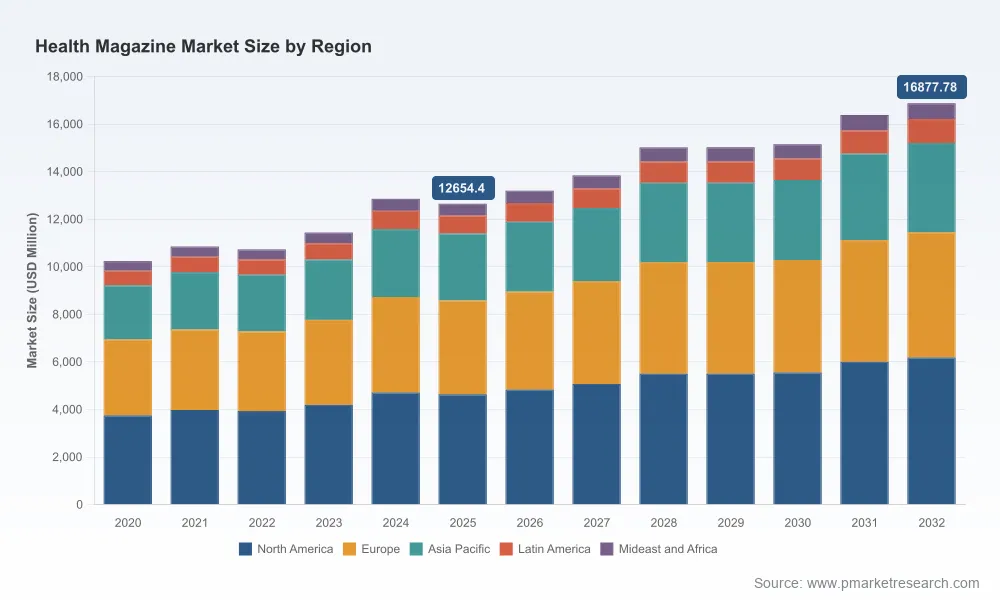
For executive teams planning budgets, allocation, and innovation roadmaps in 2026, the market presents both opportunity and risk. The sector has demonstrated resilience through recent volatility, with global revenue reaching a baseline of approximately USD 12,654.40 million in 2025. Looking ahead, the forecast horizon through 2032 indicates sustained expansion, anchored by a projected compound annual growth rate of 4.2%. This trajectory reflects more than passive consumption trends; it signals structural adaptation across formats, distribution channels, and monetization strategies. Early forecast years project revenues approaching USD 13,201.44 million in 2026, scaling toward USD 16,877.78 million by 2032. These figures are not merely historical snapshots—they are the baseline against which capital deployment, partnership strategy, and product development must be calibrated.
The strategic value of this research lies in its ability to translate macro momentum into actionable decision frameworks. Health magazine publishers are no longer competing solely on editorial quality or circulation reach. They are navigating a layered ecosystem where subscription economics, advertising demand cycles, single-copy dynamics, regional maturity, and format preferences intersect with regulatory expectations and labor-cost pressures. Understanding where value is being created—and where margins are eroding—requires granular visibility that summary reports cannot provide. This study is designed to deliver precisely that visibility, while maintaining the analytical discipline necessary for sound executive judgment.
Market Architecture and Structural Shifts Defining 2026
The health magazine sector is undergoing a fundamental reconfiguration of how content is produced, distributed, and monetized. The most pronounced shift is the deepening integration of digital platforms alongside legacy print operations. Publishers are recalibrating editorial calendars, subscription gating, and engagement loops to align with consumer preferences that increasingly favor on-demand, personalized, and mobile-first consumption. This transition is not simply a technological upgrade; it is a strategic reorientation that influences everything from audience acquisition costs to lifetime value modeling.
Editorial direction is also being reshaped by broader wellness paradigms. Holistic health, mental well-being, preventative care, and lifestyle integration are moving from niche coverage to central editorial pillars. At the same time, macroeconomic and operational pressures are redirecting content strategy. Employer-sponsored health benefits are projected to rise significantly in 2026, which is prompting both publishers and readers to focus more intensively on cost management, accessible wellness guidance, and practical health navigation. These twin forces—cultural emphasis on comprehensive well-being and financial pressure on healthcare spending—are creating a content environment where relevance and credibility must coexist.
PW Consulting
Revenue models are evolving in parallel. Subscription-based income continues to anchor publisher economics, but the balance between recurring access, advertising partnerships, and single-copy transactions is being renegotiated across the market. Digital delivery enables more flexible pricing, targeted bundling, and data-informed retention tactics, while print retains strategic importance in specific demographic segments and premium brand positioning. The intersection of these revenue streams determines not only top-line performance but also operational scalability and resilience during advertising downturns.
Health Products Market
Competitive Landscape and Strategic Positioning
The market is characterized by a concentrated yet diverse competitive field. Concentration metrics indicate that the top three players hold approximately 31.4% of market share, while the top five collectively account for roughly 42.8%. This structure suggests that scale advantages exist, but meaningful differentiation remains available for publishers who execute strongly on niche authority, audience trust, and digital experience quality.
Several established organizations define the current competitive baseline. Hearst Communications operates one of the largest lifestyle publishing portfolios globally, spanning titles such as Men's Health, Women's Health, Runner's World, and Bicycling, with content delivered across print and digital formats. AARP maintains one of the highest-circulation publication profiles through AARP: The Magazine and AARP Bulletin, with a strong wellness orientation tailored to older adults. Sussex Publishers is recognized for a diverse health publication portfolio emphasizing evidence-based information. Rodale Inc. has long functioned as a pioneer in fitness, nutrition, and healthy living content. Meredith Corporation, now part of People Inc./Dotdash Meredith, contributes health-related titles within its broader lifestyle ecosystem. Condé Nast continues to deliver high-quality lifestyle and health-related editorial through its magazine brands. WW International focuses on weight management and wellness-oriented magazine offerings. New Hope Media concentrates on natural products and holistic health publications. Remedy Health Media specializes in personalized and digital health content designed for consumer engagement.
Recent corporate activity underscores the strategic urgency of portfolio expansion and format integration. In March 2025, Hearst Communications announced the acquisition of Healthline Media to broaden its health content capabilities across print and digital channels. Moves like this illustrate how incumbents are pursuing scale, cross-format reach, and digital-first audience capture simultaneously. For market participants, the implication is clear: competitive advantage will increasingly depend on the ability to combine credible health editorial with flexible distribution, data-informed engagement, and monetization models that can withstand shifts in advertising and subscription demand.
What This Research Delivers: Practical Intelligence for Executive Decision-Making
This study is structured to support direct application in strategy, planning, and investment review. It combines market sizing, segmentation logic, and competitive context into a unified analytical framework that executives can use to pressure-test assumptions and prioritize initiatives. The report moves beyond descriptive trends to examine how structural factors influence growth durability, margin potential, and strategic risk.
Core components of the research include:
- A longitudinal view of market size from 2020 through 2025, paired with a forecast trajectory extending to 2032, enabling scenario planning around baseline growth and external shocks.
- Segmentation analysis that isolates the structural contributions of format preferences, revenue streams, and regional dynamics without reducing the market to oversimplified share narratives.
- Competitive profiling of leading publishers, including operational scope, content positioning, and recent strategic actions that signal where the market is consolidating or diversifying.
- Market dynamics assessment covering digital integration, subscription model adoption, consumer preference shifts, and the influence of healthcare cost trends on editorial focus and advertising behavior.
- Concentration and competitive intensity indicators that help decision-makers evaluate barriers to entry, partnership opportunities, and positioning options within an increasingly layered landscape.
Crucially, the report is designed to support practical decisions rather than abstract observation. Whether the objective is to evaluate market entry, assess partnership viability, refine content strategy, or reallocate resources between print and digital operations, the analysis provides a grounded reference point. The emphasis is on clarity, comparability, and strategic deployability.
Implications for 2026 Strategy and Capital Allocation
For leadership teams operating in 2026, the health magazine market rewards disciplined strategic focus. Growth is projected to continue, but the path to capturing value is uneven across formats, revenue models, and audience segments. Publishers that treat digital transformation as a peripheral initiative rather than a core economic driver will face mounting pressure on engagement and retention. Organizations that continue to rely on single revenue channels without diversifying their monetization mix will be more exposed to volatility in advertising cycles and subscription churn.
At the same time, the market presents targeted expansion opportunities for players who can align content credibility with audience-specific needs. Wellness-focused editorial, evidence-based health information, personalized digital experiences, and holistic well-being coverage are not merely editorial themes; they are strategic differentiators that influence subscription willingness, advertising relevance, and long-term brand equity. In this environment, strategic decisions should be informed by a clear understanding of where growth is structurally supported and where it is dependent on transient demand.
This research is intended to reduce uncertainty in exactly those decisions. By integrating historical performance, forward-looking forecasts, competitive context, and market dynamics, it provides the intelligence necessary to allocate resources with greater confidence. The complete dataset, segment-level breakdowns, regional and format comparisons, and detailed revenue-stream analysis are available through the full study. Prospective users are encouraged to access the source report to obtain the complete intelligence package required for detailed planning, benchmarking, and investment evaluation.
For detailed analysis of this topic, please visit the official page: Worldwide Health Magazine Market
Lacy Lee
Senior Marketing Manager
[email protected]
PW Consulting: www.pmarketresearch.com





























Sign in to leave a comment.