
Strategic Intelligence in Respiratory Care: Unlocking Growth in the Worldwide Inhalation Lactose Market Through 2032
The global respiratory therapeutics landscape is undergoing a structural transformation, driven by aging demographics, rising prevalence of chronic pulmonary conditions, and continuous innovation in dry powder inhaler technology. At the core of this evolution lies a critical excipient: inhalation-grade lactose. Serving as the primary carrier particle in most dry powder inhaler formulations, its physicochemical properties directly dictate aerosolization efficiency, dose uniformity, and patient compliance. Understanding the trajectory of this specialized market is no longer a peripheral concern for pharmaceutical manufacturers, excipient suppliers, or healthcare investors. It has become a strategic imperative. Our latest Worldwide Inhalation Lactose Market study delivers the analytical rigor required to navigate this space through 2032, translating historical performance, current market dynamics, and forward-looking projections into actionable intelligence for enterprise decision-making in 2026 and beyond.
Inhaled Nitric Oxide Market
Why 2026 Demands a Fresh Strategic Lens on Inhalation Lactose
Pharmaceutical supply chains are operating under unprecedented macroeconomic and regulatory scrutiny. Excipient procurement, once treated as a commoditized back-office function, now sits at the intersection of drug efficacy, formulation stability, and cost structure optimization. The inhalation lactose segment exemplifies this shift. As dry powder inhaler platforms gain market share over traditional metered-dose systems, manufacturers are demanding excipients with tightly controlled particle size distributions, predictable flow characteristics, and consistent batch-to-batch purity. Simultaneously, raw material volatility is reshaping procurement strategies. Recent market observations indicate that lactose pricing in the United States experienced significant upward pressure in early 2026, with FOB benchmarks reflecting double-digit year-over-year increases alongside tight availability for specific mesh specifications. These conditions underscore a broader reality: pricing transparency, supply continuity, and grade-specific qualification are now integral to formulation risk management.
The 2026 baseline for this market reflects a mature but steadily expanding ecosystem. Historical tracking from 2020 through 2025 demonstrates consistent revenue progression, moving from approximately 1,045 million USD to over 1,345 million USD. The forecast window extending to 2032 projects a compound annual growth rate of 5.5 percent, translating into a market trajectory that surpasses 1,950 million USD by the end of the period. These figures are not merely backward-looking indicators; they represent a structural signal. Sustained growth at this pace implies steady formulation adoption, incremental capacity investments, and ongoing refinement of excipient performance standards. For executives evaluating capital allocation, supplier partnerships, or pipeline prioritization, the 2026 inflection point offers a clear window to align strategy with market momentum before competition intensifies further.
Mapping the Competitive Architecture
The inhalation lactose supply base is characterized by a concentrated yet highly specialized vendor landscape. Market concentration metrics indicate that a small group of globally established players commands the majority of commercial share, reflecting the technical barriers associated with pharmaceutical-grade manufacturing, regulatory compliance, and application-specific formulation expertise. Our analysis profiles the organizations that have shaped this competitive environment, including DFE Pharma, MEGGLE Pharma, Kerry, and Armor Pharma, each of which brings distinct capabilities to the table.
DFE Pharma operates from Goch, Germany, positioning itself as a leading global supplier of pharmaceutical excipients with a comprehensive portfolio of inhalation-grade lactose tailored for dry powder inhaler applications. Its offering spans standard and customizable grades engineered for pulmonary drug delivery, emphasizing formulation flexibility and technical support. MEGGLE Pharma, headquartered in Wasserburg am Inn, Germany, maintains a strong presence through its InhaLac family of products, encompassing sieved, milled, and fine-milled alpha-lactose monohydrate grades developed specifically for dry powder and nasal delivery systems. Production occurs on dedicated lines, reinforcing quality consistency and regulatory readiness. Kerry, based in Tralee, Ireland, contributes decades of pharmaceutical lactose expertise alongside its Aero Flo inhalation-grade portfolio, designed explicitly for dry powder inhalation applications. Armor Pharma, operating from France, has established a solid position in inhalation-grade lactose with GMP-compliant production capabilities focused on high-purity excipient manufacturing.
Recent activity within this competitive set illustrates how innovation and capacity strategy continue to reshape the market. In early 2024, MEGGLE Pharma expanded its inhalation lactose lineup with the introduction of InhaLac 170, a grade offering a particle size distribution optimized for next-generation dry powder inhalers. Developments of this nature highlight the industry's emphasis on precision particle engineering, as formulation scientists seek carriers that balance flowability with dispersibility in increasingly sophisticated inhaler devices. Our report examines these strategic moves in detail, evaluating how product line expansions, process optimizations, and geographic production footprints influence supplier selection criteria and long-term procurement resilience.
Dissecting Market Segmentation Without Losing Sight of Commercial Reality
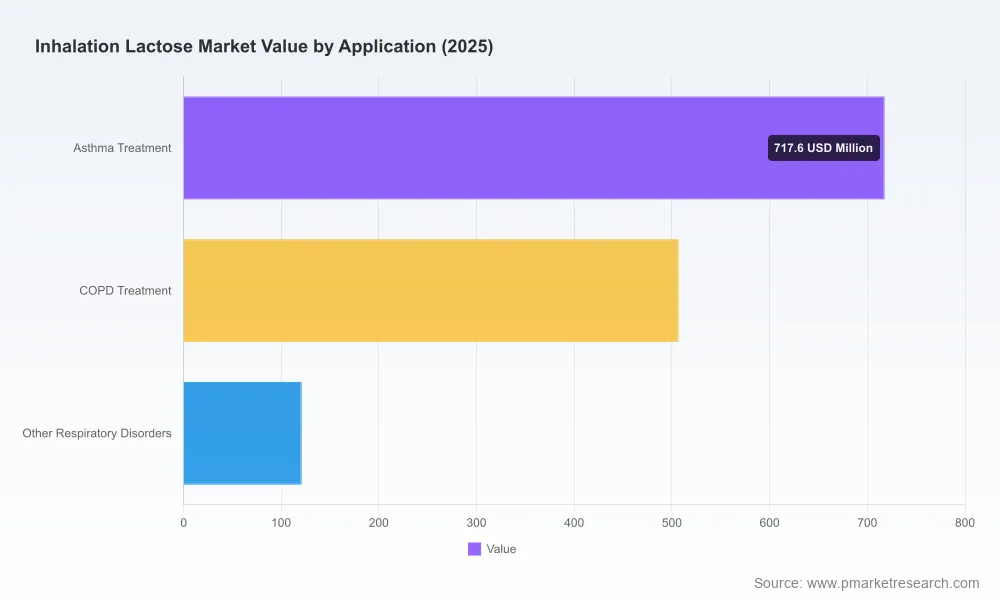
A superficial view of inhalation lactose treats it as a singleCommodity category. The reality is far more nuanced. The market is structured around distinct processing methodologies and therapeutic applications, each carrying different performance requirements, regulatory considerations, and commercial implications. Processing-based segmentation differentiates between sieved, milled, and micronized grades, reflecting varying degrees of particle size control and surface characteristics. Application-based segmentation spans asthma treatment, chronic obstructive pulmonary disease management, and other respiratory disorders, each demanding specific dose delivery profiles and formulation compatibility.
What matters for strategic planning is not simply which categories exist, but how they interact with device technology, regional demand patterns, and manufacturing economics. Sieved grades have historically served as reliable carrier materials for conventional dry powder formulations, while milled and micronized variants address the need for enhanced fine-particle fraction and improved lung deposition in advanced inhaler systems. Meanwhile, asthma and COPD remain dominant therapeutic drivers, but emerging respiratory indications and combination delivery approaches are gradually broadening the addressable demand base. Our study provides a structured breakdown of these segmentation pathways, helping readers understand which grade families align with specific formulation goals, which therapeutic segments exhibit the strongest volume expansion, and how regional manufacturing and demand distributions influence supply chain configuration. To preserve analytical depth while encouraging detailed exploration, we recommend accessing the full report for segment-level valuations, regional revenue distributions, and application-specific growth trajectories that exceed the scope of this overview.
What the Full Study Delivers: An Operational Blueprint for Decision-Makers
Market sizing alone does not drive competitive advantage. Enterprise teams require a multidimensional view that connects macro trends to operational execution. Our Worldwide Inhalation Lactose Market research is designed to function as a decision-support toolkit rather than a static data dump. The study integrates demand-side analysis, supply-side evaluation, competitive benchmarking, and forward-looking scenario framing into a cohesive narrative. Key components include:
- Comprehensive historical tracking and forecast modeling covering the 2020 to 2032 horizon, enabling trend validation and sensitivity assessment across multiple growth pathways
- Segmentation analysis by product type and therapeutic application, with structured commentary on formulation relevance, device compatibility, and commercial prioritization
- Regional market evaluation that maps demand centers, manufacturing footprints, and supply chain logistics, highlighting where procurement strategy, regulatory environment, and infrastructure availability intersect
- Competitive profiling of leading suppliers, including capability assessment, product portfolio structure, and strategic positioning within the inhalation excipient ecosystem
- Analysis of recent industry developments, product introductions, and capacity-related movements that signal shifting supplier dynamics and formulation priorities
- Contextual evaluation of raw material conditions and pricing environment factors that influence cost planning, inventory strategy, and supplier negotiation leverage
- Strategic implications for pharmaceutical developers, excipient manufacturers, contract development and manufacturing organizations, and investment stakeholders seeking to align portfolios with market direction
Rather than presenting isolated statistics, the report connects market metrics to practical questions: How should formulation teams evaluate grade selection under device-specific constraints? Which supplier capabilities are becoming table stakes in regulated markets? Where do procurement teams face the greatest exposure to raw material volatility, and what contracting approaches can mitigate disruption? By addressing these issues within a unified analytical framework, the study supports more disciplined planning across R&D, sourcing, commercial strategy, and market intelligence functions.
Translating Market Intelligence into 2026 Action Plans
The most valuable market research does not simply describe what is happening. It clarifies what organizations should do about it. For inhalation lactose, the strategic agenda in 2026 revolves around several interdependent priorities. First, formulation and device teams must align excipient specifications with evolving inhaler performance targets, particularly as next-generation dry powder platforms demand tighter control over particle morphology and dispersibility. Second, procurement and supply chain leaders need to evaluate supplier resilience beyond unit pricing, considering qualification timelines, regulatory documentation, production redundancy, and geographic diversification. Third, commercial and business development teams should assess where inhalation lactose demand is consolidating versus expanding, identifying opportunities to support new product launches, generic formulation entry, or regional market penetration.
Raw material conditions add another layer of complexity. The observed tightening in certain lactose specifications and the upward pricing drift recorded in early 2026 illustrate how upstream dairy market dynamics can cascade into pharmaceutical excipient planning. Organizations that rely on single-source arrangements or fixed-price assumptions without understanding grade-specific availability risk encountering formulation delays, cost overruns, or qualification bottlenecks. By contrast, teams that integrate excipient market intelligence into scenario planning can structure inventory strategies, negotiate flexible supply terms, and prioritize grade alternatives without compromising product performance. Our study provides the contextual foundation required to make these choices with greater confidence.
Aligning Research Investment with Strategic Outcomes
In a market projected to grow steadily through the end of the decade, information asymmetry translates directly into competitive risk. Companies that depend on fragmented data sources, outdated supplier assumptions, or high-level industry commentary are more likely to misjudge segment opportunities, underestimate qualification lead times, or overlook emerging formulation requirements. A dedicated market study eliminates these blind spots by consolidating historical performance, segmentation logic, competitive intelligence, and forward-looking projections into a single reference framework.
For pharmaceutical developers, the report supports formulation strategy, excipient selection, and regulatory planning. For excipient and ingredient suppliers, it clarifies demand direction, competitive positioning, and product development priorities. For investors and advisory teams, it provides a structured basis for evaluating growth potential, market concentration dynamics, and the strategic relevance of inhalation-grade lactose within the broader respiratory therapeutics ecosystem. The objective is consistent across these audiences: reduce uncertainty, accelerate decision cycles, and align resource allocation with the most credible market roadmap available.
Worldwide Inhalation Lactose Market
Next Steps: Accessing the Full Market Intelligence Package
This overview has outlined the strategic context, competitive structure, segmentation logic, and operational relevance that define the worldwide inhalation lactose market as it moves through 2026 and toward 2032. Yet the depth required for precise planning extends well beyond the macro signals discussed here. Regional revenue distributions, application-specific volume patterns, grade-level commercial splits, supplier capability comparisons, and detailed scenario analysis are all essential components of a robust decision-making process. These insights are fully developed in our complete market research publication.
We invite pharmaceutical executives, excipient industry leaders, procurement professionals, and market intelligence teams to explore the full study for the granular data, structured segmentation breakdowns, and competitive assessment needed to inform 2026 strategy. Accessing the complete report will provide the specific market sizes, forecast trajectories, and segment-level detail necessary to translate high-level growth signals into concrete procurement, formulation, and investment actions. In a market where precision, compliance, and supply continuity determine formulation success, comprehensive intelligence is not an optional enhancement. It is a strategic necessity.
For detailed analysis of this topic, please visit the official page: Worldwide Inhalation Lactose Market
Lacy Lee
Senior Marketing Manager
[email protected]
PW Consulting: www.pmarketresearch.com

























Sign in to leave a comment.