
Navigating the Synthetic Frontier: Strategic Imperatives in the Global Lab-Grown Rough Diamond Market
The global diamond industry is undergoing a structural transformation. As consumer preferences shift toward ethical sourcing and cost-effective luxury, the laboratory-grown sector has moved from niche experimentation to mainstream commercial viability. For executives, investors, and supply chain strategists, understanding the trajectory of lab-grown rough diamonds is no longer optional—it is essential. This article introduces PW Consulting's latest comprehensive study, the Worldwide Lab-Grown Rough Diamond Market, designed to equip decision-makers with the granular intelligence required to navigate the complexities of this rapidly evolving landscape through 2032.
Macro Trajectory and Market Velocity
The historical performance of the lab-grown rough diamond sector demonstrates a consistent upward momentum. Between 2020 and 2025, the market expanded from approximately 7.4 billion USD to over 11.5 billion USD, reflecting a compound annual growth rate that outpaces traditional luxury segments. Our forecasting models project this trajectory to continue, with revenues expected to breach the 21.7 billion USD mark by 2032. This expansion is underpinned by a forecast period CAGR of 9.45 percent, signaling sustained demand drivers rather than transient hype.
Such growth is not uniform across all vectors. The acceleration is fueled by technological maturity, specifically the scaling of production capacities that drive down unit costs while improving stone quality. The market is transitioning from a phase of proving feasibility to one of optimizing scale. For corporate strategists, this inflection point represents a critical window to secure supply contracts, negotiate pricing leverage, or identify acquisition targets before the market becomes saturated with legacy players. The data suggests that while the headline numbers are robust, the underlying composition of growth varies significantly by production methodology and geographic deployment, details of which are reserved for the full proprietary dataset.
Production Technologies: CVD and HPHT Dynamics
The ecosystem of lab-grown rough diamonds is primarily bifurcated into two dominant production methodologies: Chemical Vapor Deposition (CVD) and High Pressure High Temperature (HPHT). Each pathway offers distinct advantages regarding crystal purity, size potential, and cost structure. CVD techniques generally allow for higher purity and larger single-crystal growth, making them increasingly favored for gem-quality applications that demand exceptional color and clarity. Conversely, HPHT remains a workhorse for high-volume production, particularly in industrial contexts and specific gem-grade varieties where color modification is achievable.
PW Consulting
Recent industry observations highlight the intensification of capital expenditure in both camps. Facilities are scaling up press counts and reactor volumes to compete on price per carat. For instance, recent certifications have recorded the production of record-breaking rough sizes using HPHT presses with substantial cubic capacity. Simultaneously, CVD specialists are refining gas mixture efficiencies to lower operational costs. Understanding the relative market share and profitability margins of these methods is vital for assessing supplier risk. A company overly reliant on one technology may face vulnerabilities if raw material costs for that specific process fluctuate. Our report dissects these technological leverage points, analyzing how production method segmentation influences cost curves and supply reliability across different end-use scenarios.
Competitive Landscape and Key Incumbents
The market structure is characterized by a mix of established diamond conglomerates, specialized technology firms, and a growing cohort of regional manufacturers. Concentration metrics indicate that the top three firms hold a significant portion of market revenue, while the top five control nearly sixty percent of the total share. This consolidation suggests that pricing power and technological IP remain concentrated among key players, though fragmentation persists in specific regional manufacturing hubs.
Synthetic Diamond Grit Market
Strategic Profiles of Market Leaders
Several entities define the current competitive boundaries. De Beers Group, through its Element Six and Lightbox divisions, maintains a formidable presence, leveraging decades of brand equity and dual-method production capabilities for both gem and industrial sectors. In the Americas, Diamond Foundry Inc. has carved a niche by emphasizing renewable energy integration in its CVD processes, appealing to the ethical consumer segment while targeting larger rough sizes for high-value jewelry.
The supply base is heavily augmented by manufacturers in China and India. Entities such as Henan Huanghe Whirlwind and Zhongnan Diamond represent massive scale HPHT operations, supplying both industrial grit and gem-quality rough to global markets. Similarly, Indian CVD producers like ABD Diamonds and Bhanderi Lab Grown Diamonds are integral to the downstream polishing and export supply chains. In the technology frontier, firms like IIa Technologies focus on high-purity CVD material for both gem and high-tech applications, pushing the boundaries of usability beyond traditional jewelry.
Other notable participants include New Diamond Technology, recognized for large colorless and fancy-color HPHT output, and Adamas One Corp., which employs patented processes to differentiate its product suite. The presence of diversified conglomerates like Sumitomo Electric Industries and Swarovski AG further illustrates the cross-industry interest in synthetic diamond material, bridging the gap between fine jewelry and advanced industrial applications. For a strategist, mapping the capabilities of these incumbents against one's own supply chain requirements is the first step in mitigating procurement risk.
2025-2026 Industry Dynamics and Regulatory Shifts
The market environment is being reshaped by concurrent technological milestones and regulatory realignments. In late 2025, significant developments captured the industry's attention. An unnamed manufacturer in Henan Province achieved a milestone by producing the world's largest lab-grown rough diamond, certified by the International Gemological Institute, utilizing a facility equipped with hundreds of cubic presses. This event underscores the rapid scaling potential of HPHT infrastructure in key production regions.
Simultaneously, the certification landscape is evolving. The Gemological Institute of America announced a shift in its quality assessment framework effective October 2025, moving toward a simplified 'premium' or 'standard' classification for lab-grown stones rather than the traditional 4Cs grading used for natural diamonds. This differentiation aims to clarify consumer communication but also alters how quality is benchmarked in transactions. Furthermore, HRD Antwerp declared the cessation of loose lab-grown diamond grading services starting January 1, 2026, reinforcing a strategic pivot toward natural diamond integrity. These shifts create a complex environment where grading standards vary by authority and region, impacting pricing transparency and consumer confidence.
CVD Diamond Market
For businesses, these dynamics imply that compliance and grading strategy must be re-evaluated. Relying on a single grading standard may become insufficient as market segmentation becomes more nuanced.
Scope and Analytical Depth of the Report
To address the multifaceted challenges outlined above, the Worldwide Lab-Grown Rough Diamond Market report provides an exhaustive analytical framework. The study is structured to support both high-level strategic planning and operational decision-making. It encompasses historical data from 2020 through the base year of 2025, establishing a robust baseline for trend analysis, and extends detailed forecasts through 2032.
Key components of the analysis include:
- Segmentation Analysis: Deep dives into market splits by production method and application category, isolating the growth drivers and value pools within CVD and HPHT streams, as well as distinguishing between jewelry/fashion demand and industrial/electronics utility.
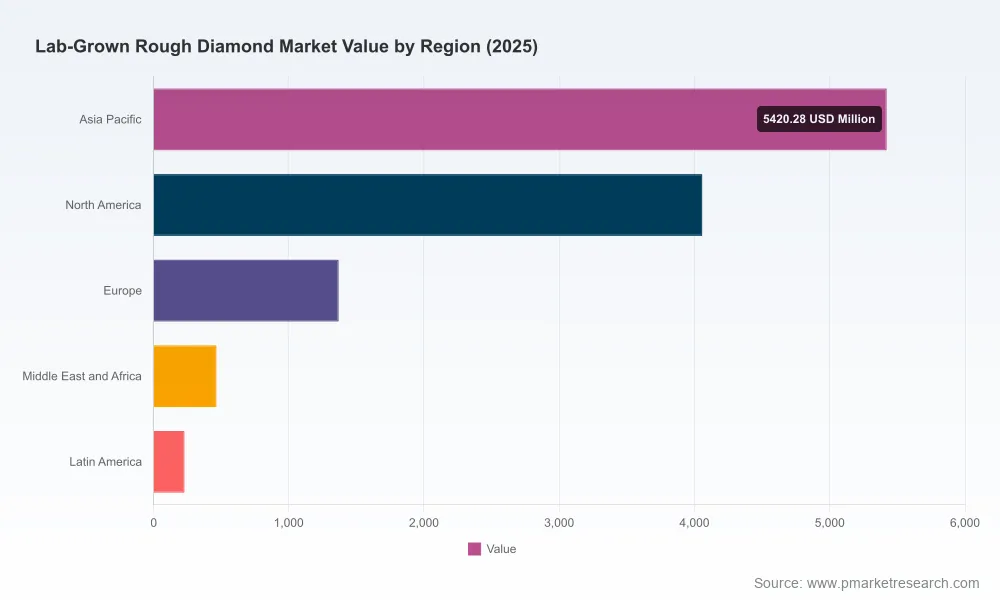
- Regional Intelligence: A comprehensive review of market performance across major geographies, highlighting regional consumption patterns, manufacturing hubs, and trade flows without disclosing specific proprietary valuation figures in this summary.
- Competitive Benchmarking: Detailed profiles of key companies, assessing their production capacities, technological focus, and recent strategic moves to map the competitive intensity and identify potential partnership or acquisition opportunities.
- Regulatory and Certification Impact: An evaluation of how evolving grading standards and certification policies from bodies like GIA and HRD Antwerp influence market pricing, consumer perception, and supply chain compliance.
- Cost and Supply Chain Dynamics: Insights into raw material inputs, including gas mixtures for CVD and press infrastructure for HPHT, and how these factors drive production economics.
The report synthesizes quantitative data with qualitative industry context to provide a holistic view. It is designed to answer critical questions regarding where value is concentrating, which technologies offer the best scalability, and how regulatory changes might alter the competitive playing field. By integrating market concentration data with company-specific developments, the study offers a granular perspective on the forces shaping revenue distribution and market access.
Strategic Imperatives for 2026 and Beyond
As the market approaches the 2030s, the strategic focus for stakeholders must shift from volume expansion to value optimization and risk management. The projected growth to over 21.7 billion USD by 2032 suggests ample opportunity, but the path is fraught with competitive and regulatory variables. Executives should prioritize securing supply chains that are resilient to technological shifts and certification changes. Understanding the concentration of market power among top players is essential for negotiating leverage, while awareness of regional manufacturing capacities can inform sourcing diversification strategies.
Furthermore, the divergence in application segments—jewelry versus industrial—requires tailored approaches. Jewelry demand is sensitive to consumer perception and ethical narratives, while industrial demand is driven by performance metrics and cost efficiency. A unified strategy may not suffice; segmentation of business units or product lines may be necessary to capture value in both domains.
The Worldwide Lab-Grown Rough Diamond Market report serves as a definitive guide for navigating these complexities. It provides the data-driven foundation necessary to validate investment theses, refine market entry strategies, and anticipate shifts in the competitive landscape. In an industry where information asymmetry can dictate market position, access to precise, forward-looking intelligence is a decisive advantage.
For detailed analysis of this topic, please visit the official page: Worldwide Lab-Grown Rough Diamond Market
Lacy Lee
Senior Marketing Manager
[email protected]
PW Consulting: www.pmarketresearch.com






























Sign in to leave a comment.