
Strategic Intelligence Brief: The Worldwide Lactation Massager Market 2026–2032
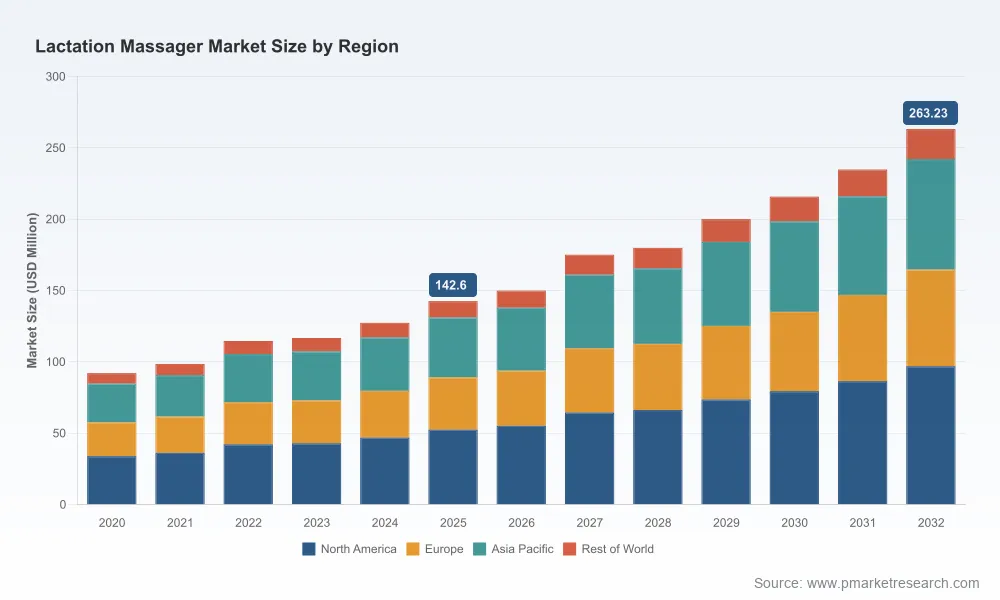
The global lactation massager market has transitioned from a niche wellness accessory to a structured therapeutic category within maternal healthcare and postpartum self-care. Between 2020 and 2025, worldwide revenue expanded from roughly 92.15 million USD to an estimated 142.6 million USD in 2025, reflecting sustained adoption across consumer retail and clinical support channels. Forecasts indicate continued acceleration, with market valuation projected to reach 150.02 million USD in 2026 and grow to 263.23 million USD by 2032. At this trajectory, the category is expected to record a compound annual growth rate of 9.15 percent across the 2026–2032 forecast period.
This expansion is not merely a volume story. It reflects a structural recalibration of how postpartum mothers, lactation consultants, and healthcare providers approach milk flow support, engorgement relief, and breast inflammation management. Electric vibration units, heat-integrated models, and manual tools now occupy distinct positioning within the product architecture, while demand is increasingly shaped by clinical validation, reimbursement ambiguity, and regulatory specificity. For executives evaluating product roadmaps, channel strategy, and investment timing, the 2026 decision window is especially critical. The market is entering a phase where differentiation depends less on first-mover availability and more on therapeutic credibility, feature integration, and the ability to navigate class-specific regulatory expectations.
The Worldwide Lactation Massager Market research study was designed to give leadership teams a decision-grade map of this evolving landscape. Rather than presenting static totals, the analysis connects historical momentum (2020–2025) with a forward-looking view (2026–2032) that highlights where growth is concentrated, how product architecture is shifting, and which competitive moves are likely to shape share dynamics over the next several years.
Why 2026 Is aStrategic Inflection Point
The 2026 base year marks the point where early adoption patterns begin to crystallize into durable demand channels. After the rapid post-2022 expansion, the market has matured enough for buyers to compare function, evidence, and ecosystem fit with greater sophistication. At the same time, the growth path through 2032 suggests that the category will not plateau near current levels. Instead, it is expected to scale through continued product innovation, broader consumer familiarity, and deeper integration with broader maternal care routines.
From a strategic planning perspective, this matters because markets at this stage reward companies that can align product features with the practical requirements of nursing and pumping routines, while also anticipating the compliance and reimbursement environment that influences purchasing behavior. The study's forecast structure supports scenario planning by separating baseline momentum from the variables that can accelerate or constrain uptake in specific channels and geographies. Executives can use this framing to test product launches, pricing posture, and channel commitments against a realistic growth curve rather than aspirational benchmarks.
What the Research Deliverable Covers
The report is built as an operational reference for strategy, marketing, and product teams. It translates macro momentum into usable intelligence across multiple dimensions, including market sizing, segmentation structure, competitive positioning, and industry dynamics. The analysis is organized to support both high-level market orientation and tactical decision-making, with particular attention to the factors that influence purchase logic in home-care environments and institutional lactation settings.
PW Consulting
The core sections of the research include:
Worldwide Breastfeeding Accessories Market
- A historical and forecast revenue view that anchors the 2025 baseline and traces expected growth through 2032, enabling leaders to evaluate whether internal planning assumptions align with broader category momentum.
- A segmentation framework that separates product types, usage contexts, and regional demand patterns, helping teams identify where functional differentiation and channel prioritization are likely to produce the strongest returns.
- A competitive landscape assessment that maps the strategies, product architectures, and recent developments of leading manufacturers, with emphasis on how brands are building distinct value propositions around heat, vibration, compression, and clinical credibility.
- A market dynamics review that examines regulatory classification, quality and labeling expectations, and reimbursement realities, all of which shape commercialization strategy and go-to-market design.
- An industry context scan that captures the broader signals influencing adoption, including maternal health awareness, postpartum self-care trends, and the increasing role of clinically informed product claims.
The study is intentionally structured to avoid superficial categorization. Where many market summaries stop at aggregate size, this research connects sizing to the operational logic behind demand formation. That includes the relationship between product features and everyday use cases, the role of clinical and pilot evidence in shaping buyer trust, and the practical implications of operating in a category where therapeutic classification and reimbursement pathways are still evolving.
Competitive Landscape: Differentiation Over Density
The lactation massager market is not defined by saturation alone. It is shaped by a set of companies that are pursuing different routes to relevance: some through engineered feature combinations, others through clinical validation, and still others through ecosystem alignment with pumps, nursing accessories, and consumer-direct distribution. The competitive field reflects a category in which brand trust, usability, and therapeutic positioning are becoming increasingly important relative to basic availability.
Breast Pump Market
Several companies illustrate the strategic directions now visible in the market. MammaEase has built its offering around lactation-focused product design intended to address clogged ducts, engorgement, mastitis, and milk flow support, with warming and vibrating configurations aimed at reducing pumping time and improving comfort. Crane USA provides a dedicated lactation massager focused on loosening and comforting breast tissue to support breastfeeding and milk expression. Lactamo positions its product as a clinically validated aid combining temperature, movement, and compression, with independently trialed results intended to reinforce its role in managing common breastfeeding challenges.
LaVie Mom emphasizes patented lactation massager designs for nursing and pumping users, targeting engorgement relief, duct clearance, mastitis support, and improved lymphatic drainage. Momcozy, operating through ROOT Technology Ltd, offers multiple lactation massager variants that combine warming, vibration, and kneading functions, with features such as adjustable heat and vibration levels and waterproof construction. These products are often presented as part of a broader maternal care bundle, including breast pumps. Frida Mom contributes a 2-in-1 heat and vibration massager with adjustable modes designed to support milk flow for nursing and pumping users.
The landscape also includes brands that anchor their positioning in material choice, simplicity, and ecosystem compatibility. Haakaa is known for silicone-based manual breastfeeding products and offers lactation support tools and breast massagers designed for natural, non-toxic relief within its broader product ecosystem. Munchkin, Inc. offers the Milkmakers Warm Touch Lactation Massager, a product designed specifically for pumping and nursing mothers to aid milk flow. Together, these players illustrate that differentiation is increasingly tied to design philosophy, claims substantiation, and the ability to fit into the everyday routines of new mothers and the professionals who support them.
Recent industry activity reinforces the direction of travel. In April 2025, Lactamo-related independent trial results conducted from April to July 2025 at Amsterdam University Medical Centre were published, quantifying breast inflammation and positioning the product as a breakthrough aid. These results build on earlier hospital pilot data and reflect a broader movement toward evidence-informed positioning in a category that has historically relied more on consumer familiarity than clinical documentation. In July 2024, Lovemère launched what it described as the smallest ever warming lactation massager, emphasizing comfort, relief, and convenience for breastfeeding and pumping users. Developments like these show that product leadership is increasingly expressed through miniaturization, comfort engineering, and clinical visibility rather than feature count alone.
Dynamics Shaping Commercial Reality
The lactation massager category operates within a regulatory and reimbursement environment that directly influences product development, marketing claims, and purchasing pathways. Manufacturers must account for the fact that lactation massagers are typically regulated as Class II therapeutic massagers or vibrators under 21 CFR Part 890 Subpart F, with product code IRO. Depending on the device characteristics, this framework can require 510(k) clearance or qualify a product for exemption, while still subjecting manufacturers to quality system and labeling requirements.
This regulatory posture introduces practical constraints. Companies developing therapeutic vibrators and massagers need to align with FDA special controls that address specifications for vibration frequency, leakage current, and skin-surface temperature range where heat is applied. For product teams, these requirements are not only compliance items; they also influence engineering choices, claim language, packaging, and the overall risk profile of new launches. In a category where consumer trust is closely tied to safety and consistency, regulatory clarity can become a competitive asset as much as a regulatory obligation.
Reimbursement dynamics add another layer of strategic complexity. There are no dedicated CPT or HCPCS codes specifically for lactation massager devices. Related breastfeeding support services, such as counseling or pumps, may use general evaluation and management codes or breast pump codes such as E0602 and E0603. However, lactation massagers themselves are generally not separately reimbursable under standard durable medical equipment policies. This means that purchasing decisions frequently depend on out-of-pocket consumer willingness, retail visibility, bundling with pumps or care programs, and the perceived value of symptom relief and convenience. For commercial leaders, the implication is clear: channel design, pricing architecture, and claim framing must account for a reimbursement landscape that does not currently treat lactation massagers as a standalone covered category.
Using the Study for 2026 Decision-Making
The strategic value of the Worldwide Lactation Massager Market research lies in its ability to connect market structure with decision-ready framing. For corporate strategy and business development teams, the study provides a baseline for evaluating market entry, expansion, or partnership opportunities against realistic size and growth assumptions. For product and innovation leaders, it helps clarify where feature integration, clinical substantiation, and design refinement are likely to generate the strongest differentiation. For marketing and channel teams, it supports prioritization by highlighting where demand is forming and how competitive positioning is evolving.
The analysis also supports risk planning. In a category influenced by regulatory classification, reimbursement ambiguity, and consumer trust, assumptions about adoption speed and pricing power should be tested against the operational realities reflected in the research. The study's structure allows leaders to compare their internal forecasts with broader market logic, identify where strategic assumptions may be too optimistic or too conservative, and refine launch timing accordingly.
This introduction outlines the scope and strategic relevance of the research. It is intended to demonstrate the analytical depth available in the full study while preserving the detailed segmentation figures, regional breakdowns, application splits, concentration metrics, and company-level profiles for the complete report. Those elements provide the precise quantitative and qualitative intelligence needed for detailed planning, and they are presented in the full publication in a format designed for executive review, strategic workshops, and cross-functional alignment.
For leadership teams preparing 2026 decisions in maternal health, consumer wellness, or related product portfolios, the Worldwide Lactation Massager Market research offers a structured basis for evaluating where growth is coming from, how competitive advantage is being built, and what operational conditions will shape execution over the remainder of the decade. The full report extends this briefing into the detailed market intelligence necessary to convert direction into action.
For detailed analysis of this topic, please visit the official page: Worldwide Lactation Massager Market
Lacy Lee
Senior Marketing Manager
[email protected]
PW Consulting: www.pmarketresearch.com


























Sign in to leave a comment.