
Global Lubricating Grease Market Outlook 2026: Strategic Intelligence for Industry Leaders
As industrial operations face tightening regulatory frameworks, shifting raw material costs, and evolving end-use performance requirements, lubricating grease has moved from a commodity afterthought to a strategic component of asset reliability and compliance. This comprehensive market research delivers a full-spectrum view of the global lubricating grease landscape, offering decision-makers the clarity needed to navigate the period from 2026 through 2032 with confidence.
Our analysis covers the six-year historical baseline from 2020 to 2025 and projects forward across a seven-year forecast window extending to 2032. During the historical period, the global market expanded steadily, climbing from 5.47 billion USD in 2020 to an estimated 6.85 billion USD by 2025. Looking ahead, the trajectory continues with measured but consistent momentum, reaching approximately 7.12 billion USD in 2026 and advancing toward 9.38 billion USD by 2032. This expansion reflects a compound annual growth rate of 4.6 percent, signaling a market that is neither爆炸性 nor stagnant, but steadily resilient, shaped by industrial modernization, fleet management demands, and infrastructure investment cycles.
Why This Research Matters for 2026 Decision-Making
The 2026 operating environment is defined by convergence. Regulatory timelines for per- and polyfluoroalkyl substances (PFAS) are accelerating across multiple jurisdictions, lithium-based raw material pricing is stabilizing after extended volatility, and major producers are executing capacity expansions and formulation shifts that will reshape supply availability. In this context, anecdotal benchmarking or fragmented data points are insufficient. Enterprises require a structured, evidence-based view that connects macro market movements to actionable commercial strategy.
This report is designed to convert complex market signals into executive-ready intelligence. Rather than presenting abstract growth curves, the study maps where value is concentrated, which applications are pulling demand, how regional dynamics diverge, and what competitive actions will matter most over the next planning cycle. It equips strategy teams, procurement leaders, and R&D directors with a shared factual foundation for capacity planning, portfolio positioning, supplier negotiations, and market entry or expansion decisions.
Inside the Report: Operational Intelligence You Can Use
The research is built around practical applicability. Each section is structured to support real business conversations, not just retrospective commentary. The scope of coverage includes:
- Market sizing and forward projections with a consistent methodology that connects historical behavior to forecast assumptions
- A structured segmentation framework examining product type, application vertical, and regional demand patterns in a way that supports portfolio prioritization
- Competitive landscape profiling that goes beyond company descriptions to evaluate positioning, formulation specialties, and recent strategic moves
- Regulatory and raw material dynamics that directly affect formulation choices, compliance costs, and sourcing strategies
- An assessment of market concentration and the implications for pricing power, channel access, and differentiation opportunities
The report also integrates recent corporate developments and regulatory milestones that influence near-term supply and formulation strategy. These are not isolated news items; they are analyzed for their downstream impact on customer requirements, regional compliance burdens, and competitive differentiation. Readers will find a clear line of sight from external developments to internal decision points, whether those decisions involve product formulation roadmaps, capacity allocation, or risk-mitigation planning around compliance-driven demand shifts.
Automotive Grease Market
Market Structure and Concentration: What the Numbers Reveal
A defining characteristic of this market is meaningful concentration among leading suppliers, which shapes pricing behavior, innovation cadence, and customer negotiation dynamics. The study finds that the three largest competitors collectively hold about 52 percent of market revenue, while the top five account for approximately 65 percent. This level of concentration indicates that scale players retain substantial influence over standard-grade offerings and broad distribution channels, but it also leaves room for specialized performers to capture value through application-specific formulations, regulatory-aligned products, and service-led engagement models.
For buyers and competitors alike, concentration has practical consequences. Large incumbents can leverage broad manufacturing footprints and established brand portfolios, yet they must also manage the pressure of regulatory reformulation, regional compliance variance, and the need to maintain performance consistency across diverse operating conditions. Smaller or more specialized participants can compete by focusing on high-performance niches, sustainable or restricted-substance formulations, or tailored technical support. The report unpacks these dynamics so that organizations can determine where they are exposed to concentrated supply risk and where they can exploit gaps in standardized offerings.
Competitive Landscape: Strategic Positioning in a Consolidating Market
The competitive field includes global energy and chemicals majors, specialized lubrication manufacturers, and regional champions with strong vertical-specific footprints. The report profiles the companies that are actively shaping the market through product architecture, capacity decisions, and formulation innovation.
Shell PLC continues to anchor its grease portfolio around the Shell Gadus range, emphasizing lithium and complex lithium greases for bearings, open gears, and multi-purpose industrial applications. Its recent February 2025 expansion of Cassida food-grade high-temperature grease manufacturing capacity at its Hamburg blending plant illustrates a strategic response to growing demand for EU food safety compliance, highlighting how regulatory and end-use requirements can drive asset decisions.
ExxonMobil Corporation maintains a strong position through the Mobilgrease line, including the Mobilith series engineered for high-temperature stability and water resistance. This performance orientation reflects the broader industrial need for lubricants that can withstand harsher duty cycles and extended service intervals. BP p.l.c. competes with Castrol Spheerol and Optigear greases, serving both automotive and industrial applications and leveraging a brand architecture that connects performance messaging to distinct use cases.
FUCHS SE has emerged as a particularly noteworthy competitor in the reformulation space. Its RENOLIT DURAPLEX and related high-performance lithium complex greases are complemented by bio-based and PFAS-free formulations. In April 2025, FUCHS launched RENOLIT DURAPLEX BIO, a PFAS-free lithium complex grease using renewable esters designed for REACH-compliant European customers. That move is strategically significant because it ties sustainability, regulatory readiness, and performance into a single offering, an approach that increasingly matters to procurement groups facing multi-jurisdiction compliance demands.
Chevron Corporation supplies premium greases for industrial and marine applications, while Klüber Lubrication München SE & Co. KG focuses on high-performance greases for heavy-duty and extreme-condition industrial machinery. Sinopec continues to expand its relevance in high-temperature lithium greases for steel and cement applications, backed by a 2025 capacity expansion to serve those industrial customers more robustly. D-A Lubricant Company, Inc. rounds out the landscape with specialized offerings including the Brad Penn brand for industrial and automotive use, illustrating how targeted product identity can support competitive separation in a concentrated market.
Together, these profiles reveal two parallel competition themes: the battle for standard-volume positions in major application verticals, and the race to develop compliant, high-performance formulations that reduce customer exposure to regulatory and operational risk.
Raw Material and Regulatory Dynamics: The Forces Reshaping Formulation Strategy
Market evolution is increasingly governed by two intertwined forces: input cost stability and regulatory pressure on substance classes. On the raw material side, lithium hydroxide spot prices stabilized around early-to-mid 2016 low-to-mid teen USD per kilogram levels during most of 2024. This stabilization is meaningful for grease manufacturers because lithium-based thickeners remain central to many high-performance formulations. More predictable input costs can support steadier pricing planning and margin management, but they also raise the stakes for companies that must balance formulation performance with cost discipline.
On the regulatory side, PFAS-related developments are accelerating and diversifying across jurisdictions. In January 2025, the FDA issued a notice that 35 food contact notifications for PFAS in paper and paperboard packaging were no longer effective following voluntary phase-out. In March 2025, Canada published a proposed order adding PFAS, excluding fluoropolymers, to Schedule 1 to CEPA for public consultation. The EU REACH proposal, updated in August 2025, expanded coverage of PFAS restrictions with options including a ban with time-limited derogations. Meanwhile, France Decree No. 2025-1376 took effect on January 1, 2026, prohibiting the manufacture, import, export, and placing on the market of products containing PFAS above regulated limits.
These actions are not isolated administrative steps; they influence formulation roadmaps, customer acceptance criteria, and market access. For lubricating grease producers and buyers alike, the practical challenge is no longer whether PFAS-related regulation is coming, but how quickly different regions will move, how substitute formulations will perform, and whether compliance-driven changes will alter application performance or service life. The report integrates these signals into a unified view of risk and opportunity, allowing organizations to anticipate reformulation needs and evaluate where early compliance can become a commercial advantage rather than a cost center.
Lubricating Grease Market
Segmentation Insights: Where Demand Is Being Generated
Demand for lubricating grease does not grow uniformly across applications or regions. Instead, it reflects the operational priorities of different industries and the pace of economic activity in different parts of the world. The study examines how major application verticals contribute to total market demand and how their growth profiles differ. Automotive and transportation remains a central driver of volume, reflecting the continuous need to maintain vehicle fleets, reduce wear, and support reliability across diverse operating environments. Construction also represents a substantial demand base, consistent with the material handling, equipment maintenance, and heavy-duty service conditions characteristic of project-based activity.
General manufacturing, agriculture, mining, and power generation each contribute distinctly to the market, but with different growth rhythms and performance requirements. Some verticals prioritize broad compatibility and cost efficiency, while others require greases that can endure elevated temperatures, moisture exposure, contamination risk, or long lubrication intervals. By analyzing these application patterns without reducing them to static share figures, the report helps readers understand where demand resilience is strongest and where sensitivity to economic cycles, regulatory shifts, or raw material changes is likely to be greater.
Regional dynamics further complicate the picture. Demand is distributed across North America, Europe, Asia Pacific, Latin America, and the Middle East and Africa, with each region shaped by its own industrial mix, regulatory environment, and competitive intensity. Rather than presenting narrow regional percentages, the study focuses on the strategic implications of regional variation: where infrastructure and industrial activity support steady consumption, where compliance requirements influence formulation preferences, and where local competition or import dynamics affect market access. This regional framing is especially useful for companies planning distribution expansion, export strategy, or localized formulation adaptation.
Product Type Trends: The Shift Toward Performance and Compliance
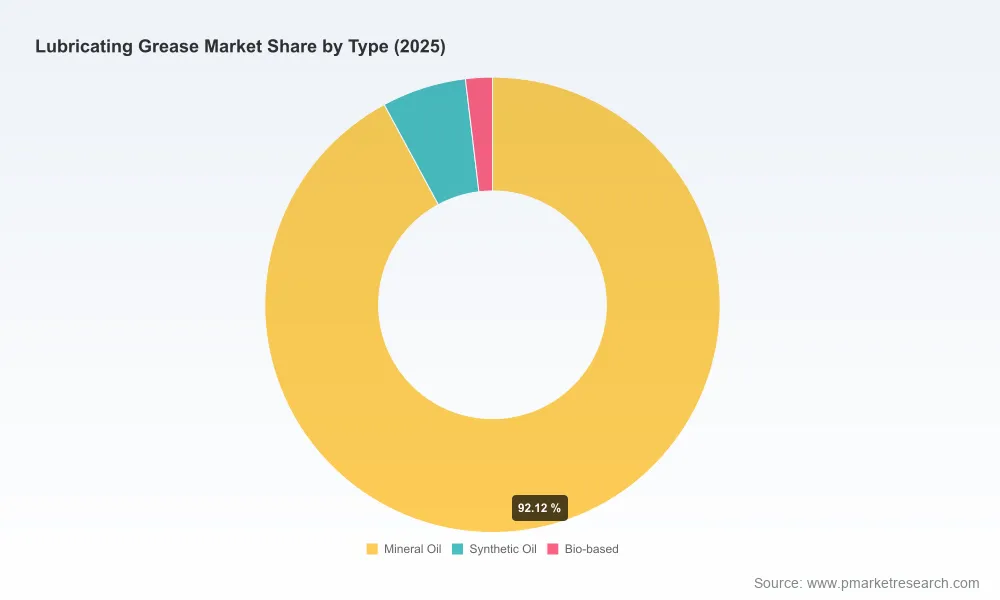
The product type landscape continues to be dominated by mineral oil-based greases in absolute terms, reflecting their broad compatibility, established supply chains, and wide application fit. At the same time, synthetic oil and bio-based options occupy a strategically important space. Synthetic formulations are valued where thermal stability, oxidation resistance, or extended service life is required. Bio-based and other emerging sustainable formulations are gaining attention not only for environmental positioning but also because they can be engineered to support compliance objectives in markets where restricted substances and renewable content are becoming procurement considerations.
This is not a simple substitution narrative. The more important insight is that product type choice is increasingly tied to a combination of performance, regulatory exposure, and customer specification. As a result, manufacturers that can offer credible high-performance alternatives while navigating restricted-substance requirements are better positioned to defend margins and capture specification-driven demand. The report explores these trade-offs in a way that supports product roadmap planning and customer-facing technical messaging.
The Strategic Case for Downloading the Full Report
Executive summaries and headline figures can signal direction, but they rarely provide the depth required to make confident commitments. In a market where concentration, regulation, raw material behavior, and application-specific performance needs interact continuously, incomplete information creates strategic risk. This research is built to reduce that risk by connecting the market’s macro trajectory to the operational decisions that determine outcomes in 2026 and beyond.
The full study provides the detailed segmentation logic, competitive movement analysis, regulatory timeline synthesis, and application-specific interpretation needed to support procurement strategy, product planning, sales positioning, and investment prioritization. It is intended for teams that must move beyond general market awareness and into specific decisions about where to compete, what formulations to prioritize, which customer requirements will become non-negotiable, and how to align capacity and sourcing with the next phase of demand growth.
For organizations that need to act on the lubricating grease market rather than simply observe it, the complete report offers the evidence base, comparative framing, and forward-looking structure required to turn market intelligence into commercial advantage.
For detailed analysis of this topic, please visit the official page: Lubricating Grease Market
Lacy Lee
Senior Marketing Manager
[email protected]
PW Consulting: www.pmarketresearch.com





























Sign in to leave a comment.