
Navigating the Digital Ledger: Strategic Imperatives in the Worldwide Oil and Gas Accounting Software Market
The global energy sector stands at a critical inflection point where financial transparency, operational efficiency, and regulatory compliance converge. As oil and gas enterprises navigate volatile commodity cycles, evolving extraction technologies, and increasingly stringent reporting mandates, the backbone of their financial operations—accounting software—has transformed from a back-office utility into a strategic enabler. Our latest Worldwide Oil and Gas Accounting Software Market research offers a comprehensive, data-driven lens into this rapidly maturing landscape. Designed for executive leadership, finance directors, and technology procurement teams, this study maps the market's trajectory from 2020 through 2032, providing the analytical rigor necessary to inform capital allocation, vendor selection, and digital transformation roadmaps in 2026 and beyond.
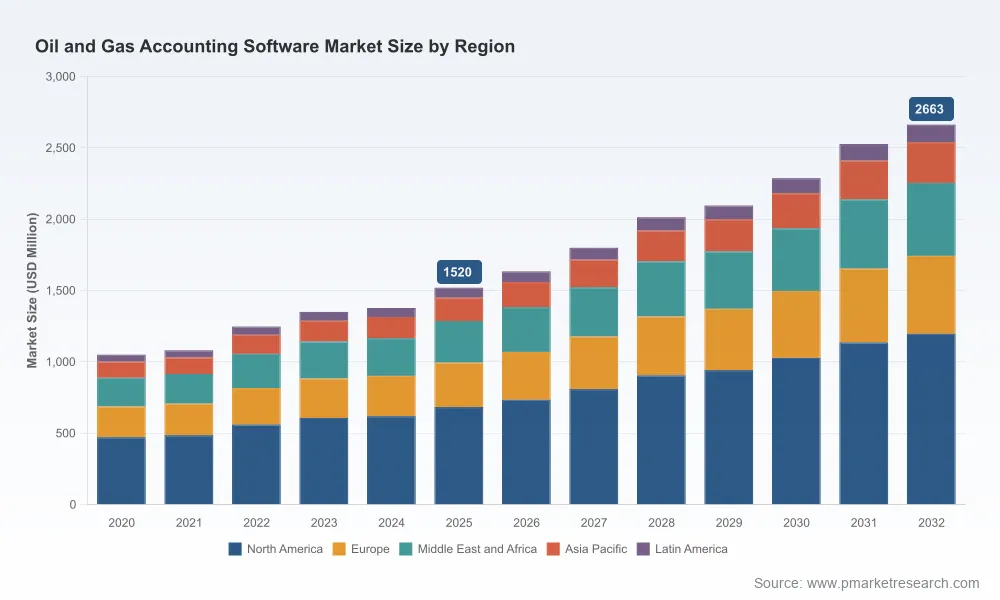
At its core, the market has demonstrated remarkable resilience and expansion. Historical revenue data reveals a consistent upward trajectory, with the sector growing from approximately $1,050 million in 2020 to roughly $1,520 million by 2025. This expansion reflects a broader industry realization that legacy, generalized accounting platforms cannot adequately handle the highly specialized workflows inherent to upstream, midstream, and downstream operations. Looking ahead, the market is projected to reach $1,634 million in 2026 and continue its ascent toward $2,663 million by 2032, driven by a forecasted compound annual growth rate of 8.34%. For decision-makers, these figures are not merely abstract metrics; they signal an accelerating adoption cycle, intensifying competitive pressure among solution providers, and a widening window of opportunity for organizations that strategically align their financial technology stacks with operational realities.
Decoding the Market Architecture
The research dissects the market across multiple dimensions, offering a granular view of deployment preferences, application-specific demand, and regional adoption patterns. Cloud-based architectures have emerged as the dominant deployment model, reflecting a decisive industry shift toward scalable, remotely accessible financial ecosystems. Organizations are increasingly prioritizing solutions that enable real-time revenue distribution, joint interest billing, and automated compliance tracking without the infrastructure overhead of traditional on-premise deployments. This transition is not simply a matter of technological preference; it is a strategic response to operational complexity, dispersed field operations, and the need for seamless integration with existing enterprise resource planning (ERP) environments.
Application-wise, the demand landscape reveals distinct priorities across the value chain. Upstream operations continue to drive substantial software expenditure, as operators require robust platforms to manage complex production accounting, acreage and land management, and the intricate financial mechanics of joint ventures. Midstream and downstream segments similarly depend on specialized accounting tools to optimize revenue recognition, manage transportation and storage cost allocations, and maintain rigorous audit trails across diversified asset portfolios. Each segment presents unique configuration requirements, and our analysis underscores that successful software implementations increasingly hinge on vendors' ability to deliver modular, industry-tailored functionality rather than one-size-fits-all financial suites.
Regionally, the market exhibits a mature concentration in North America, where established operator bases, complex leasehold structures, and well-defined regulatory frameworks have historically accelerated accounting software adoption. Europe and the Middle East and Africa follow as significant markets, each shaped by distinct operational models, fiscal regimes, and compliance expectations. Asia Pacific and Latin America represent high-growth frontiers, where expanding exploration activities, infrastructure development, and modernization initiatives are creating fresh demand for specialized financial management platforms. While high-level regional breakdowns provide strategic directionality, the full report delves into localized adoption drivers, procurement cycles, and competitive intensity to help enterprises calibrate their go-to-market or vendor-evaluation strategies with precision.
Accounting Software Market
Competitive Dynamics and Vendor Positioning
The competitive landscape is characterized by a blend of purpose-built niche providers and generalized enterprise platforms, each vying to capture slices of a growing but highly specialized market. Industry concentration metrics indicate a moderately consolidated environment, with the top three players capturing a meaningful share of total revenue and the leading five collectively representing just over half of market value. This structure suggests both a maturing ecosystem and ample room for differentiation through functionality, integration capabilities, and domain expertise.
Several key participants define the current competitive contours. Quorum Software has long established itself as a reference point for upstream-focused accounting, offering platforms engineered for joint interest billing, revenue distribution, AFE management, and regulatory compliance—functions that are indispensable for operators managing complex consortium structures. W Energy Software has gained traction by delivering agile, cloud-native solutions that emphasize API-driven integrations, revenue accounting, land management, and compliance workflows tailored to mid-to-large operators seeking flexibility and rapid deployment. Enertia Software bridges upstream and midstream requirements through integrated ERP and accounting capabilities, combining production accounting, pipeline functions, financial reporting, and land management into unified environments.
PakEnergy continues to focus on energy-specific ERP modules covering joint interest billing, AFE management, revenue distribution, accounts payable and receivable, and field operations support, recently reinforced by high-profile client implementations that highlight the platform's operational fit for complex land and accounting workflows. Enverus has carved a specialized position around upstream and midstream invoice processing, accounts payable automation, field ticket handling, and broader back-office efficiency gains, aligning its solutions with the daily operational realities of field-to-office financial reconciliation.
Beyond these purpose-built players, enterprise technology giants maintain a significant presence. IFS (BOLO) offers ERP and production accounting solutions widely utilized by major oil and gas organizations for comprehensive operations and financial management. SAP and Oracle provide expansive ERP ecosystems—including NetSuite and Fusion Cloud—that support multi-currency financials, regulatory reporting, and industry-adapted accounting modules, appealing to operators seeking to consolidate their financial technology stack under a single vendor umbrella. Other notable contributors include P2 Energy Solutions, Pandell, Petrofly, and Sage Intacct, each bringing distinct strengths in land management, cloud-based production accounting, or industry-specific financial management.
Recent market activity underscores the velocity of innovation and competitive maneuvering. In late 2025, a notable client implementation highlighted how operators are selecting vendors based on proven land management and accounting excellence, reinforcing the importance of referenceable deployments. Earlier product updates from established players have emphasized feature depth in production accounting, revenue distribution, and joint interest billing, signaling that differentiation increasingly hinges on operational granularity rather than broad platform claims. Additionally, broader industry moves—such as major service providers launching hydrocarbon accounting systems to support measurement and accounting processes—illustrate how the boundary between operational technology and financial software continues to blur, creating both integration opportunities and complexity for buyers.
Forces Reshaping the Market Landscape
Several structural dynamics are redefining how oil and gas companies evaluate, procure, and deploy accounting software. Regulatory evolution stands at the forefront. The FASB's recent updates to accounting guidance for internal-use software costs reflect a broader shift toward recognizing modern agile development methods, a change that carries direct implications for capitalization, amortization, and financial reporting practices within technology-intensive enterprises. Simultaneously, extractive industry companies must navigate evolving SEC reporting taxonomies, which have introduced new disclosure elements relevant to oil and gas operations. These regulatory currents elevate the importance of accounting platforms that can adapt rapidly to changing compliance requirements without disrupting core financial processes.
Worldwide Oil and Gas Accounting Software Market
Environmental, social, and governance reporting has also emerged as a decisive adoption driver. Increasing regulatory and stakeholder pressure for ESG disclosure is pushing organizations to embed integrated tracking modules within their accounting systems, linking financial data with emissions, resource usage, and operational sustainability metrics. This convergence is transforming accounting software from a purely financial tool into a broader corporate responsibility and risk management platform, expanding both functionality requirements and implementation scopes.
Security and data governance concerns introduce additional complexity. Cloud-based solutions offer clear advantages in scalability and remote accessibility, but they also raise heightened questions around the protection of sensitive financial and operational data. Organizations are increasingly scrutinizing vendor security postures, data residency options, and compliance certifications, making robust privacy frameworks and audit-ready controls a non-negotiable evaluation criterion.
Cost structures and labor dynamics further shape procurement decisions. The implementation and ongoing maintenance of sophisticated oil and gas accounting platforms represent significant expenditures, particularly for smaller operators that must rely on specialized labor for configuration, integration, and compliance management. This reality is driving a bifurcated market: larger enterprises are pursuing comprehensive, integrated environments that consolidate functions across finance, operations, and reporting, while smaller players are seeking streamlined, rapidly deployable solutions that minimize customization overhead while still addressing core industry-specific workflows.
What the Research Delivers for 2026 Decision-Makers
This study is engineered to translate market complexity into actionable intelligence. It provides a full historical baseline and forward-looking forecast, enabling finance leaders and strategy teams to benchmark current market positions, anticipate adoption shifts, and scenario-plan around revenue growth, technology investment, and vendor negotiation timelines. The report maps deployment and application trends in detail, helping organizations align their software architecture choices with operational priorities, integration needs, and scalability requirements. It examines competitive positioning across both niche and enterprise vendors, offering a structured framework to evaluate solution capabilities, partnership potential, and long-term vendor viability.
Beyond high-level trends, the research delves into practical procurement considerations. It explores how regulatory changes affect platform selection, how ESG reporting demands are reshaping feature roadmaps, how security and compliance expectations influence cloud versus on-premise decisions, and how labor and implementation costs vary across operator profiles. The analysis also contextualizes recent product launches, client implementations, and feature updates within broader market momentum, giving technology procurement teams a current, ground-level view of what vendors are delivering and where differentiation truly resides.
For organizations planning multi-year digital finance strategies, the study provides the analytical scaffolding needed to answer critical questions: Which deployment models align best with our operational footprint? What functional depth is non-negotiable for upstream versus downstream environments? How do regulatory trajectories influence platform roadmaps? Where does the market's competitive balance suggest favorable procurement leverage, and where does vendor concentration warrant caution? These are not abstract inquiries; they are the foundation of sound capital allocation, risk mitigation, and operational resilience in a sector where financial accuracy and compliance are inextricably linked to commercial performance.
Looking Ahead
The Worldwide Oil and Gas Accounting Software Market is entering a phase of accelerated consolidation, functionality specialization, and regulatory-driven evolution. Organizations that treat accounting software as a strategic asset—rather than a commoditized utility—will be better positioned to manage joint venture complexity, streamline compliance, and integrate ESG and operational data into coherent financial narratives. Those that delay modernization or rely on fragmented, poorly integrated tools will face mounting friction as reporting expectations intensify and operational scale expands. Our comprehensive research equips executives with the market-wide perspective and segment-level insight necessary to navigate this environment with confidence. For teams seeking detailed regional adoption patterns, application-specific sizing, and deep competitive benchmarking, the full report offers the complete intelligence framework required to turn market understanding into decisive, 2026-ready strategy.
For detailed analysis of this topic, please visit the official page: Worldwide Oil and Gas Accounting Software Market
Lacy Lee
Senior Marketing Manager
[email protected]
PW Consulting: www.pmarketresearch.com



























Sign in to leave a comment.