
The Resilience Imperative: Strategic Intelligence for the Global Residential Backup Power Market Through 2032
The global residential backup power market has transitioned from a niche contingency planning sector to a core component of household infrastructure strategy. As grid instability, extreme weather events, and increasing electrification of homes converge, homeowners and installers are reevaluating how they secure uninterrupted energy. Our latest Worldwide Residential Backup Power Market research provides a comprehensive analytical framework for navigating this evolving landscape. This article outlines the strategic value of the study for executive decision-making in 2026, highlighting the structural shifts, competitive pressures, and regulatory inflection points that will define the next seven years of industry growth.
The market has demonstrated consistent expansion over the past half-decade, with revenue climbing from approximately $10.54 billion in 2020 to $15.42 billion in 2025. This trajectory reflects a compound annual growth rate of 8.15 percent across the historical review period, signaling an industry that has moved beyond cyclical recovery into sustained structural demand. Forward-looking projections extend through 2032, with the market anticipated to exceed $26.68 billion by the terminal forecast year. Such growth is not merely a function of population expansion or replacement cycles; it is being reshaped by technology substitution, fuel diversification, and regional policy acceleration. Understanding the mechanics behind these numbers is essential for capital allocation, product roadmap planning, and go-to-market positioning.
Structural Shifts Across Technology, Fuel, and Regional Demand
The composition of residential backup demand reveals a market in technological transition. Traditional generator architectures continue to command meaningful share, but the rise of battery energy storage systems and uninterruptible power supply solutions is restructuring how households approach resilience. The interplay between standby generation and behind-the-meter storage is creating hybrid deployment patterns that defy simple categorization. Fuel preferences are similarly evolving, with legacy gasoline and diesel applications sharing the landscape alongside natural gas and propane installations, while solar-integrated and electric-driven backup configurations are gaining traction in specific housing stock and climate zones.
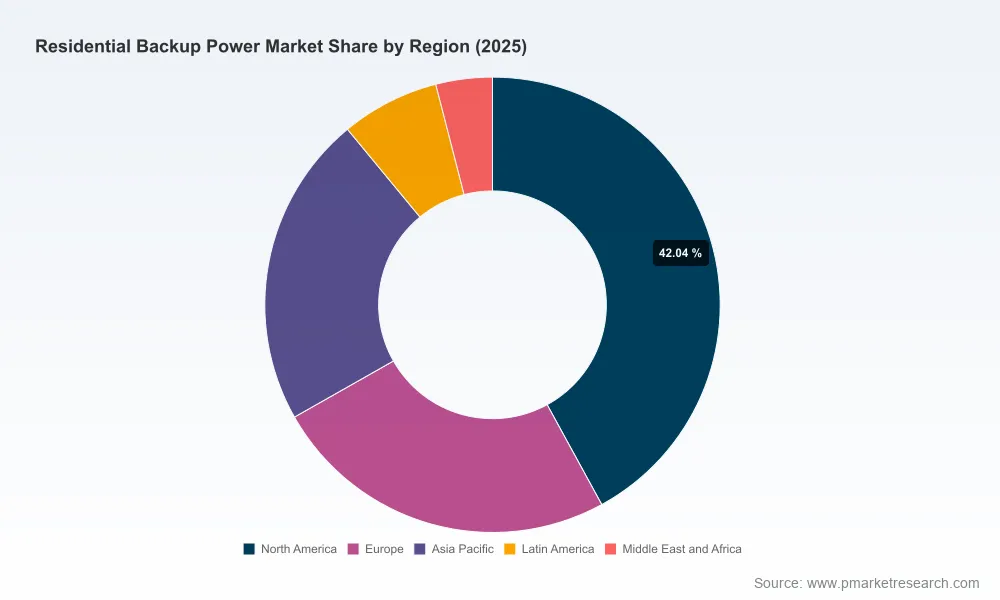
Regional dynamics further complicate the picture. North America remains a foundational market driven by storm-prone geographies, high rates of homeownership, and established installer networks. Europe presents adistinct demand profile shaped by energy security considerations and building efficiency mandates. Asia Pacific is emerging as a high-potential region where urbanization, grid reliability concerns, and rapid residential electrification are expanding the addressable base. Latin America and the Middle East and Africa contribute incremental but strategically relevant growth, often tied to specific infrastructure gaps and off-grid adjacency. Our research maps these regional vectors without reducing them to static percentages, instead emphasizing the demand drivers, installation channel structures, and policy environments that differentiate each geography.
Industry cost structures are undergoing parallel transformation. Lithium-ion battery pack prices for stationary storage applications fell to $70 per kilowatt-hour in 2025, compressing the economics of battery-backed residential solutions and altering the total cost of ownership calculus for homeowners and distributors. At the same time, installed costs for residential home battery backup systems in 2026 range from roughly $8,500 for smaller 5 kilowatt-hour units to between $11,500 and $12,500 for larger 13 kilowatt-hour-plus configurations. These figures underscore the importance of modular design, installer efficiency, and component sourcing strategies in maintaining margin health as hardware costs decline but labor and integration complexity remain significant.
Regulatory Tailwinds and Policy Cliffs Shaping Deployment Economics
Policy frameworks are becoming as consequential as hardware innovation in determining where and how quickly residential backup solutions scale. In the United States, the federal residential clean energy tax credit, which provided a 30 percent incentive for home battery systems, expired after December 31, 2025. This expiration introduces a pricing and demand timing question for 2026 planners: how will channel partners adjust promotional pricing, financing offers, and inventory positioning in the absence of the federal credit? The answer varies by market maturity, installer behavior, and the availability of state or utility-level incentives that may partially offset the federal change.
Worldwide Residential Backup Power Market
At the state level, regulatory activity is accelerating in both permissive and programmatic directions. Texas S.B. 1202, effective September 2025, streamlines permitting for residential distributed energy resources including standby power and storage, reducing friction in installation timelines and potentially expanding the reachable homeowner base in a state already sensitive to grid disruption risk. Virginia H.B. 2346, enacted in May 2025, requires a pilot program for virtual power plants aggregating up to 450 megawatts of residential battery storage and distributed energy resources for grid services. This development signals a longer-term monetization pathway for residential storage beyond backup alone, aligning household resilience investments with grid-support value streams.
These regulatory dynamics do not operate in isolation. They interact with utility interconnection standards, local building codes, and evolving safety requirements for stationary storage. A strategic assessment of the market must therefore account for the permeability of regulatory barriers, the variability of incentive cliffs, and the emerging opportunity to participate in aggregated grid services. The research synthesizes these threads into a decision-oriented view of where policy will amplify demand, where it will introduce compliance complexity, and where it will reshape revenue models for residential backup offerings.
Competitive Dynamics Among Established and Emerging Players
The competitive landscape is anchored by a concentrated group of incumbents and a growing set of entrants targeting specific technology niches and customer segments. The market exhibits meaningful concentration, with the top three competitors holding an estimated 42.5 percent combined share and the top five reaching 58.2 percent. This structure indicates that scale, brand trust, distribution reach, and integrated product ecosystems confer measurable advantages, while also leaving room for specialized players to capture share through differentiated technology, pricing, or channel strategy.
Generac Holdings Inc. remains a dominant force in residential standby generators, with a commanding presence in North American home standby applications and a portfolio spanning air-cooled Guardian series units, PWRcell home battery storage, and hybrid solutions for whole-home backup. The company continued to expand its residential lineup in early 2025, launching six new portable inverter generators across 49 and 50 states, including an 8,000-watt model, and introducing a new 28-kilowatt air-cooled home standby generator alongside updated PWRcell 2 energy storage systems. These moves illustrate a strategy of broadening the portable-to-standby continuum while reinforcing battery integration capabilities.
Kohler Co. competes in the premium standby segment with a focus on quiet operation, reliability, and durable whole-house backup performance across 20 to 26 kilowatt-class models. Cummins Inc. positions its QuietConnect series, including the RS20A, around residential optimization emphasizing quiet operation, cold-start reliability, and commercial-grade durability. Briggs & Stratton supplies the PowerProtect series up to 26 kilowatts on natural gas for whole-home backup, complementing its portable and inverter model offerings for residential use. Together, these American-engineered brands reinforce a strong incumbent backbone in the standby generator segment, where installer relationships and service networks often influence purchase decisions as much as hardware specifications.
The battery storage arena features a different competitive logic. Tesla, Inc. leads in residential battery backup with Powerwall systems designed for seamless whole-home or critical-load backup, solar integration, and smart energy management. Enphase Energy provides Encharge home battery storage systems with microinverter integration, supporting modular residential backup and solar compatibility. Caterpillar Inc. brings industrial engine expertise to residential and light commercial standby generators, while Champion Power Equipment targets residential backup and emergency home power needs with portable and inverter generators. EcoFlow, operating across China and the United States, specializes in portable and whole-home battery backup systems such as the Delta Pro Ultra for modular residential emergency power. Honda Motor Co., Ltd. complements this field with portable inverter generators widely used for residential backup, known for fuel efficiency, quiet operation, and emergency reliability.
These profiles reveal a market where competitive advantage is increasingly derived from integration depth, ecosystem compatibility, and channel execution rather than hardware alone. The research examines how these companies are positioning across standby generation, battery storage, and hybrid solutions, and where the pressure points lie for new entrants and established players alike.
What the Research Delivers for 2026 Decision-Making
The Worldwide Residential Backup Power Market study is designed as an operational intelligence tool rather than a high-level summary. It provides an integrated view of market sizing across historical and forecast horizons, with detailed segmentation that enables scenario planning by technology pathway, fuel type, and regional demand structure. Decision-makers can use the analysis to test supply commitments, evaluate product mix shifts, and anticipate channel demand in advance of seasonal installation cycles.
Beyond sizing, the report maps the competitive field with company profiles, recent development tracking, and positioning analysis that clarify who is gaining traction in which subsegments and why. It incorporates market concentration metrics to inform partnership, acquisition, and competitive response strategies. The study also integrates the regulatory and cost environment, including incentive expirations, permitting reforms, virtual power plant pilot programs, and evolving installed-cost ranges, to help planners model pricing, margin, and adoption sensitivity under alternative policy scenarios.
For product and strategy teams, the research offers a structured assessment of technology substitution trends, including the relative momentum of generator-based backup versus battery energy storage and uninterruptible power supply solutions. For sales and distribution leaders, it provides context on regional demand drivers, installer behavior, and the practical implications of hardware cost declines on channel pricing and inventory planning. For corporate development, it highlights where concentration dynamics, emerging entrants, and technology integration opportunities may create acquisition targets, partnership rationale, or defensive positioning requirements.
Worldwide Backup Power Market
The aim is to reduce uncertainty in a market where the cost of misreading demand timing, technology mix, or regulatory impact can be substantial. By connecting macro growth trajectories with segment-level dynamics and competitive realities, the study equips leadership teams to make more informed choices about capacity, portfolio emphasis, geographic prioritization, and go-to-market investment.
Conclusion: Turning Market Complexity into Strategic Advantage
The residential backup power market is expanding at a pace that rewards disciplined strategy and punishes reactive planning. Growth to over $26.68 billion by 2032 will not be evenly distributed across technologies, fuels, or regions, and the winners will be those who can interpret demand signals early, align product and channel strategies with policy and cost shifts, and compete effectively in a concentrated yet evolving landscape. This research is built to support that effort, offering the depth required for credible planning while reserving the granular segment-level detail for decision-makers who need to act on it.
Organizations that engage with the full study will gain access to the segmentation data, regional demand breakdowns, competitive positioning tables, and policy-sensitive scenario framing necessary to translate market growth into executable strategy. For executives preparing 2026 investment and product decisions, the opportunity is clear: understand the structure of the market now, anticipate the inflection points already in motion, and position your organization to capture value as residential backup power becomes an increasingly central component of home energy resilience.
For detailed analysis of this topic, please visit the official page: Worldwide Residential Backup Power Market
Lacy Lee
Senior Marketing Manager
[email protected]
PW Consulting: www.pmarketresearch.com




























Sign in to leave a comment.