
Strategic Intelligence for the Global Tire Supply Chain: Navigating the 2026 Logistics Landscape
The worldwide tire logistics market is entering a critical phase of consolidation, automation, and geographic realignment. As manufacturers, distributors, and retail networks confront shifting regulatory mandates, raw material volatility, and rising sustainability expectations, the ability to design resilient, data-driven supply chains has become a decisive competitive advantage. This analysis draws on PW Consulting’s newly released Worldwide Tire Logistics Market research, a comprehensive study engineered to bridge high-level market intelligence with actionable operational guidance for enterprise decision-makers preparing for the 2026 planning cycle and beyond.
Understanding the trajectory of tire logistics requires more than tracking headline numbers. It demands a granular reading of how transport modes, service architectures, regional demand curves, and technological investments interact across a fragmented global network. The following insights outline the structural forces shaping the industry, examine the competitive landscape, and demonstrate how targeted market intelligence can translate into measurable operational resilience.
Market Trajectory and Structural Growth Dynamics
Over the past half-decade, the tire logistics sector has demonstrated steady monetary expansion, reflecting both rising global vehicle production and the increasing complexity of moving bulky, high-value products through integrated supply networks. Historical baselines from 2020 through 2025 show consistent upward momentum, with market valuation climbing from approximately $17.4 billion to $22.5 billion. The forward-looking forecast window extending to 2032 projects continued growth, driven by expanding distribution footprints, heightened service specialization, and sustained investment in storage and handling infrastructure. A compound annual growth rate of 5.23 percent underscores the market’s structural resilience even as participating firms navigate cost pressures and capacity constraints.
Tire Market
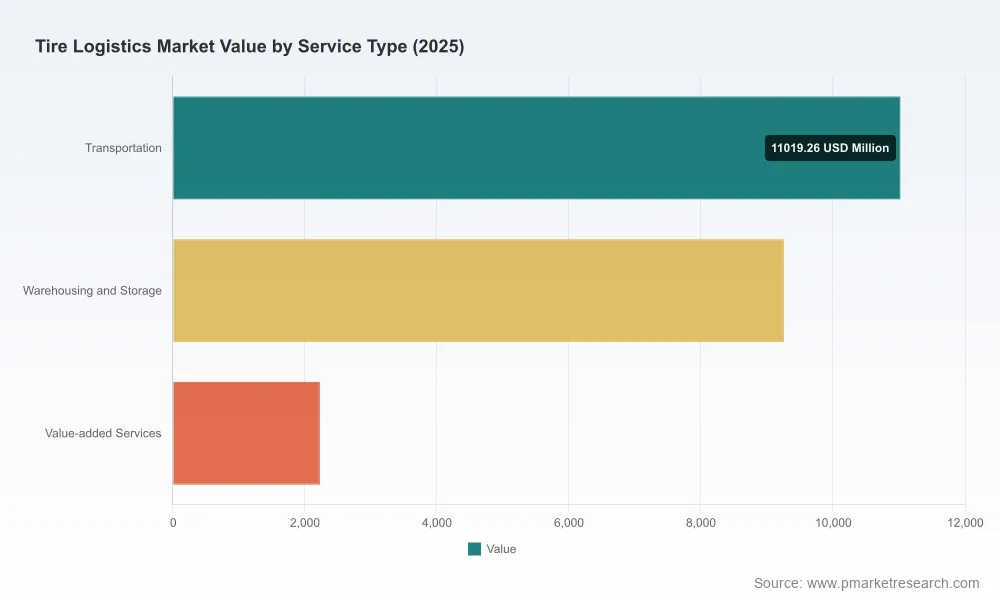
This trajectory is not uniform across every operational dimension. The demand profile is shaped by how tire manufacturers and distributors allocate resources across transportation, warehousing, and value-added handling. Road-based movement continues to anchor the majority of logistical throughput, while maritime flows support intercontinental distribution and rail networks serve regional corridor efficiency. Simultaneously, warehousing and storage have grown into a substantial revenue pillar, reflecting the industry’s shift toward buffer inventory strategies, regional fulfillment nodes, and centralized staging hubs. Value-added services, though a smaller share of total activity, are expanding rapidly as suppliers seek customized handling, sequencing, and downstream preparation capabilities.
Geographic demand patterns reveal distinct operational priorities. Asia Pacific remains a dominant volume center, supported by dense manufacturing clusters and expanding domestic distribution networks. Europe follows with mature logistics infrastructure and deep integration across continental routes, while North America continues to scale its wholesale and retail fulfillment architecture. Middle East and Africa, along with Latin America, represent emerging pathways where infrastructure investment and dealer network expansion are gradually reshaping service requirements. For enterprise planners, these regional variations are not merely statistical; they inform network design, carrier selection, inventory positioning, and risk allocation strategies.
Operational and Regulatory Forces Reshaping Logistics Design
The tire supply chain is being redefined by intersecting operational pressures that demand more sophisticated planning tools and coordinated execution. Raw material volatility, fuel cost fluctuations, and periodic port congestion have introduced recurring variability into transportation schedules and pricing models. At the same time, new environmental compliance frameworks have elevated the importance of traceability, waste management, and reverse logistics. Updated recycling guidelines introduced across multiple states have increased compliance scrutiny for tire shops and supply chain participants alike, while industry-wide sustainability reporting standards are pushing firms to standardize environmental impact measurement across the entire value chain.
Infrastructure investment is responding in kind. Tire manufacturers and logistics providers are increasingly deploying automated warehousing systems that combine conveyor networks, stacker cranes, and robotic handling to reduce physical footprint, accelerate inventory turnover, and lower labor intensity in high-volume storage environments. Intelligent material flow architectures are enabling more precise sorting, sequencing, and distribution within production facilities and regional distribution centers. These automation-driven upgrades are no longer optional enhancements; they are becoming baseline expectations for organizations managing large tire portfolios under tight service-level commitments.
For decision-makers, the practical implication is clear: logistics strategy must now account for regulatory alignment, sustainability reporting obligations, and automation readiness at the same time that cost efficiency and delivery reliability remain paramount. Models that treat compliance, automation capital, and transport optimization as separate workstreams risk underpricing operational risk and missing coordination benefits.
Competitive Landscape and Core Capability Profiles
The market structure remains moderately concentrated, with the largest participants capturing a meaningful share of specialized tire logistics activity while a broad field of regional and functional specialists competes on service differentiation, network density, and technology integration. Analysis of the competitive environment highlights several archetypes that collectively shape how tires move from production lines to end markets.
- Global supply chain integrators have built dedicated tire logistics capabilities spanning inbound raw material flow, finished goods warehousing, and distribution network design. Their value proposition centers on end-to-end scale, international routing expertise, and standardized service architectures that support major tire manufacturers across multiple continents.
- Long-standing transport partnerships continue to anchor intercontinental tire movements, particularly for established manufacturers that rely on deep operational continuity, sea freight optimization, and multi-year collaboration to stabilize plant-to-market flows.
- Specialized logistics providers have developed comprehensive tire handling ecosystems that cover raw material inbound, plant operations support, warehousing, distribution, and even wheel mounting. Some have scaled dedicated tire sites to serve large portions of the global top-tier producer base, signaling the strategic importance of industry-specific infrastructure.
- Independent and national distribution networks remain central to retail fulfillment. These organizations operate extensive wholesale channels that connect major brand portfolios with tire retailers and service centers, relying on broad distribution footprints and inventory availability to maintain market reach.
- Automation and material flow specialists are increasingly embedded in the industry’s operational backbone, delivering intelligent storage, sorting, and distribution systems designed to optimize internal logistics at tire production and handling facilities.
- Regional and mid-market providers contribute agility, tailored transport solutions, and niche warehousing services, often focusing on tire hotel concepts, returns management, and localized distribution support across specific European or North American corridors.
Recent operational activity reinforces the direction of this competitive evolution. Distribution networks are expanding physical footprints to improve regional service coverage, including new large-scale facilities in key metropolitan corridors that strengthen dealer support in targeted territories. Tire manufacturers are simultaneously advancing their own logistics infrastructure, with newly constructed or expanded distribution centers designed to increase storage capacity and streamline outbound flows. In parallel, automation contracts are materializing around major production expansions, with integrated warehouse systems, automated guided vehicles, conveyors, and robotics being deployed to support higher throughput and tighter handling precision in overseas manufacturing sites. Together, these moves reflect an industry that is physically scaling while simultaneously digitizing and automating its movement and storage processes.
Spare Parts Logistics Market
What the Worldwide Tire Logistics Market Research Delivers
PW Consulting’s Worldwide Tire Logistics Market research is structured to convert these market signals into concrete planning inputs. The study moves beyond surface-level market sizing to deliver operational intelligence that can be applied to network strategy, service portfolio design, carrier evaluation, and technology investment decisions. Decision-makers will find coverage that connects demand behavior, transport mode economics, service-type dynamics, and regional operating environments into a coherent analytical framework.
PW Consulting
The report emphasizes practical application. It maps how transportation, warehousing, and value-added service segments interact under different volume and cost scenarios, helping organizations benchmark their current operating model against prevailing industry configurations. It examines regional operating characteristics in a way that supports market entry assessment, capacity planning, and distribution network optimization without oversimplifying local complexity. It also integrates the competitive landscape with recent facility, automation, and partnership developments, allowing readers to evaluate how incumbent players are repositioning their capabilities and where service gaps or partnership opportunities may emerge.
Equally important, the research incorporates the regulatory and sustainability context that increasingly shapes logistics execution. Updated compliance expectations, recycling obligations, and standardized environmental reporting requirements are examined alongside operational realities, providing a foundation for risk-aware planning. This integrated approach ensures that market intelligence is not treated as a standalone dataset, but as an input to coordinated supply chain strategy.
Strategic Implications for 2026 Decision-Making
For executives, supply chain leaders, and commercial planners, the practical value of this research lies in its ability to connect external market conditions with internal execution choices. The 2026 planning environment calls for a balanced posture: one that protects service reliability while preparing for continued automation, regulatory alignment, and geographic network adjustment.
- Distribution strategies should be tested against evolving regional demand patterns and transport mode economics, particularly where road-based throughput, maritime scheduling, and warehousing capacity intersect.
- Capital allocation for storage and handling infrastructure should be evaluated with an eye toward automation readiness, space efficiency, and throughput scalability, especially for organizations managing high-volume tire inventories.
- Compliance and sustainability planning should be embedded into logistics design rather than treated as downstream reporting tasks, given the growing scrutiny around recycling practices and environmental impact measurement.
- Competitive positioning should account for both scale-based integrators and specialized providers, with attention to where dedicated tire expertise, local network density, or technology-enabled handling can create differentiated service outcomes.
Ultimately, the market is rewarding organizations that combine operational discipline with forward-looking intelligence. The firms that succeed will be those that can interpret macro growth signals, translate them into network and service decisions, and respond to the simultaneous pressures of cost, compliance, and capacity.
Accessing the Full Market Intelligence
This overview highlights the strategic contours of the worldwide tire logistics market, but the complete research contains the detailed segmentation analysis, regional operating profiles, service-type dynamics, competitive benchmarking, and scenario-based interpretation required for precise enterprise planning. Readers seeking the full dataset, methodological context, and actionable market breakdowns are encouraged to access the complete study through PW Consulting’s official research portal. The full report provides the depth necessary to support network design, service strategy, procurement decisions, and long-range investment planning across the tire logistics value chain.
For detailed analysis of this topic, please visit the official page: Worldwide Tire Logistics Market
Lacy Lee
Senior Marketing Manager
[email protected]
PW Consulting: www.pmarketresearch.com



























Sign in to leave a comment.