
Strategic Horizons: Navigating the Worldwide Medical Beauty Hyaluronic Acid Injection Market in 2026
The aesthetic medicine industry stands at a critical inflection point in 2026. As demand for non-invasive procedures continues to reshape global healthcare consumption, the hyaluronic acid injection market remains a cornerstone of medical beauty portfolios. For executives, investors, and strategic planners, understanding the trajectory of this sector is not merely an academic exercise; it is a prerequisite for capital allocation, product positioning, and competitive maneuvering. Our latest Worldwide Medical Beauty Hyaluronic Acid Injection Market research offers a comprehensive lens through which to view these dynamics, providing the granularity required to make informed decisions in a rapidly evolving landscape.
This report serves as a strategic compass for the forecast period spanning 2026 through 2032. By anchoring our analysis in historical performance from 2020 to 2025, we establish a robust baseline against which future growth can be measured. The research is designed to move beyond superficial market summaries, delivering actionable intelligence that addresses the specific challenges and opportunities facing stakeholders in the dermal filler ecosystem. As we release this body of work, the focus remains on how these insights translate into tangible competitive advantages for organizations operating within this high-growth vertical.
Market Trajectory and Forecast Dynamics
The macroeconomic environment for hyaluronic acid injections has demonstrated remarkable resilience and expansion over the past half-decade. Historical data indicates a consistent upward trajectory, with the market value growing from approximately 4.05 billion USD in 2020 to an estimated 6.45 billion USD by 2025. This growth reflects a compound annual growth rate that underscores the sustained consumer interest in minimally invasive aesthetic procedures. As we look toward the 2026 forecast period, the momentum shows no signs of abating. The projected valuation for 2026 sits at 7.21 billion USD, signaling a significant step forward in market maturity.
Long-term projections suggest that this expansion will continue through the end of the decade. By 2032, the market is anticipated to reach a valuation exceeding 12 billion USD. This growth is not linear; it is driven by a complex interplay of technological innovation, regulatory shifts, and changing demographic preferences. The forecast CAGR of 9.38 percent throughout the 2026 to 2032 period highlights a sector that is outpacing many traditional healthcare markets. For corporate strategists, this implies that the window for market entry or share expansion remains open, but the margin for error is narrowing as competition intensifies.
Understanding the velocity of this growth is essential for capacity planning and R&D investment. The data suggests that the market is transitioning from a phase of rapid adoption to a phase of sophisticated differentiation. Companies that rely solely on volume expansion may find themselves vulnerable to competitors who prioritize product innovation and clinical outcomes. Our analysis dives deep into the forces propelling this growth, distinguishing between temporary trends and structural shifts that will define the industry for years to come.
Strategic Segmentation and Product Landscape
A superficial view of the market aggregates all hyaluronic acid injections into a single category. However, strategic decision-making requires a nuanced understanding of the product types and application areas that drive revenue. The market is bifurcated primarily between monophasic and biphasic hyaluronic acid technologies. Each type offers distinct rheological properties that cater to different clinical indications and patient expectations. Monophasic formulations are often favored for their smooth integration and natural feel, while biphasic variants provide structural support for deeper tissue restoration. The balance between these technologies varies by region and provider preference, creating distinct opportunities for manufacturers who can tailor their portfolios to specific local needs.
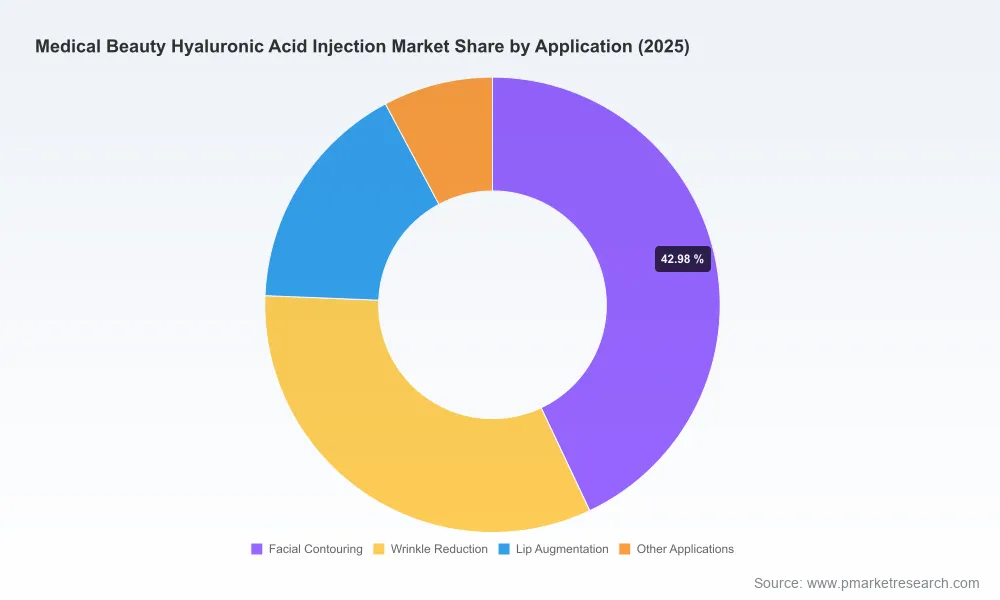
Application-wise, the demand landscape is diverse. Facial contouring remains a dominant driver of consumption, reflecting the growing emphasis on facial harmony and structural enhancement. Wrinkle reduction continues to be a foundational segment, appealing to both younger consumers seeking prevention and older demographics looking for restoration. Lip augmentation represents a specialized yet high-value niche that requires specific product characteristics and skilled administration. There are also emerging applications that extend beyond the traditional face, utilizing HA fillers for hand rejuvenation and other off-label indications that are gaining regulatory traction.
Beyond the finished product, the supply chain dynamics concerning raw materials are equally critical. The hyaluronic acid raw material market itself is experiencing growth, driven by the shift toward non-animal microbial fermentation-sourced HA. This transition has become the standard for regulated medical applications, minimizing contamination risks and ensuring consistency. The valuation of raw materials varies significantly based on molecular weight and endotoxin limits, with prices for medical-grade hyaluronic acid ranging widely depending on the purity and specifications required. This upstream volatility impacts margins and supply security for downstream manufacturers, making supply chain resilience a key component of our strategic analysis.
Competitive Landscape and Key Players
The global competitive landscape is characterized by a mix of established multinational corporations and agile regional players. Market concentration indicates that a significant portion of revenue is captured by a core group of leaders, with the top three companies holding a substantial share of the market. The top five players collectively command an even larger portion of industry revenue, suggesting that scale and brand recognition remain powerful moats. However, the presence of numerous specialized firms indicates that niche expertise and innovation can still carve out significant value.
Leading the pack are industry titans such as AbbVie, known for the JUVÉDERM Collection which spans volume restoration, wrinkle correction, and lip augmentation. Their recent strategic announcements regarding the next chapter in HA injectables signal a continued commitment to innovation at the highest level. Galderma follows closely with its Restylane portfolio, utilizing NASHA and OBT technologies for a broad range of indications including hand rejuvenation. Recent regulatory approvals for new syringe technologies highlight their focus on enhancing the delivery experience for practitioners.
Merz Pharma maintains a strong position with the Belotero range, which is designed to integrate seamlessly into facial tissue to correct wrinkles and folds. Similarly, Teoxane Laboratories has carved a niche with their RHA collection, focusing on resilient hyaluronic acid designed for natural movement in dynamic facial areas. The market also sees significant activity from companies like Evolus, which has expanded its footprint with new injectable gels approved for dynamic wrinkles, and Hugel, which supplies global markets with products like THE CHAEUM and BYRYZN.
Hyaluronic Acid Market
In the raw material and manufacturing space, Bloomage Biotechnology Corporation Limited stands out as a major producer for medical beauty applications, influencing the supply chain from the ground up. LG Chem contributes with high-molecular-weight BDDE-crosslinked sodium hyaluronic acid fillers, while companies like HTL Biotechnology specialize in pharmaceutical-grade production. The landscape also includes emerging entrants and regional specialists such as Shanghai Haohai Biological Technology, Croma-Pharma, Sinclair Pharma, and IBSA, each bringing unique formulations to the table. Recent regulatory milestones, such as the FDA approval of the Obagi saypha MagIQ gel by Waldencast, demonstrate that the barrier to entry remains permeable for those with strong clinical data and regulatory acumen.
Regulatory Shifts and Industry Dynami
Regulatory frameworks play a pivotal role in shaping market access and product lifecycles. Between 2023 and 2025, the FDA approved multiple new hyaluronic acid dermal fillers, including specific indications for temple hollowing and infraorbital hollows. These approvals expand the addressable market for existing products and introduce new capabilities for practitioners. For companies operating in this space, staying abreast of regulatory changes is not optional; it is a core competency that determines speed to market and geographic reach.
The supply chain evolution toward non-animal microbial fermentation-sourced HA has standardized quality expectations across the industry. This shift reduces variability and contamination risks, aligning with stricter regulatory requirements in North America and Europe. However, it also raises the technical bar for manufacturers, favoring those with robust bioprocessing capabilities. The interplay between raw material costs and finished product pricing remains a delicate balance, influenced by molecular weight specifications and endotoxin limits that dictate the grade of the final product.
PW Consulting
Value for 2026 Decision Making
Why does this specific body of research matter for decisions being made today? In a market moving at the pace of 9.38 percent CAGR, lag time in strategic planning can result in missed opportunities or misallocated resources. This report provides the detailed segmentation data and competitive benchmarking required to validate market entry strategies, optimize pricing models, and identify partnership opportunities. It moves beyond general industry commentary to provide specific forecasts that can be integrated into financial models and strategic roadmaps.
Hyaluronic Acid Dermal Filler Market
For organizations looking to capitalize on the 2026 to 2032 growth window, the granularity of this analysis is essential. It allows stakeholders to stress-test their assumptions against realistic market scenarios and understand the relative positioning of key competitors. Whether assessing the viability of a new product launch, evaluating a potential acquisition, or planning capacity expansion, the insights contained herein are designed to reduce uncertainty. The detailed breakdowns of regional performance, application splits, and company-specific trajectories are available in the full report, offering the depth required for high-stakes decision making.
In conclusion, the Worldwide Medical Beauty Hyaluronic Acid Injection Market presents a landscape of significant opportunity tempered by increasing complexity. The convergence of technological innovation, regulatory evolution, and shifting consumer preferences creates a dynamic environment where informed strategy is the primary differentiator. Our research is built to support executives in navigating this complexity, providing the clarity needed to execute with confidence. For those requiring the full depth of our analysis, including specific regional valuations, application splits, and detailed competitive profiles, the complete market report is available for review and download on our platform.
For detailed analysis of this topic, please visit the official page: Worldwide Medical Beauty Hyaluronic Acid Injection Market
Lacy Lee
Senior Marketing Manager
[email protected]
PW Consulting: www.pmarketresearch.com
















Sign in to leave a comment.