
Strategic Intelligence for the 2026 Decision-Maker: Navigating the L-Alanine Market
In the rapidly evolving landscape of specialty amino acids, L-Alanine stands as a critical node connecting industrial manufacturing, food science, and pharmaceutical development. As we move through the mid-2020s, understanding the trajectory of this market is not merely an academic exercise but a strategic imperative for stakeholders across the value chain. PW Consulting's latest comprehensive study offers a rigorous examination of the L-Alanine sector, providing the analytical depth required to make informed capital allocation and operational decisions in the forecast period extending to 2032.
This article serves as a strategic preview of our full market research publication. It outlines the macro-economic context, highlights the operational dynamics shaping supply and demand, and examines the competitive architecture that defines the industry. However, the complete quantitative texture—the granular segmentation and precise regional valuations necessary for bottom-up modeling—is reserved for the full report. Here, we focus on the strategic narrative that underpins the data.
L-Alanine Market
The Macro Trajectory: From Historical Stability to Forecasted Growth
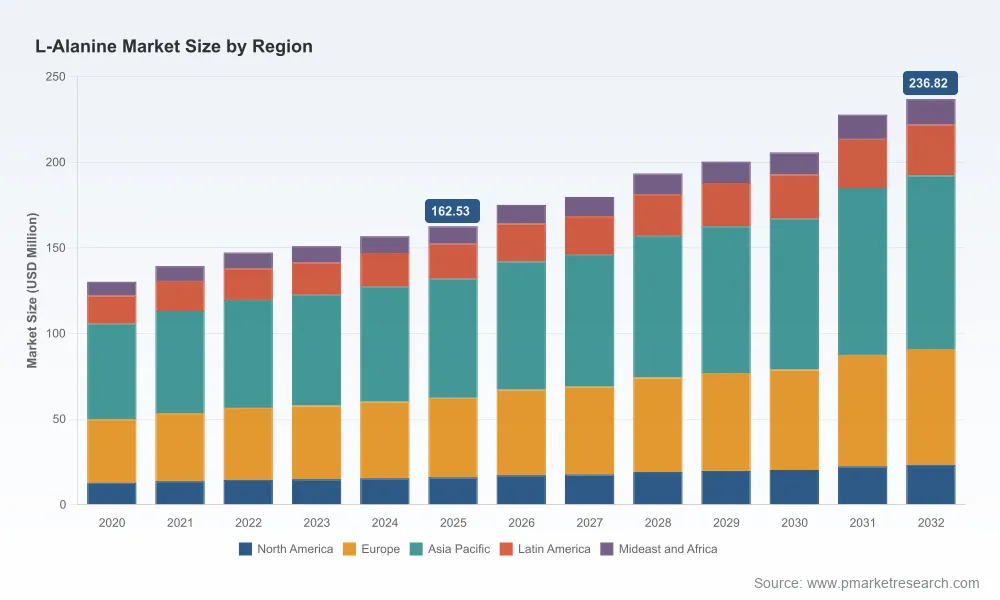
The L-Alanine market has demonstrated consistent resilience over the past half-decade, transitioning from a mature state to a period of renewed expansion. Historical data tracking from 2020 through the base year of 2025 reveals a steady upward curve in revenue generation. This period of historical validation is crucial because it establishes the baseline reliability of the supply chain and the consistent demand pull from downstream sectors. The market has grown from a foundational level in 2020 to a significantly elevated valuation by 2025, reflecting the compound annual growth rate that characterizes the sector's recent performance.
Looking forward, the forecast period from 2026 to 2032 indicates continued momentum. The industry is projected to expand its revenue base substantially by the end of the decade. This is not a linear projection; it accounts for potential volatilities in raw material sourcing, regulatory shifts, and the adoption rates of new production technologies. For a Chief Strategy Officer or an Investment Director, the key takeaway is the confidence level around this growth. The forecast suggests that L-Alanine will remain a high-demand commodity, driven by diversified application verticals rather than reliance on a single industry spike.
Our analysis indicates that the market value is expected to reach significant milestones by 2032. This long-range visibility is essential for capacity planning. Companies considering capital expenditure on fermentation facilities or synthetic biology infrastructure need to know that the demand curve supports such investments. The growth trajectory implies that while the market is competitive, the aggregate pie is expanding enough to reward efficiency and innovation.
Segmentation Dynamics Without the Noise
While specific percentage splits are detailed in the full dataset, the structural composition of the market deserves strategic attention. The L-Alanine market is not a monolith; it is segmented by type, application, and geography, each with distinct pricing powers and volume drivers.
The segmentation by type reveals a dominance of industrial and food-grade categories. However, the pharmaceutical grade segment, while smaller in aggregate volume compared to industrial uses, commands higher margin thresholds and stricter compliance requirements. Strategic decisions often hinge on whether a company positions itself in the high-volume, lower-margin industrial stream or the specialized, high-compliance pharmaceutical stream. Each path requires different operational capabilities and risk management frameworks.
In terms of application, the breadth of usage is a key strength of the L-Alanine market. The food and beverage sector continues to be a primary consumption driver, leveraging the compound for flavor enhancement and nutritional fortification. Simultaneously, the nutrition sector—encompassing dietary supplements and clinical nutrition—provides a stable demand floor. The pharmaceutical application, while specialized, offers high-value opportunities for companies with the requisite quality certifications. Understanding the interplay between these application verticals is critical for forecasting demand shocks. For instance, a surge in health-conscious consumer behavior impacts the nutrition segment, while industrial processing efficiencies impact the food and beverage segment.
Geographically, the market exhibits a global footprint. However, the distribution of consumption and production capacity varies significantly. Some regions serve as primary manufacturing hubs leveraging cost advantages in raw materials and labor, while others are key consumption centers driven by local formulation needs. Our full report dissects these regional nuances, but strategists should note that supply chain resilience often depends on understanding these geographic arbitrage opportunities and constraints.
Competitive Landscape: The Key Players
The competitive environment in the L-Alanine market is characterized by a mix of global conglomerate presence and specialized regional expertise. Market concentration metrics indicate that while there is a degree of consolidation among top players, there remains sufficient fragmentation to allow for niche competition. The CR3 and CR5 metrics suggest an oligopolistic tendency in certain segments, yet new entrants utilizing innovative synthetic biology methods are challenging traditional production models.
Several key companies define the current landscape. Ajinomoto Co., Inc. remains a pivotal figure, leveraging its fermentation-based production capabilities to serve both pharmaceutical and food-grade markets globally. Their long-standing reputation in amino acid technology provides a significant barrier to entry for competitors lacking similar scale and R&D depth.
Evonik Industries AG represents another pillar of the industry, particularly in the high-specification end. Their focus on non-animal-derived L-Alanine meeting EP/USP/JP grades positions them uniquely for medical nutrition and biopharma applications. This regulatory compliance capability is a vital asset in an industry where certification delays can stall product launches.
In the Asia-Pacific region, companies like Kyowa Hakko Bio Co., Ltd. continue to specialize in high-purity fermentation products. Their focus on pharmaceutical and nutritional markets underscores the region's importance as both a production and innovation hub. Meanwhile, Chinese manufacturers such as Anhui Huaheng Biotechnology Co., Ltd. and SINOGEL Amino Acid Co., Ltd. represent the scaling power of the region. Anhui Huaheng, for instance, has been active in expanding its portfolio through synthetic biology, targeting animal nutrition, human nutrition, and personal care.
Recent activities from these players highlight the dynamic nature of the competition. For example, Anhui Huaheng Biotechnology has recently focused on product releases related to health benefits and intermediates, signaling a strategy aimed at capturing value in adjacent nutritional markets. They have also pursued sustainability certifications, such as the EcoVadis Silver Medal, indicating that environmental, social, and governance (ESG) performance is becoming a competitive differentiator. Such moves suggest that the barrier to entry is rising not just through capital requirements but through the need for verified sustainability and quality standards.
Industry Dynamics and Operational Context
Production technology remains a central dynamic in the L-Alanine market. The shift towards fermentation-based production using renewable sugars is altering the cost structure of the industry. Compared to alternative chemical pathways, fermentation offers potential cost reductions and aligns better with sustainability goals. This technological preference is not static; it evolves with advancements in strain engineering and process optimization. Companies that can lower their unit costs through biological efficiency gain a distinct pricing advantage in volume-driven segments.
Regulatory frameworks also play a decisive role in market access. L-Alanine's approval as a non-animal-derived non-essential amino acid under major monographs such as EP, USP, and JP is critical for players targeting medical nutrition and biopharma applications. Compliance with these standards is not optional; it is a gatekeeper for high-value contracts. Furthermore, regulatory scrutiny from bodies like the FDA impacts operational continuity. For instance, recent regulatory interactions involving key industry participants highlight the importance of maintaining impeccable compliance records to avoid disruptions.
Supply chain stability is another dynamic factor. The reliance on renewable sugars as raw materials ties the market to agricultural commodity cycles. Fluctuations in sugar prices or availability can ripple through to production costs. Therefore, strategic sourcing agreements and vertical integration are common tactics among leading firms to mitigate input cost volatility.
Additionally, the industry is seeing increased attention on sustainability credentials. As end-users in the food and pharmaceutical sectors face their own ESG pressures, they are increasingly demanding transparency and sustainability from their raw material suppliers. Companies that can document lower carbon footprints or ethical sourcing practices may command premium positioning or secure long-term partnerships more easily.
Strategic Value of the Full Research Report
While this overview provides the strategic context, the full L-Alanine Market Research report from PW Consulting delivers the quantitative precision required for execution. Decision-makers need more than directional trends; they need the specific data architecture to build financial models and risk assessments.
The complete report includes:
- Detailed historical and forecast revenue data segmented by specific regions, types, and applications, allowing for granular bottom-up analysis.
- In-depth profiles of key competitors, including their strategic moves, capacity expansions, and recent developments that could signal shifts in market share.
- Analysis of market concentration and competitive intensity, helping companies benchmark their position against the CR3 and CR5 landscapes.
- Assessment of raw material cost dynamics and regulatory impacts specific to different grades and regions.
- Identification of emerging opportunities in niche applications such as sports nutrition, clinical enteral feeding, and specialized industrial intermediates.
For 2026 planning, access to this level of detail is indispensable. Whether you are evaluating a potential partnership, considering a capacity expansion, or assessing a competitor's threat level, the nuanced data provided in the full study enables a more robust decision-making framework. The macro trends are clear, but the specific allocation of resources depends on understanding where the growth pockets are most concentrated and which segments offer the best risk-adjusted returns.
The L-Alanine market offers substantial opportunity for those equipped with the right intelligence. The convergence of technological innovation, regulatory clarity, and growing demand across health and industrial sectors creates a fertile environment for strategic growth. However, realizing this potential requires navigating a complex landscape of competing players and varying compliance standards.
We invite strategy leaders, investors, and industry executives to utilize this full market research study as a cornerstone of their 2026-2032 planning process. The insights contained within are designed to transform uncertainty into a structured strategic roadmap, ensuring that your organization is positioned to capitalize on the evolving dynamics of the global L-Alanine industry.
Beta-Alanine Market
For detailed analysis of this topic, please visit the official page: L-Alanine Market
Lacy Lee
Senior Marketing Manager
[email protected]
PW Consulting: www.pmarketresearch.com



























Sign in to leave a comment.