
Navigating the Latex Powder Market: Strategic Intelligence for 2026 Decision-Makers
The global landscape for powdered organic and specialty materials is undergoing a structural shift. As industries converge around natural ingredients, regulatory compliance, and performance-driven formulations, market participants require more than traditional forecasting models. They need a strategic compass calibrated to volatility, supply chain constraints, and evolving end-user expectations. Our latest market research on Latex Powder provides exactly that framework, translating historical momentum into actionable intelligence for the 2026 fiscal cycle and the decade ahead.
Worldwide Latex Binders Market
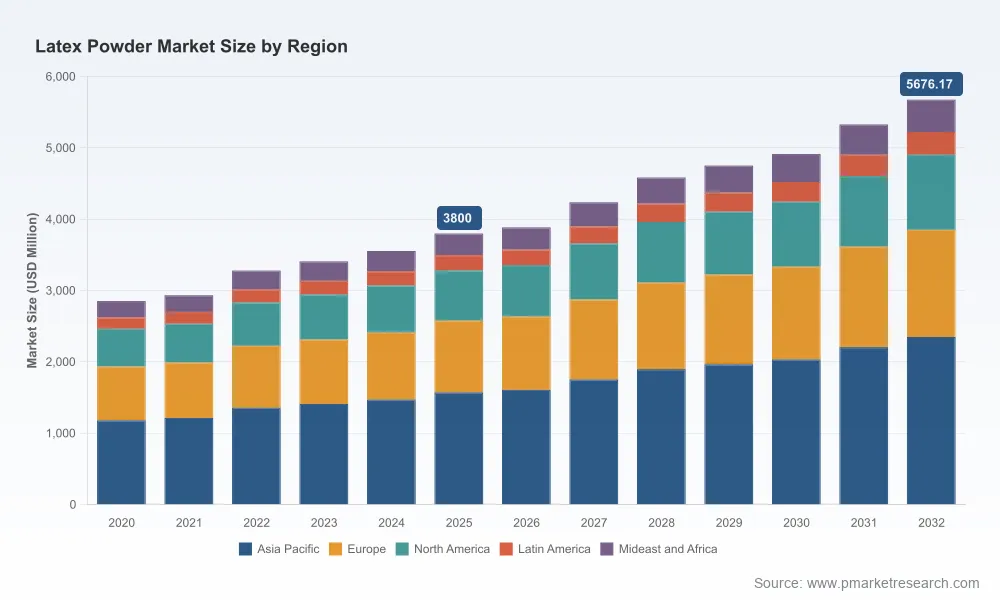
The base-year assessment positions the sector at approximately $3.8 billion in 2025, building on a five-year expansion trajectory that has steadily accelerated from the $2.85 billion mark recorded at the start of the decade. Looking forward, our forecast period extends through 2032, mapping a compound annual growth rate of 5.9 percent. This trajectory is not a simple extrapolation; it reflects the compounding effect of demand diversification, capacity optimization, and regulatory standardization across multiple verticals. The numbers tell a story of resilience, but the underlying dynamics demand a deeper, more granular reading.
For executives planning capital allocation, product development, and market-entry strategies in 2026, the central question is no longer whether the sector will expand. It is how growth will be distributed across regions, polymer categories, and application segments, and which competitive positions will capture disproportionate value as the market matures.
Macro Trajectory and the Architecture of Growth
Historical data from 2020 through 2025 reveals a market that has absorbed shocks, adapted to input cost fluctuations, and maintained a consistent upward slope. The progression from $2,934 million in 2021 to $3,409 million in 2023, and onward to $3,555 million in 2024, underscores a sector that has moved beyond early-cycle volatility into a phase of structural expansion. The jump to the 2025 base of $3.8 billion marks a threshold: demand is now sufficiently diversified that single-market shocks no longer dictate aggregate performance.
Our forecast work extends this arc through 2026 at $3,885 million, accelerating toward $4,237 million in 2027 and $4,585 million by 2028. The momentum continues through 2030 at $4,914 million before reaching $5,328 million in 2031 and $5,676 million in 2032. This curve is shaped by several interacting forces: broadening adoption in construction and industrial applications, reformulation trends favoring natural and specialty inputs, and a regulatory environment that is simultaneously opening new market access points while imposing tighter compliance discipline.
What matters for strategy is not the headline figure, but the divergence beneath it. The forecast implies that growth will not be evenly spread. Certain geographic corridors will outpace others based on infrastructure investment cycles and regulatory readiness. Certain polymer categories will benefit from formulation preferences and supply reliability, while others will face substitution pressure or margin compression. Application segments will diverge sharply depending on construction activity, retrofit demand, and performance specifications. The full research unpacks these divergences systematically, but the strategic implication is immediate: portfolio decisions made in 2026 must be anchored to segment-level elasticity, not aggregate growth assumptions.
Competitive Positioning and Strategic Echoes
The competitive landscape is defined by a mix of specialized manufacturers, regional processors, and ingredient suppliers leveraging botanical and synthetic feedstocks. Market concentration metrics indicate that the top three players command a combined share of 52 percent, while the top five reach 58 percent. This level of concentration suggests a market where scale, regulatory compliance, and supply chain control confer meaningful advantages, yet sufficient fragmentation remains to enable niche positioning and regional differentiation.
Within this architecture, companies such as MartinBauer illustrate the strategic direction of leading participants. Headquartered in Vestenbergsgreuth, Germany, the firm operates at the intersection of botanical sourcing and specialty ingredient manufacturing, including Cape Aloe Leaves Latex Powder derived from Aloe ferox latex. Its product footprint spans food, beverage, and dietary supplement applications, reflecting a broader industry trend in which latex powder categories are increasingly evaluated through the lens of natural provenance, functional reliability, and compliance readiness.
This is not merely a company profile; it is a signal. The emphasis on botanical sourcing, monograph alignment, and application-specific formulation points to a market where differentiation is built on traceability, regulatory acceptance, and end-user trust. In a sector where concentration is moderate but rising, the ability to demonstrate compliance with recognized standards and to secure consistent raw material flows becomes a competitive moat. The report details how these positioning strategies are playing out across different categories and where gaps in supply assurance or documentation create openings for new entrants or aggressive incumbents.
Latex Powder Market
For strategists, the takeaway is that competitive advantage in 2026 will likely hinge on three interlocking capabilities: securing reliable feedstock under evolving conservation and trade frameworks, aligning product documentation with official monographs and national compendia, and tailoring formulations to the performance expectations of downstream applications. The research maps how these capabilities translate into share dynamics and margin profiles across the competitive set.
Regulatory and Raw Material Dynamics Reshaping the Field
No strategic assessment of this market is complete without confronting the regulatory and raw material currents that will shape cost structures and market access in the coming years. The sector is operating in an environment where conservation considerations, official standardization, and national ingredient monographs intersect with commercial demand. Bitter aloe species, including Aloe ferox, are subject to CITES governance for international trade, introducing a compliance layer that affects sourcing strategy, export planning, and inventory architecture. At the same time, Cape Aloe is recognized in the USP official monograph and appears in Health Canada’s Compendium of botanical monographs, reinforcing a path to market for products that meet established documentation and quality benchmarks.
Health Canada’s ingredient monograph explicitly permits aloe latex for bowel movement promotion, illustrating how national regulatory frameworks can create clear demand signals for specific applications. These parallel developments—one constraining volume flows through trade controls, the other enabling product acceptance through recognized monographs—create a nuanced operating environment. Companies must navigate conservation compliance without sacrificing product consistency, and they must align documentation with the standards that downstream buyers and regulators increasingly expect.
The raw material dimension adds further complexity. Cape Aloe Leaves Latex Powder is produced from the latex of Aloe ferox leaves, a natural laxative ingredient whose supply depends on agricultural conditions, harvesting practices, and trade routing. In a market where input consistency and sourcing transparency are becoming differentiators, the ability to manage these variables—while maintaining cost discipline and meeting monograph requirements—will separate resilient operators from those exposed to disruption. The full study traces how these dynamics influence segment attractiveness, pricing behavior, and the strategic posture of key suppliers.
Practical Intelligence Inside the Research
This market research is designed as a decision-support instrument, not a static data table. It integrates historical performance, forward-looking forecasts, and operational context into a cohesive framework that executives can deploy across planning cycles. The report provides a structured examination of market size evolution, growth drivers, restraint factors, and the regional and category-level dynamics that determine where value will accrue. It also delivers a practical view of the competitive field, including company profiles, operational footprints, and the strategic implications of recent industry developments.
Readers will find detailed segmentation analysis that disaggregates the market along regional lines, polymer type classifications, and application categories. This breakdown allows planners to evaluate growth opportunities with precision, identify concentration risks, and assess substitution or expansion potential within specific verticals. The research further incorporates an assessment of market concentration and competitive intensity, helping stakeholders understand where scale advantages are entrenched and where agility or specialization can create outsized returns.
Beyond structure, the report translates context into action. It addresses how raw material considerations and regulatory frameworks shape sourcing strategy, how compliance pathways influence product acceptance, and how application-level demand patterns will evolve as downstream industries adjust formulation standards and procurement practices. The objective is to equip strategy teams with a clear map of opportunities, constraints, and competitive levers, enabling them to align investment, R&D, sales focus, and supply chain design with the most resilient growth paths.
Strategic Priorities for 2026 and Beyond
As organizations finalize 2026 plans, the Latex Powder market presents a set of strategic choices that cannot be reduced to a single growth assumption. The aggregate trajectory is favorable, with a 5.9 percent CAGR guiding the market from $3.8 billion toward nearly $5.7 billion by 2032. Yet the real value lies in understanding where that growth concentrates, which categories lead or lag, and how regulatory and raw material conditions will redistribute advantage across competitors.
Leaders should evaluate their exposure to regional demand cycles, their readiness to meet monograph and conservation requirements, and their ability to secure consistent input streams in a market where trade controls and agricultural variability matter. They should also scrutinize application-level demand dynamics, especially where performance specifications, retrofit activity, and formulation shifts are redirecting procurement toward higher-value or more compliant options. In a market with meaningful concentration at the top, the decisive question is whether an organization can leverage its position through compliance credibility, supply assurance, and application-specific value creation.
The complete research consolidates these considerations into a single, analyst-grade reference. It provides the segmentation granularity, competitive context, and dynamic assessment needed to move from macro confidence to segment-level precision. For teams seeking to time investment, prioritize product roadmaps, and anticipate regulatory inflection points, this report offers the analytical depth required to make 2026 decisions with clarity rather than conjecture.
Access the Full Research
The insights summarized here represent the strategic surface of a much deeper analysis. To access the full segmentation breakdowns, regional and category-level evaluations, competitive profiles, and comprehensive forecast tables, please visit the source page for the Latex Powder Market research. There you will find the complete intelligence package designed to support capital planning, market entry assessment, supply chain strategy, and competitive positioning across the 2026 to 2032 horizon.
Navigate the full report to transform high-level growth signals into segmented, decision-ready intelligence tailored to your portfolio, your operating geography, and your competitive objectives.
For detailed analysis of this topic, please visit the official page: Latex Powder Market
Lacy Lee
Senior Marketing Manager
[email protected]
PW Consulting: www.pmarketresearch.com




















Sign in to leave a comment.