
The Sustainable Interior Shift: Strategic Intelligence for the Plant-based Leather in Automobile Interiors Market
The global automotive industry is undergoing a fundamental material transformation. As OEMs face intensifying pressure to reduce carbon footprints, eliminate plastics, and meet stringent sustainability mandates, plant-based leather has emerged from a niche experimentation phase into a mainstream strategic imperative. For executives navigating the 2026 development and sourcing cycles, understanding the trajectory of this market is no longer optional. Our latest comprehensive market research, Plant-based Leather for Automobile Interiors Market, provides the analytical architecture required to translate macro trends into actionable portfolio strategies, supplier negotiations, and technology adoption roadmaps.
Drawing on a rigorous historical baseline spanning 2020 through 2025 and a forward trajectory extending to 2032, this research quantifies the accelerating commercial momentum behind bio-derived interior materials. The overall market, measured in USD millions, has demonstrated consistent expansion over the past half-decade, reflecting a structural pivot rather than a cyclical fluctuation. As we project into the 2026 to 2032 forecast period, the trajectory indicates a sustained double-digit annual growth rate, positioning plant-based leather as one of the highest-velocity segments within the broader automotive sustainability ecosystem. For leadership teams evaluating capital allocation, R&D investment, or supply chain diversification in 2026, this growth dynamic demands a calibrated response that balances speed to market with long-term material security.
Decoding the Material and Application Architecture
The commercialization pathway for plant-derived interior surfaces is neither monolithic nor uniform. Success in this space requires a granular understanding of feedstock origins, processing methodologies, and application-specific performance thresholds. Our research dissects the market across multiple material source categories, revealing how botanical inputs and agricultural byproducts are being engineered into automotive-grade substrates. From cactus-derived innovations to mycelium architectures, pineapple leaf fibers, fruit waste valorization, and cork-based bio-residuals, each feedstock presents a distinct balance of cost structure, scalability, tactile performance, and sustainability credentials.
Equally critical is the application mapping. Automotive interiors are not a single canvas; they are a matrix of functional zones, each with unique thermal, wear, UV, and safety requirements. The analysis segments adoption patterns across seating surfaces, dashboard and console assemblies, door panels, and steering wheel surrounds with trim applications. By isolating how material preferences diverge across these components, executives can prioritize validation pathways, align supplier capabilities with component-level specifications, and anticipate where certification friction is likely to emerge during series production ramp-up.
Geographic Deployment and Competitive Concentration
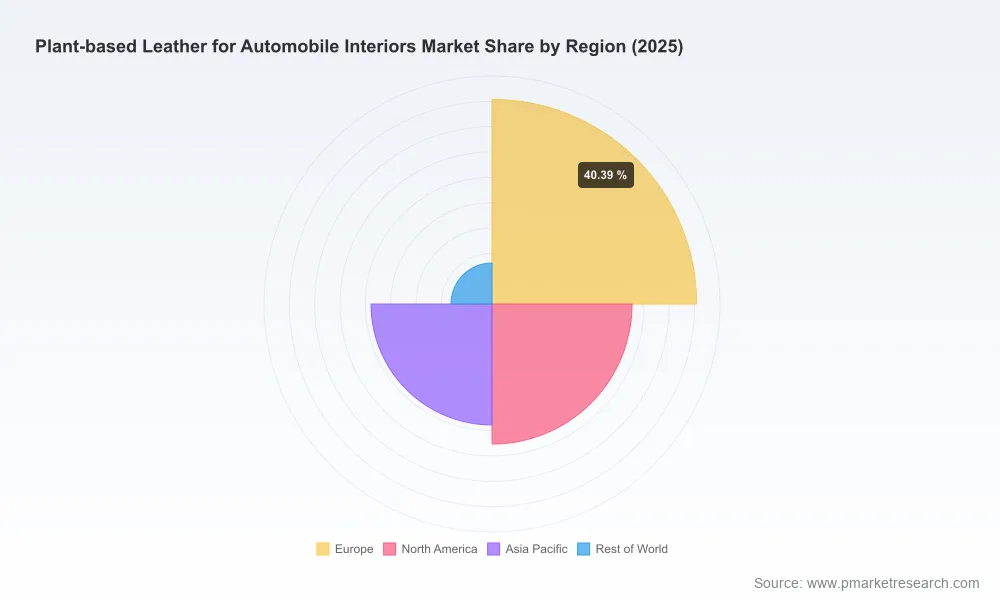
Regional dynamics in the plant-based leather interior market reflect a complex interplay of regulatory maturity, OEM sustainability commitments, and localized supply chain readiness. Our geographic segmentation traces how Europe, North America, Asia Pacific, and the Rest of World are each progressing along different adoption curves, shaped by distinct policy environments, consumer sentiment, and manufacturing infrastructure. Rather than presenting static share percentages, the research provides a qualitative and quantitative framework to assess where regional demand is clustering, which markets are moving from pilot programs to volume production, and where cross-border sourcing strategies can yield cost and carbon advantages.
On the supply side, the market remains moderately consolidated, with the top three players commanding a notable share of revenue and innovation activity, while a broader ecosystem of participants continues to expand. Our competitive intelligence maps the concentration landscape, the positioning of incumbents versus emerging biomaterial developers, and the strategic levers each player is deploying. Understanding this structure is essential for OEMs and tier suppliers seeking to mitigate single-source dependency, secure preferential access to next-generation materials, or evaluate acquisition and partnership targets that align with 2026 procurement objectives.
Operational Intelligence Embedded in the Report
This is not a high-level trend narrative. The publication is engineered as a decision-support instrument for strategy, procurement, and sustainability functions. It delivers a multidimensional operational briefing that includes:
- Detailed material-source profiling, encompassing feedstock origin, processing technology, performance characteristics, and scalability constraints for each major plant-based category.
- Application-level analysis that maps material suitability, validation requirements, and integration pathways across seats, dashboards, consoles, door panels, and steering components.
- Geographic deployment intelligence that highlights regional regulatory drivers, OEM program activity, and supply chain localization opportunities.
- Competitive benchmarking that evaluates technology positioning, partnership ecosystems, production readiness, and differentiation strategies among leading developers and material suppliers.
- Regulatory and lifecycle-context assessment covering material certification pathways, recyclability considerations, VOC and solvent-reduction benchmarks, and bio-based content verification frameworks.
- Strategic recommendations for OEMs, tier suppliers, and material innovators seeking to time investments, structure JDA and co-development agreements, and align product roadmaps with evolving consumer and compliance expectations.
Throughout, the research connects material science with commercial reality, enabling teams to move from sustainability ambition to executable procurement and engineering plans.
Competitive Landscape: Who Is Setting the Pace
The competitive field in plant-based automotive leather is characterized by rapid collaboration, cross-industry partnerships, and targeted concept-to-production transitions. Leading innovators are no longer operating in isolation; they are embedding themselves into OEM technology pipelines and tier-supplier scaling frameworks. Our research profiles the companies that are shaping this dynamic, examining their geographic footprints, material architectures, and strategic alliances.
Ananas Anam, headquartered in London with operations spanning the Philippines and Spain, has extended its Piñatex platform, derived from waste pineapple leaf fibers, into automotive interiors through a joint development agreement with Forvia. This collaboration targets low-impact vegan materials for vehicle seats and surfaces, signaling a deliberate move from fashion-forward applications into regulated automotive environments. Complementing this, Forvia’s MATERI’ACT unit continues to advance a broader portfolio of bio-based and recycled leather alternatives, reinforcing its role as a materials technology enabler within OEM development programs.
Adriano Di Marti, based in Mexico, has introduced Deserttex, a cactus-based biomaterial engineered specifically for automotive use. Its deployment in the Mercedes-Benz Vision EQXX interiors and alignment with BMW sustainable material programs illustrate how plant-derived substrates are being validated against the tactile and durability expectations of premium vehicle segments. The company’s emphasis on a supple, low-water vegan leather alternative positions it at the intersection of sustainability and consumer-premium aesthetics.
Modern Meadow, operating from Nutley, New Jersey, is advancing INNOVERA, a bio-designed leather alternative that integrates plant-based proteins, biopolymers, and recycled tire materials. The company’s development partnership with Mercedes-Benz for the CONCEPT AMG GT XX seats, alongside plans targeting future series production interiors, demonstrates how hybrid bio-design approaches are progressing from concept showcases to potential volume integration. Recent program disclosures have highlighted INNOVERA-based LABFIBER material featured in the CONCEPT AMG GT XX for Nappa-like leather alternative seats, reinforcing the cadence of concept-to-validation activity.
Natural Fiber Welding (NFW), based in Peoria, Illinois, produces MIRUM, a 100 percent bio-based, plastic-free plant-based leather certified by the US Department of Agriculture. Composed of natural rubber, fibers, plant oils, pigments, and minerals, MIRUM is being scaled for automotive interior applications through a partnership with Sage Automotive Interiors, part of Asahi Kasei. This collaboration underscores a strategic focus on plastic-free, circular solutions for seats and surfaces, leveraging a major tier supplier’s global OEM reach to accelerate deployment.
Worldwide Passenger Car Interiors Market
Uncaged Innovations, headquartered in New York, is developing grain-based protein leather alternatives sourced from wheat, soy, and corn, engineered to replicate the look, feel, and even the scent profile of traditional leather. Its partnership with Hyundai CRADLE targets durable, low-carbon automotive interiors, with program objectives emphasizing a substantially reduced carbon footprint relative to conventional leather. This alignment with a major OEM innovation arm reflects the growing emphasis on material choices that deliver both performance parity and lifecycle decarbonization.
Beyond pure-play biomaterial developers, established chemical and tier suppliers are shaping the market through solvent-free, low-VOC alternatives and recyclable backings. BASF’s Haptex polyurethane solution offers a solvent-free, low-VOC pathway for synthetic and vegan leather in automotive interiors, with Haptex 4.0 designed to be 100 percent recyclable when combined with PET fabric, eliminating layer peel-off in recycling processes. Lifecycle assessments associated with these solutions indicate meaningful reductions in greenhouse gas emissions and water usage compared to conventional solvent-based synthetic leather production, providing material decision-makers with quantifiable sustainability arguments to support adoption. Asahi Kasei, through Sage Automotive Interiors, continues to invest in and partner with NFW to scale MIRUM for global OEMs, reinforcing the importance of tier-level scaling capability in converting innovative materials into volume-ready components.
Market Dynamics: Regulation, Recycling, and Feedstock Reality
The pace of adoption in plant-based automotive leather is being shaped as much by compliance and circularity requirements as by consumer preference. Regulatory frameworks and OEM sustainability targets are accelerating the search for materials that reduce reliance on animal-derived inputs, lower petrochemical content, and support end-of-life recovery. At the same time, practical constraints around feedstock consistency, material uniformity, and component-grade validation remain central to commercial scaling.
Recent industry developments illustrate how these dynamics are playing out in real time. In mid-2025, Modern Meadow entered a development partnership with Mercedes-Benz to use its INNOVERA bio-designed leather alternative in the CONCEPT AMG GT XX technology program seats, with the stated aim of progressing toward series production. The same material family was featured in the CONCEPT AMG GT XX for Nappa-like leather alternative seats, highlighting the increasing willingness of premium OEMs to showcase bio-designed interiors in flagship technology programs. In parallel, Uncaged Innovations announced a partnership with Hyundai CRADLE to co-develop grain-based plant protein leather alternatives for vehicle interiors, with a focus on durability, customizability, and a substantially lower carbon footprint than traditional leather. These moves underscore a broader pattern: biomaterial developers are securing footholds in OEM innovation pipelines, while certifying partners and tier suppliers work to translate concept-validated materials into production-ready specifications.
Beyond partnership activity, material and regulatory signals are reshaping procurement calculus. USDA-certified bio-based content has become a meaningful differentiator for plastic-free formulations, while solvent-free, recyclable polyurethane systems are gaining traction among OEMs seeking to reduce VOC exposure, support closed-loop recycling, and improve lifecycle emissions profiles. Together, these factors are narrowing the gap between sustainability aspiration and engineering feasibility, but they also raise the bar for supplier validation, traceability, and long-term material availability.
Strategic Imperatives for 2026 Decision-Making
For organizations charting their 2026 strategy, the plant-based leather interior market presents both opportunity and execution risk. The upside lies in aligning early with materials that can support regulatory compliance, consumer-facing sustainability storytelling, and long-term cost structures as feedstock economies mature. The execution challenge lies in navigating material variability, validating performance across diverse interior zones, securing scalable supply, and structuring partnerships that balance exclusivity with continuity.
Our research is designed to support leaders through each of these dimensions. By triangulating market sizing, material and application segmentation, geographic deployment, competitive positioning, and the latest partnership and regulatory developments, it provides a consolidated view of where value is being created and where risk is accumulating. Decision-makers can use this intelligence to prioritize validation programs, assess supplier portfolios, map regional sourcing strategies, and time investments in line with OEM program calendars and sustainability targets.
The window for strategic positioning is narrowing as program cycles accelerate and biomaterial suppliers scale from pilot to volume production. Comprehensive market intelligence is the foundation for making those decisions with confidence, rather than relying on fragmented announcements or incomplete adoption signals.
Automotive Interior Leather Market
Access the Full Intelligence
This article provides a strategic preview of the market landscape, competitive dynamics, and operational context shaping plant-based leather in automobile interiors. To move from directional insight to actionable deployment, organizations require the detailed segmentation, company profiling, regional analysis, and validation-roadmap guidance contained in the full publication. The complete Plant-based Leather for Automobile Interiors Market research report delivers the granular data, structured frameworks, and forward-looking assessments necessary to inform 2026 procurement, R&D, and partnership decisions. We invite strategy, sustainability, and supply chain leaders to access the full report and equip their teams with the intelligence needed to navigate this rapidly evolving market with precision.
PW Consulting Chemical & Energy Research Center
For detailed analysis of this topic, please visit the official page: Plant-based Leather for Automobile Interiors Market
Lacy Lee
Senior Marketing Manager
[email protected]
PW Consulting: www.pmarketresearch.com


























Sign in to leave a comment.