
Strategic Foresight in a Breathing World: Why the 2026 PM2.5 Monitors Market Intelligence Matters
Air is no longer a passive backdrop to commerce; it is a regulated, measured, and monetized asset. As the global community tightens its grip on particulate matter exposure, the PM2.5 monitors market has transitioned from a niche environmental instrumentation segment into a strategic infrastructure play. Our latest comprehensive market study maps this transformation across a 2020–2025 historical baseline and projects forward through 2032, delivering a decision-grade intelligence framework for executives navigating compliance, product development, and capital allocation in 2026 and beyond.
The trajectory is unmistakable. Valued at approximately 350.0 million USD in 2020, the market has compounded steadily to 500.0 million USD by 2025, and the forward curve anticipates a 6.98 percent CAGR, positioning the sector to approach 770.0 million USD by 2032. These are not abstract projections. They are the numerical expression of regulatory ratcheting, sensor miniaturization, and institutional adoption migrating from government networks into commercial and industrial environments. For strategy leaders, the question is no longer whether to engage this space, but how to sequence entry, partnership, or investment with precision.
The 2026 Inflection Point: Regulatory Architecture as Market Catalyst
The market's momentum is anchored in a regulatory environment that has become both stricter and more technically prescriptive. The U.S. Environmental Protection Agency lowered the primary annual PM2.5 National Ambient Air Quality Standard to 9.0 micrograms per cubic meter, effective February 2024, with final designations scheduled by February 2026. This tightening does not merely raise the compliance bar; it fundamentally reshapes procurement logic. Organizations that once treated monitoring as a periodic audit function are now embedding continuous, certified instrumentation into their operational fabric.
This shift is visible in state-level execution. Multiple states have transitioned filter-based reference methods to continuous analyzers between 2024 and 2025 to satisfy EPA network requirements under the strengthened standards. The operational implication is clear: demand is migrating from legacy, labor-intensive sampling toward real-time and near-real-time monitoring architectures. Leaders who understand this migration pattern can anticipate procurement cycles, align product roadmaps, and position service offerings where the friction of compliance is greatest.
Certification architecture further amplifies the dynamic. In May 2025, Focused Photonics Inc. announced that its BPM-200 PM2.5 Monitor received US EPA certification, demonstrating reference-grade performance for ambient monitoring. By December 2025, the EPA issued an updated list designating multiple new and modified PM2.5 reference and equivalent methods, including the BPM-200 and continued approvals for BAM series instruments from Met One and Horiba, as well as the Spirant BAM1000 from Ecotech. These designations are not ceremonial. They determine which instruments qualify for regulatory networks, which data streams are defensible in compliance contexts, and which vendors can credibly compete for institutional contracts.
For market participants, the strategic lesson is that certification and designation are compounding assets. A single approval can unlock procurement eligibility, but the cumulative roster of recognized methods signals which instrument families are gaining institutional trust. The December 2025 updates confirm ongoing FEM status for established platforms, while also opening doors for newer entrants that can match reference-grade performance in more compact or specialized form factors. The market rewards those who can translate technical certification into procurement readiness.
Market Architecture: Where Growth Concentrates and Why
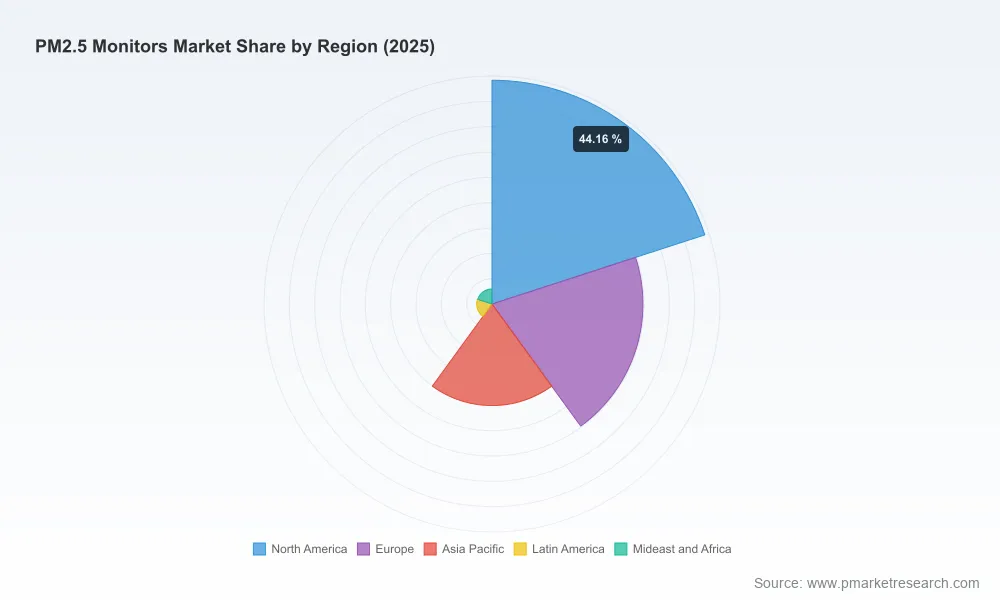
Behind the headline trajectory lies a market structure that rewards clarity of positioning. The overall revenue base of 500.0 million USD in 2025 is distributed across a competitive field that is broad but not infinitely fragmented. Concentration metrics indicate a CR3 of 25.0 percent and a CR5 of 32.0 percent, suggesting a landscape where scale, certification portfolios, and distribution relationships matter, yet leave meaningful room for specialized players and regional challengers.
The product architecture reflects a market in the midst of functional diversification. Portable PM2.5 monitors represent the largest product cohort at approximately 301 million USD, underscoring the pull toward mobility, rapid deployment, and situational awareness. Fixed station monitors account for roughly 150 million USD, preserving their role in regulatory-grade ambient networks and long-term compliance installations. Wearable PM2.5 monitors, at approximately 50 million USD, are smaller but strategically telling: they point to the expansion of personal exposure monitoring and the blurring line between environmental instrumentation and occupational health technology.
The application landscape tells a parallel story of institutional priorities. Ambient air quality monitoring dominates at approximately 349 million USD, reflecting the continued centrality of regulatory networks and government procurement. Indoor air quality monitoring, at roughly 121 million USD, signals a commercial and consumer-facing expansion driven by building management, workplace wellness, and real estate value propositions. Industrial emissions monitoring, at approximately 30 million USD, remains a focused but high-stakes niche where measurement accuracy directly intersects with compliance, risk management, and operational efficiency.
PM2.5 Monitors Market
These structural relationships are not static. The strategic opportunity for 2026 lies in recognizing how these categories reinforce one another. A portable monitor may begin as a site-assessment tool, evolve into a fixed-station complement, and ultimately feed data into an indoor or industrial monitoring program. A wearable sensor may start in occupational health and later inform building-level ventilation strategy. Executives who view the market as a set of interconnected use cases, rather than isolated product silos, will be better positioned to design bundled offerings, cross-sell pathways, and data-driven service models.
Competitive Landscape: Certification, Continuity, and the Battle for Institutional Trust
The competitive field is defined by a mix of established instrument manufacturers, specialized environmental monitoring firms, and large integrated companies that leverage broader industrial or scientific portfolios. What differentiates leaders in this space is rarely price alone; it is the ability to combine technical credibility, regulatory alignment, and deployment reliability.
Thermo Fisher Scientific continues to anchor the regulatory segment with Partisol 2025i and TEOM-series PM2.5 samplers, serving as FRM and FEM reference points for regulatory air monitoring. Its presence underscores the enduring importance of reference-grade continuity in compliance-critical environments. Teledyne API maintains a strong real-time position with T640 and T640x continuous PM2.5 mass monitors, holding EPA FEM designations since 2016 with ongoing modifications for continued regulatory use. It is worth noting that a 2023 data correction was applied for high bias relative to FRM methods, a reminder that even designated instruments operate within an evolving calibration and validation landscape. Strategic buyers and partners alike must treat certification as a living status, not a fixed endorsement.
Met One Instruments provides BAM series and GBAM beta attenuation monitors, with multiple FEM designations for continuous ambient air quality monitoring. Horiba Instruments complements this ecosystem with APDA-371 beta attenuation monitors integrated into BAM/GBAM systems and EPA FEM approvals. Ecotech supplies the Spirant BAM1000 and other beta attenuation monitors compatible with EPA BAM/GBAM configurations. Together, these firms illustrate how the continuous-monitoring stack is built around beta attenuation architectures that balance regulatory acceptance with operational continuity.
On the portable and flexible side, Aeroqual Group specializes in portable and fixed PM2.5 air quality monitors for ambient and indoor use. TSI Incorporated develops SidePak personal aerosol monitors and DustTrak real-time PM2.5 analyzers, extending the market's reach into personal exposure and granular particulate profiling. GrayWolf Sensing Solutions offers real-time PM2.5 monitors for industrial and ambient applications, while Focused Photonics Inc. has emerged as a notable participant after its BPM-200 achieved EPA certification for reference-grade ambient performance. Enviro Technology Services adds further depth with beta attenuation monitors including BAM series instruments bearing FEM approvals. Siemens AG rounds out the landscape by providing comprehensive air quality monitoring solutions that include PM2.5 analyzers, reflecting the appeal of integrated, platform-level approaches.
This competitive mosaic matters because procurement decisions in this market are sticky and criteria-heavy. Once an organization standardizes on an instrument family, switching costs rise not only in equipment terms but in data continuity, validation history, and operator familiarity. For new entrants, the path to traction often runs through differentiated form factors, faster deployment, or cost-efficient performance that still satisfies compliance expectations. For incumbents, the challenge is to protect reference-grade credibility while expanding into adjacent use cases where customers want smaller footprint, lower total cost of ownership, or richer data integration.
What the Research Delivers: Operational Intelligence for 2026 Decisions
Our study is built to convert market complexity into executable insight. It goes beyond top-line sizing to examine the mechanics that determine winners and laggards in a compliance-driven instrumentation market. The analysis integrates historical performance, forward demand signals, and the regulatory calendar that shapes procurement behavior.
Practitioners will find detailed assessment of product-type dynamics, including how portable, fixed-station, and wearable categories are evolving in functionality, adoption context, and competitive pressure. The report examines application-level demand patterns across ambient, indoor, and industrial monitoring, with attention to how each segment's procurement logic differs in terms of validation requirements, renewal cycles, and integration priorities. Regional demand is assessed through the lens of regulatory intensity, monitoring network maturity, and industrial concentration, helping leaders identify where deployment pressure is strongest and where local partnerships or distribution strategies will matter most.
Competitive profiling is structured around the variables that actually drive vendor selection: certification and designation status, instrument architecture, data continuity, service ecosystems, and the ability to operate across both regulatory and commercial environments. The study also maps recent developments, including certification awards, EPA method designations, and state-level network transitions, to show how the competitive field is being reshaped in near real time. This is not a static vendor list; it is an operational view of who is gaining eligibility, who is reinforcing incumbency, and where new openings are forming.
For capital allocation and market entry planning, the research provides a structured basis for evaluating segment attractiveness without reducing the market to oversimplified rankings. It highlights where concentration creates defensive moats and where fragmentation allows targeted plays. It considers how certification timelines, data-validation expectations, and network modernization schedules interact to create demand spikes and procurement windows. The objective is to give strategy teams a clear field map and a decision framework, not a generic trend narrative.
Strategic Implications: Positioning for a Compliance-Led Growth Cycle
The 2026 decision environment will reward organizations that treat PM2.5 monitoring as a system rather than a product. The regulatory tightening to a 9.0 microgram annual standard, combined with the transition from filter-based reference methods to continuous analyzers, means that measurement is becoming more embedded, more continuous, and more tied to operational decision-making. That creates demand not only for hardware, but for validation support, data integration, calibration discipline, and service reliability.
For instrumentation manufacturers, the strategic imperative is to align product roadmaps with the certification calendar and the deployment preferences of both regulatory and commercial buyers. Reference-grade credibility remains the backbone of institutional sales, but the fastest growth vectors may come from compact, deployable, and application-specific solutions that still meet the expectations of compliance-conscious customers. For technology and service providers, the opportunity lies in helping clients interpret, integrate, and act on PM2.5 data across ambient, indoor, and industrial contexts. For investors and corporate developers, the market's moderate concentration and multi-segment structure suggest that value creation can come from both scale plays and focused, high-credibility niche positions.
Alliance strategy also deserves renewed attention. Given the importance of EPA designations and the ongoing validation of methods, partnerships that combine measurement technology with deployment expertise, regional distribution, or data-management capabilities can accelerate market access. Equally, organizations that can document performance consistency across regulatory and commercial use cases will be better placed to convert pilot deployments into durable installations.
Accessing the Full Strategic Picture
The macro direction is clear, but the operating decisions that matter most are granular. Which instrument architectures align with the procurement standards buyers will apply in 2026 and 2027? Where do certification and designation updates open competitive windows, and where do they reinforce incumbency? How should organizations sequence investments across portable, fixed, and wearable categories to balance near-term revenue with longer-term optionality? What regional and application contexts offer the strongest combination of demand intensity and entry feasibility?
These are the questions our full study is designed to answer. The complete research provides the segmented detail, competitive benchmarking, regional and application-level analysis, and forward scenario context needed to move from directional confidence to precise execution. For leaders who need to translate the 6.98 percent CAGR trajectory and the broader 2032 growth path into concrete market-entry, partnership, and product decisions, the full report provides the operational intelligence that top-line summaries cannot.
The market is breathing faster, and the organizations that succeed in it will be those that pair regulatory awareness with disciplined product and go-to-market strategy. We invite decision-makers to access the complete study and use its depth to shape the next move with clarity rather than extrapolation.
Air Quality Sensor Market
For detailed analysis of this topic, please visit the official page: PM2.5 Monitors Market
Lacy Lee
Senior Marketing Manager
[email protected]
PW Consulting: www.pmarketresearch.com




























Sign in to leave a comment.