
Strategic Intelligence for the Copper Based Castings Market: Navigating Growth and Volatility in 2026
Executive Perspective
The copper based castings sector stands at a critical juncture where material science, geopolitical trade policy, and industrial demand cycles converge. For executives managing supply chains, procurement budgets, or capacity planning, the window for proactive decision-making is narrowing. Our latest market research delivers a structured intelligence framework designed specifically for 2026 corporate strategy, translating macroeconomic trajectories and operational shifts into actionable roadmaps. Rather than offering static snapshots, this analysis equips leadership teams with the analytical depth required to allocate capital, secure sourcing partnerships, and anticipate regulatory friction before it impacts margins.
Market Scale and Trajectory: Aligning Strategy with 2026 Reality
The global copper based castings market has demonstrated resilient expansion over the past half-decade, with historical valuations climbing steadily from 2020 through 2025. Our modeled baseline positions the market at approximately 18,450 million USD in 2025, projected to reach nearly 19,972 million USD in 2026. The forecast horizon extends through 2032, where cumulative revenue is anticipated to approach 26,169 million USD. These figures reflect a compound annual growth rate of 5.12 percent across the forecast window, signaling a sector that is expanding faster than general industrial manufacturing averages but remains sensitive to input cost shocks and trade realignments.
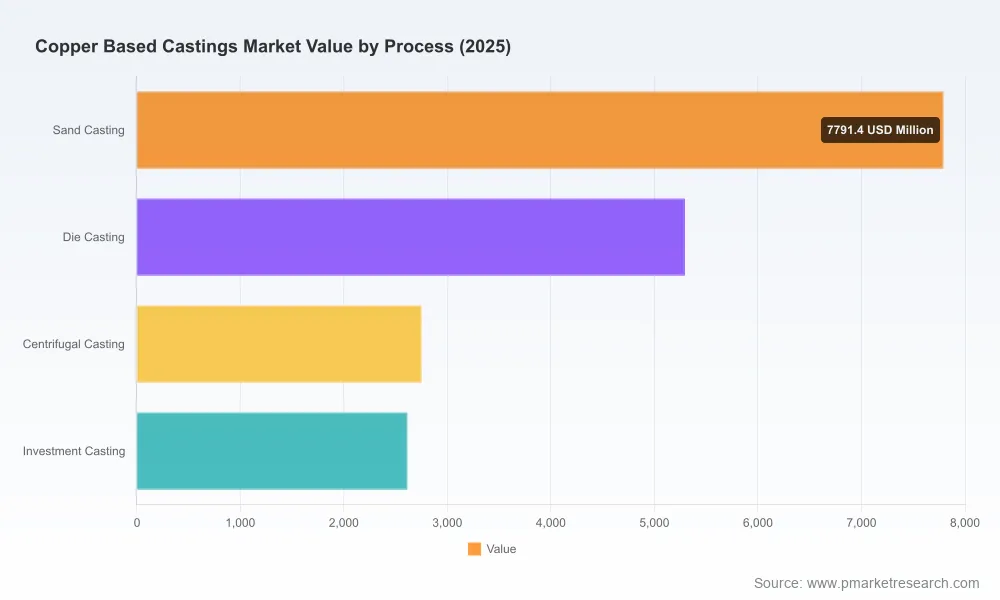
Growth is not uniform across the value chain. The structural composition of demand reveals how different alloy families, fabrication methods, and end-use verticals pull market momentum in distinct directions. Brass and bronze castings continue to anchor a substantial share of total revenue, while copper-nickel and pure copper segments serve highly specialized performance requirements. Process-side dynamics further differentiate competitive positioning, with sand casting and die casting capturing the majority of volume throughput, complemented by centrifugal and investment casting operations that serve precision-driven applications. End-use distribution spans industrial machinery, electrical and electronics infrastructure, automotive and transportation systems, building and construction projects, and marine and aerospace programs. Regionally, the market is heavily weighted toward Asia Pacific, followed by Europe and North America, with Latin America and the Middle East and Africa contributing meaningful but comparatively smaller revenue bases.
For strategy teams, the imperative is not simply to track aggregate growth but to understand where value accrues under shifting cost and compliance conditions. High-level metrics provide direction, but the segments that will dictate your 2026 performance require deeper segmentation intelligence. The full report maps these intersections with precision so that portfolio choices are made on evidence rather than assumptions.
Competitive Landscape: Positioning Against Established and Evolving Players
The market remains moderately concentrated, with the top three firms collectively accounting for approximately 18.45 percent of revenue and the top five reaching roughly 27.32 percent. This structure indicates room for differentiated positioning, particularly for firms that can combine technical capability, regional sourcing flexibility, and compliance readiness. Several incumbent and specialist organizations define the current competitive contour.
Metal Casting Market
Buffalo Metal Casting operates from Buffalo, New York, specializing in high-quality copper sand castings and non-ferrous components for electrical, thermal conductivity, and industrial applications, functioning as a single-source supplier of finished copper parts across the United States. Peel Jones Copper, based in North East England, supplies complex high-conductivity copper castings to global steelmaking, melting, and smelting industries, leveraging more than fifty years of product innovation. Electric Materials, headquartered in North East Pennsylvania, manufactures custom copper sand castings and alloy products for power generation and distribution, backed by over a century of high-conductivity component expertise. Aero Metals, located in La Porte, Indiana, produces beryllium copper investment castings for aerospace, industrial, and EMI/RFI shielding applications, maintaining ISO 9001:2015 certification and annual output exceeding 250,000 pounds.
International players add scale and alloy breadth to the landscape. AMPCO Metal, with global operations centered in Switzerland, leads in copper alloy castings and wrought products focused on high-performance industrial applications. The Wieland Group in Germany integrates copper alloy castings and semi-finished products into a broad copper processing portfolio. KME Group S.p.A. in Italy delivers global copper and alloy outputs, including castings for electrical and industrial uses. IBC Advanced Alloys, headquartered in Vancouver, Canada, with a foundry in Franklin, Indiana, produces near-net-shape copper alloy cast products including copper-nickel and aluminum-bronze alloys up to 500 pounds per piece using air-set sand molds.
Recent operational movements indicate how quickly competitive advantages can shift. In early 2026, HPW Metallwerk GmbH committed to a new UPCAST system to expand high-quality copper casting and rolling capacity, enhance product quality, and deepen vertical integration, with commissioning scheduled for April 2026. IBC Advanced Alloys progressed on two fronts: in late 2025, it successfully cast 0.2 percent aluminum-scandium alloy in partnership with NioCorp, confirming readiness for custom-part fabrication and advancing downstream alloy capabilities; by March 2026, it expanded into near-net-shape copper alloy cast products, launching copper-nickel and aluminum-bronze alloy castings via air-set sand molds. These developments matter because capacity additions, alloy experimentation, and process refinements directly reshape lead times, material availability, and qualification pathways for buyers. Understanding which players are scaling, which are innovating, and where gaps are emerging is essential for negotiating leverage and supply assurance. The report dissects these moves within a competitive intensity framework so your team can anticipate supplier behavior rather than react to it.
Industry Dynamics: Pricing, Policy, and Supply Chain Pressure Points
Three forces dominate the current operating environment: raw material volatility, evolving trade policy, and downstream demand sensitivity. Copper pricing has been volatile across 2025 and 2026. LME copper cash settlement prices reached approximately 12,147 USD per tonne in early April 2026, following record highs above 13,000 USD per tonne in January 2026. COMEX cash spot levels touched highs around 6.50 USD per pound in early 2026 amid supply concerns and tariff impacts. For casting manufacturers and end-users alike, this volatility compresses margins, complicates contract pricing, and forces more frequent inventory re-evaluation.
Trade policy introduces an additional layer of complexity. The United States has maintained a 50 percent import tariff on semi-finished copper products and copper-intensive derivative products under Section 232 since August 2025. Adjustments announced in April 2026 reduced duties on derivatives with less than 15 percent metal content to zero and set 25 percent on higher-content items. Meanwhile, the broader Section 232 investigation recommended phased tariffs on refined copper of 15 percent starting in 2027 and 30 percent starting in 2028, alongside domestic sales requirements for copper inputs and export controls on high-quality scrap. These measures are not abstract policy details; they alter sourcing logic, shift cost structures between domestic and imported inputs, and influence where capacity gets built or expanded. For multinational programs, the interaction between tariff schedules, alloy content thresholds, and scrap export controls can determine whether a sourcing strategy remains viable across a multi-year program.
The dynamic interplay between commodity prices and trade measures means that 2026 decisions must account for both near-term cost volatility and medium-term structural shifts. Organizations that integrate tariff scenarios, scrap flow constraints, and price exposure into their planning will be better positioned to protect margins and maintain continuity. The full analysis connects these macro drivers to segment-level implications and operational decision points, enabling a more resilient sourcing and production posture.
What the Report Delivers: Practical Intelligence for Execution
This market research is built for decision-makers who need more than headline figures. The report is organized to support concrete actions across strategy, procurement, engineering, and commercial planning. Core deliverables include:
- Detailed market sizing and forecast models that trace revenue trajectories from the 2020 base period through the 2032 forecast window, anchored in a five-point-one-two percent CAGR framework and expressed in USD millions.
- Segment-by-segment breakdowns across alloy types, casting processes, end-use verticals, and geographic regions, allowing teams to identify where growth concentrates and where competitive pressure is most intense.
- Competitive profiling of leading and emerging participants, including operational focus, geographic footprint, certification status, and recent capacity or product developments that affect sourcing reliability.
- Regulatory and trade policy mapping that translates tariff schedules, import duties, domestic sales requirements, and scrap export controls into practical implications for procurement strategy and program planning.
- Raw material and pricing context that links LME and COMEX movements to cost exposure, contract structures, and inventory decision timing.
- Scenario-based considerations that help leadership evaluate how shifts in demand intensity, alloy substitution, and capacity expansion could alter market access and margin profiles across the forecast period.
By integrating these layers, the report enables buyers to benchmark supplier proposals, manufacturers to prioritize capacity investments, and strategists to anticipate where structural advantages will emerge. The goal is to convert complex market signals into clear priorities that can be operationalized within existing planning cycles.
Why This Research Matters for 2026 Decisions
The copper based castings market is not simply expanding; it is being reshaped by simultaneous pressures on cost, compliance, and capability. Growth remains solid, but the distribution of that growth across alloys, processes, applications, and regions creates both opportunity and risk. Tariff frameworks are evolving, copper prices have experienced sharp movements, and competitors are investing in capacity and advanced alloy capabilities that can alter supply availability and qualification timelines. In this environment, decisions made in 2026 will influence cost structures, supplier relationships, and program continuity well beyond the current fiscal year.
Copper Based Castings Market
Access to granular segment data, competitive intelligence, and policy-driven scenario analysis is therefore not optional; it is a prerequisite for confident execution. The full report provides the depth required to align sourcing strategies, capacity plans, and commercial positioning with the realities of the current cycle. For teams preparing for 2026 commitments, the insights within this research offer a structured basis for prioritizing investments, managing exposure, and capturing share in a market where informed timing and technical positioning increasingly determine outcomes.
For detailed analysis of this topic, please visit the official page: Copper Based Castings Market
Lacy Lee
Senior Marketing Manager
[email protected]
PW Consulting: www.pmarketresearch.com





























Sign in to leave a comment.